The first clue was a refusal. Richard Zhang and Alan Lu were recent graduates trying to make American income-tax information easier to reach. They needed documents from banks, brokerages and payroll systems. They asked for access to the official pipes. The platforms, quite reasonably and rather inconveniently, did not take two young founders seriously. So the pair began building the connections themselves.
They tried browser automation, the established art of teaching a machine to click, wait, scroll and click again. It could finish the job, in the same sense that a very dutiful intern could finish the job. But interfaces moved. Pages loaded slowly. A button changing position could turn useful software into a sulk. Zhang and Lu experimented with AI-assisted maintenance and discovered that intelligence layered on top of a slow route was still traveling by the slow route.
Then they looked beneath the page. Every modern web application has a backstage conversation: the requests a browser sends to servers when a person clicks a button. The pair began reconstructing those conversations directly. Their software learned which requests depended on which identifiers, how authentication flowed through the sequence, and which call produced the desired action. The browser could stay home.
The tool hiding inside the product
The project was initially an internal tool for Taiki, the team’s tax product. But an internal tool is a dangerous thing when outsiders keep asking to use it. In October 2024, Zhang and Lu introduced Integuru on Hacker News as an open-source agent for reverse-engineering internal APIs. They explained the origin plainly, described the limits plainly, and invited feedback plainly. The post drew more than 200 points and dozens of comments. The repository later passed 4,000 stars.
The launch page became a minor joke of its own. It was so spare that commenters praised the absence of the usual glossy startup furniture. One remembered the pleasure of a serious company page with almost no JavaScript. Another called the page source amazing. Zhang’s response was short: hearing that made the team happy. For a company arguing that the interface is not the important layer, the austerity had accidental comic precision.
Integuru was not a clean replacement of one idea by another. Zhang described it as a market expansion. The team had built the tool while working on Taiki, then discovered that developers beyond tax software had the same integration problem. New requests consumed more of their time. Improving the agent became more valuable. The workaround acquired gravity until it became the center.
Reality files a bug report
Stars are applause; production is cross-examination. The early agent proved that developers wanted a faster path into closed platforms, but it could not cover all the unruly behavior of modern software. Accounts presented different states. Endpoints changed. Servers sometimes returned success codes with failed results, or HTML where yesterday they had returned JSON. Authentication developed moods.
So the team did something admirably unmagical. They built integrations by hand and maintained them for customers. Slack channels and direct texts became the listening system. Over many calls and many breakages, patterns emerged. The founders learned what a tidy demo conceals: an integration is not finished when it works once. It is finished only provisionally, subject to what thousands of real accounts and a changing platform decide to do next.
Those repairs supplied the material for a rebuilt product: wider edge-case coverage, authentication that can heal itself, production monitoring, and human support when software meets a situation it has not seen. This is the agreeable paradox in Zhang’s automation story. Manual work was not the embarrassing stage before automation. It was how the team earned the judgment required to automate.
Today Integuru describes a three-step product. Give it a URL and an account. Describe the integration in ordinary language. Receive a documented endpoint that communicates with the platform through direct HTTP requests. The company says requests generally return in under three seconds, its generated integrations exceed 99.9 percent reliability, and the system now powers more than 10 million calls per month. These are the company’s measurements, and the product’s promise lives or dies by precisely such unromantic numbers.
A founder who measures the first grin
Zhang’s public writing moves easily between technical failure modes and the interior weather of company building. On product design, he argues that makers should define the user’s “aha moment” and measure the time required to reach it. For Integuru, that moment is exact: the first successful call to a generated endpoint. Not the signup. Not the dashboard. The call.
Once defined, the metric became a chisel. The team sped up the web app, removed unnecessary steps and let users reuse settings. Then it released a command-line interface. If coding agents are customers, why make them perform a pantomime for a graphical screen? The CLI lets an agent install Integuru and work with it in the environment software already understands. It is the same argument again, applied to Integuru itself: choose the direct route.
Name the first moment when your product proves its value. Measure the distance from arrival to that moment. Then remove one ceremony at a time.
His biography makes the range of this route less surprising. Before Integuru, Zhang worked in data science at DiDi and product at Alibaba Cloud. He spent time on the investor’s side at Dragonfly, ZhenFund and Gaorong Capital. At the University of Southern California, he co-founded Blockchain at USC and served as its president for five years; he also led the entrepreneurship community Spark SC. Columbia lists him among its 2021 computer science master’s graduates. He then co-founded Overflux, a Y Combinator W23 company that worked on EV-charger installation workflows. Integuru made him a YC founder again one batch later.
The line through these roles is not a tidy devotion to one industry. It is an attraction to systems with missing connective tissue: investments looking for builders, students looking for a community, property projects facing fragmented installation work, software trapped behind interfaces. Zhang appears interested in the seam, that awkward place where one system stops and another refuses to begin.
The relief of being ignored
His sharper founder advice is psychological. At the end of 2024, Zhang wrote that few people actually care about your startup. He called the idea scary but liberating. Embarrassment is smaller than it feels; public failure usually has a shorter audience than founders imagine. His prescription was to release the mental burden and build in public.
Later, approaching two years of Integuru, he wrote that momentum compounds when a company stays alive and continues talking with customers. Every line of code and every conversation adds to expertise and reputation. His compressed instruction was “Don’t die and keep moving.” It is blunt enough to fit on a terminal prompt.
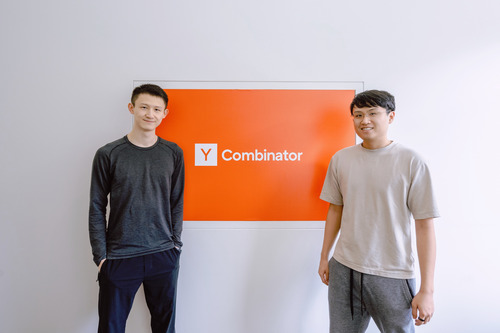
He has also described company building as a long encounter with weakness, doubt and uncomfortable emotion. A co-founder matters, in his telling, because that person experiences the whole sequence and becomes a witness. Over time, the company changes the builder. The comment sits well beside the photo of Zhang and Lu at Y Combinator: two young men beside an orange screen, looking calm in the way photographs allow, before two years of edge cases have had their say.
There is a modesty in the philosophy, even as the company tackles an immodest technical problem. Zhang’s stated aspiration has been to let developers integrate with any platform instantly. That goal may remain distant; web systems are variable, guarded and forever changing. His own writing counsels teams to choose browser automation when requirements are casual and reserve network-request work for situations where latency, reliability or volume demands it. A side door is useful because the front door does not always open. It need not become a religion.
What Integuru has built so far is a business from attentive frustration. A tax startup could not obtain access. A browser could not move quickly enough. An open-source agent could not survive every production surprise. Each obstruction exposed another layer of the actual problem. Zhang and Lu kept descending until they reached the requests themselves, then started turning those invisible conversations into a product.
Software has always contained more doors than its interface admits. Richard Zhang’s wager is that agents should learn which one to use, and that someone should keep the hinges from squeaking.