Reshma Kewalramani has a recommendation for people with demanding jobs: take a random Wednesday off. Go to Target. Visit the bank. Get your nails done. There is something quietly funny about finding the chief executive of Vertex Pharmaceuticals recommending the pleasures of an errands day. The executive calendar, that stern little machine, has allowed a human being through.
She calls these days part of finding harmony. The distinction suits a life that has required considerable rearranging. Kewalramani has been a student in Boston, an executive in California, a mother of twins, and a returning Bostonian. Since April 2020, she has been Vertex’s CEO and president. The list of responsibilities is long. A Wednesday offers the satisfaction of finishing something before dinner.
Her career invites the usual treatment: gather the titles, sort the awards, draw an arrow pointing upward. But the interesting parts involve changing her mind. An unexpected approach from another employer. A household deciding to move. The gradual realization that the career she had imagined was only one possible use of her abilities. The destination becomes obvious only after you have arrived.
“Random Wednesdays are key.”
Reshma Kewalramani
Learning a different map
Kewalramani grew up in Mumbai and moved with her family to the United States in 1983. They eventually settled on Long Island. She had left an extended family and a familiar world for a place whose social instructions were harder to read. Speaking English did not automatically supply an understanding of American childhood. Pop culture had its own entrance examination.
Teachers and an aptitude for mathematics and science helped her find her footing. There was relief in a problem that could be worked through on paper. You could participate without first mastering every social signal in the room. School offered a way to become known for what she could do.
At seventeen, she came to Boston University. The city would supply an education and much of the cast of her adult life. She met her husband, Abhijit Kulkarni, there, along with friends who remained close. She found paid laboratory work and received her first scientific grant. In 1998, she completed BU’s combined seven-year BA and MD program.
Her affection for the university includes its demands. A large urban institution supplies possibilities, but students have to locate them. Mentors do not arrive with the course catalogue. “You have to find dots and connect them,” she says. That is a fair description of the years that followed, too. The dots were there. Their eventual arrangement was still open.
Two babies, one new coast
In 2004, an opportunity at Amgen complicated a life already established in Boston. Kewalramani had trained for one professional future and was discovering a different interest within it. The prospective employer was in California. Her husband had a job. Their twin boys were six months old. Any career advice that begins and ends with being brave has skipped the packing.
She and her husband left their jobs and moved west. It was a decision about what work could become, made while the practical consequences were immediate. The new role offered a way to pursue the kind of work that increasingly interested her. Staying would have preserved a familiar place and an established path. Both choices contained things worth caring about.
The questions she uses for difficult decisions are revealing. She considers the effect on her family, the balance between learning and contributing, and whether she likes the people involved. She asks whether she can imagine what lies beyond the immediate opportunity. She also considers which choice carries greater risk. The familiar option does not receive an automatic exemption.
California became more than a brief adventure. She spent over twelve years at Amgen, taking on increasing responsibility and eventually leading its US Medical Organization. In 2015, she completed Harvard Business School’s General Management Program. Even after years in an established career, there was more to learn about running an organization.
- 1998Graduates
Boston University - 2004Moves west
Amgen - 2017Returns to Boston
Vertex - 2020Becomes
CEO & president
Different roles. Two coasts. No straight line required.
The return call
Vertex brought her back to Boston in 2017. She had not been looking for another position. The possibility nevertheless deserved a hearing. By then, the city carried the weight of friendships, education, and family history. Returning meant beginning a new job in a place that already belonged to her.
She became executive vice president and chief medical officer in April 2018. The announcement that she would succeed Jeffrey Leiden as CEO followed in 2019; she took over the following April. The eventual headline was considerable: the first woman to lead a large publicly traded US biotechnology company. The transition had taken only a few years. Preparing for it had taken much longer.
Read backward, those appointments can look like a carefully negotiated ascent. Her own account is less tidy. She had imagined reaching a senior scientific leadership role. Running the whole company had not been the goal around which she arranged her early choices. The work drew her into responsibilities she had not originally pictured.
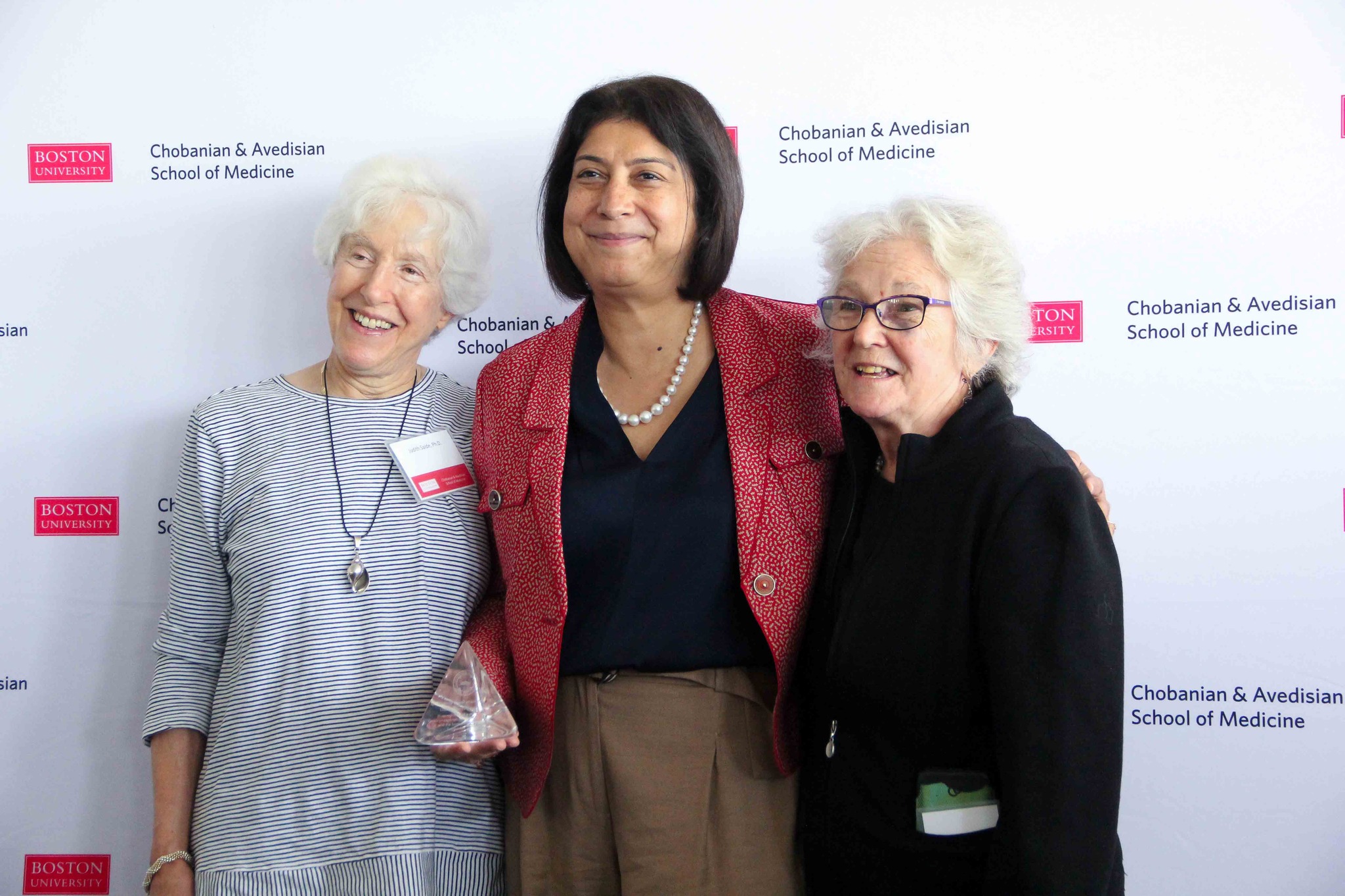
At a BU alumni gathering in 2023, she explained that the move into industry had never been about becoming CEO: “it wasn’t ever about the title.” Around her were people who had known earlier versions of her. In a photograph from the event, she stands between university mentors Judith Saide and Vickery Trinkaus-Randall. The glass award is visible. So are the relationships that preceded it.
A company has to remember
For someone whose story contains several departures, Kewalramani gives institutional memory a practical role. She describes telling new employees where Vertex has come from, including the difficult episodes. Past disappointments belong in the company’s account of itself. Otherwise, the official history becomes a souvenir that helps nobody decide what to do next.
“Culture is as simple as storytelling,” she says. That puts responsibility on the people doing the telling. A story repeated around a company can explain what matters, what went wrong, and why a particular habit exists. It can also become ceremonial noise. Its usefulness depends on whether people recognize their actual working lives in it.
Her descriptions of Vertex emphasize debate and a willingness to let a better idea win. That is a demanding expectation for any room with a hierarchy. A title can determine who gets the first word; the difficult part is making sure it does not settle the discussion. Her emphasis on collective work makes sense alongside that expectation.
At Amgen before the move to Vertex. The years between the headlines count, too.
Who gets to come along?
Her giving has a clear interest in opportunity. She has described concentrating on science education, closing opportunity gaps, and bringing more women and underrepresented students into STEM fields. Those concerns sit naturally beside her own memories of finding teachers and discovering what she could do. Someone had to make room for the student before there was an executive to applaud.
That interest extends beyond an encouraging speech. Her public service has included board roles with Year Up and the Biomedical Science Careers Program. The underlying question is concrete: who can find a route into a career, and who gets overlooked before they have a chance to begin? A capable person still needs access to people and places where that ability can develop.
In October 2025, the Asian Community Fund recognized her with its Paul W. Lee AAPI Leadership Award. The gathering brought together civic, business, and community figures across Massachusetts. It places another part of her life in view: an immigrant who became established in Boston now participating in the institutions that shape who feels welcome there.
She has spoken warmly about the fund’s work connecting people and investing in leadership. It is a consistent theme across the different rooms she occupies. Education, professional opportunity, and a sense of belonging do not happen in isolation. People introduce one another. They create an opening. They stay involved after the first introduction.
The moments without a headline
When she addressed Babson’s graduate class in 2023, Kewalramani turned to experiences that a formal biography might omit. Weekends helping in her father’s garment and electronics business. An ordinary lunch that became consequential later. She used Slumdog Millionaire to frame the way apparently disconnected experiences can accumulate into something useful.
Her point was about paying attention. A person cannot reliably identify the defining moment while it is happening. Some occasions arrive with a stage, a programme, and instructions about where to stand. Others look like another afternoon. “The biggest moments in life aren’t always the best advertised ones like graduation,” she told the graduates. Observation deserves a place beside ambition.
In May 2026, she returned to Boston University to deliver its commencement address and receive an honorary Doctor of Science. The student who had graduated in 1998 was now addressing another generation. There were awards to account for in the intervening years, including recognition from Harvard Business School and TIME. There were also decisions no programme could adequately summarize.
A good life story has room for both kinds of occasion. Kewalramani’s includes the public appointment and the family move, the professional credential and the mentor still nearby. Somewhere between the speeches and the meetings, there is also a trip to Target on a Wednesday. For once, the calendar does not require a grand explanation.