Reinhard Braun had helped build a business that crossed continents. Then he turned his attention to a journey of a few kilometres. Getting from the railway stations at Salez or Feldkirch to Ruggell's industrial area could take commuters up to an hour. For someone whose working life concerned the control of machines, this was an unusually human scheduling problem.
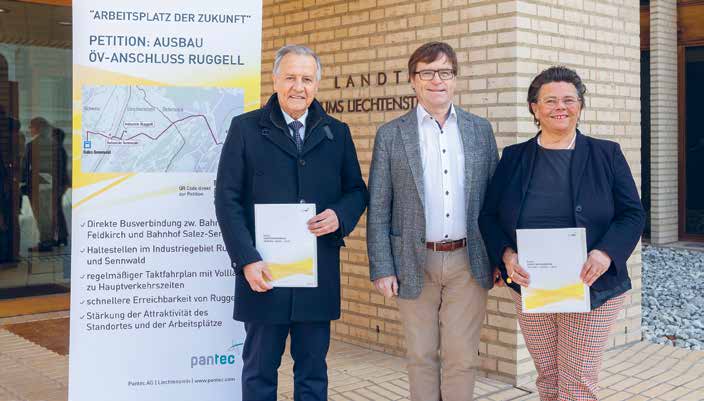
He started a petition in September 2019. By early 2020 it had gathered the required 500 online signatures. On February 13, Braun handed it to Ruggell's municipal leader, Maria Kaiser-Eberle, and parliamentary president Albert Frick. The photograph is wonderfully ordinary: three people outside a public building, documents in hand. International business has its glamorous images. Here was an employer asking for a better bus.
The episode offers a useful entrance to Braun's career. His business, Pantec, operates in the intricate territory where electronics, software and machinery must cooperate. A connection that works on a diagram still has to work for the person using it. That applies to a control system. It applies, rather neatly, to getting to work.
Before the company, the controls
His route into entrepreneurship began with electronics. Braun completed his engineering education at HTL Bregenz in Austria in 1983, then joined Oehler AG in Au, Switzerland. He led product development for textile-machine control systems. Later, at Grossenbacher AG in St. Gallen, he worked as a software engineer on CNC controls for high-end machine tools.
These are useful places to learn the difference between an attractive idea and an instruction a machine can execute. A control system brings a sequence into the physical world. Software has to agree with electronics; electronics has to agree with mechanisms. The machine, a refreshingly unsentimental critic, delivers its verdict by moving.
In 1990, Braun and a partner founded Pantec Engineering AG in Liechtenstein. He was 26. The opportunity he identified was in mechatronic systems, that combination of mechanical engineering, electronics and software which sounds forbidding until you consider how much modern machinery depends on all three getting along.
He also went back to learn the commercial side, taking a one-year course in sales and marketing direction at the University of St. Gallen while working. The sequence is revealing: technical training, responsibility inside other businesses, his own company, then further commercial education. He kept adding skills around the original engineering foundation.
A small starting point, a large map
Pantec's first official headquarters opened in Mauren in 1992. Its textile-controller business was followed by metrology in 1993 and printing in 1998. These were successive applications for an engineering business learning where its capabilities could be useful. Measurement, textiles and printing make different demands, but all give a controller plenty to do.
In 2004, the company opened the Pantec Technology Center in Ruggell and a representative office in Shanghai. Those two addresses express a practical balance: a base where the engineering organisation could develop, and a presence close to another market. Expansion involved places, people and service, as well as products.
Braun later described the China operation as a sequence. Purchasing came first, in 2004; a sales and service office followed in 2005. In his 2012 account, international business represented 95 percent of turnover, with China contributing a quarter. Those figures belong to that period. They show how far the company had travelled by then.
“Take things step by step.”
Reinhard Braun, 2012
His advice for entering foreign markets was similarly concrete: establish your own operation in major countries, work with distributors and agents elsewhere. The attraction of entrepreneurship, for him, lay in tackling difficult challenges with a team. The language has the modest scale of a working instruction. The map behind it was already international.
The view from Ruggell
There is a pleasingly personal detail behind the technology centre. When Braun was looking for a location, the view helped persuade him. Pantec later shared the landscape visible from the site and recalled its part in his decision. A founder whose business depended on precision had allowed scenery a vote.
The company links that 2004 building to the development of new areas of expertise. It is easy to discuss a headquarters as floor space or capacity. The landscape anecdote adds something less administrative: this was also a place where people would spend their days. An office address eventually becomes somebody's Monday morning.
The business continued branching out. It acquired GS Engineering in 2007, entering print decoration. RHINO arrived in 2010 for narrow-web work; CHEETAH followed in 2012 for wide-web applications. Germany and Shanghai gained subsidiaries in 2013. A motion-control platform followed in 2017, and a new headquarters for Pantec Schweiz AG in 2023.
There is a small zoological joke hiding in that industrial history. A rhinoceros and a cheetah are memorable names for equipment concerned with print finishing. The names bring a little wildlife into the factory; the engineering underneath remains a matter of controlled, repeatable work.
Leaving room for other people's expertise
One colleague mattered particularly to the print-decoration business. Peter Frei joined Pantec in 2008 and spent the next decade developing that operation. He encouraged printing houses to adopt in-line processing and helped build the applications and engineering team behind it. When Frei died in 2018, Braun temporarily took responsibility for the business.
In remembering him, Braun praised both the commercial work and the team Frei had assembled. He singled out technical understanding, persistence and a passion for the printing industry. The emphasis matters. A founder's account of a company's growth can become a solo performance. Here, Braun gave a colleague's contribution its own space.
That is a useful corrective when looking at Pantec through its founder. Braun established the business and shaped its direction. Its specialist work also depended on people who knew particular machines, applications and customers. A diversified engineering group requires many kinds of competence, and a chief executive's biography cannot sensibly absorb them all.
The customer has the next instruction
Pantec remains family-owned, with a majority of shares held by a family trust. The ownership structure is intended to support a long horizon for the company and its employees. Braun's continuing public invitation to customers is much more immediate: send observations, criticism and suggestions about products or service.
He promises to review that input personally and feed it into development and manufacturing. Pantec says more than two-thirds of its employees have direct customer contact each day. Taken together, those details describe an organisation trying to keep information moving from the user back to the people making the equipment.
It is an appealingly demanding promise. Asking customers what they think creates work. They may tell you. They may also notice something that the drawing, the production process and the internal meeting all missed. For an engineer turned founder, that feedback is another kind of input to be understood.
A tour that opened a door
In December 2011, Braun and Pantec's chief operating officer, Jürgen Schwarzmann, hosted visiting START-Vorarlberg scholarship recipients. They conducted separate tours to accommodate both technical and commercial interests. The young visitors asked about employees' training and studies, questions that bring an industrial company down to the scale of a possible individual future.
One participant, Xynthea, left encouraged to learn that Pantec employed people with migration backgrounds. She could imagine people like herself having a place there. Braun was a patron of the programme. The visit supplied something a list of products cannot: a chance to see who works inside a business and how they arrived.
The students also went home with small company gifts. A USB stick is an unassuming souvenir. The more lasting possibility was having a new answer to the question of where a young person might belong. An engineering tour can do more than explain engineering.
Another application, another field
More recently, Pantec Biosolutions, whose board Braun chairs, has been developing LaserFly for agriculture. The system combines image recognition, automated targeting and laser technology to identify weeds and pests and act selectively. Pantec describes an approach designed to intervene at individual plants rather than treat an entire field indiscriminately.
The Swiss Climate Foundation began supporting the company in spring 2025. At Liechtenstein's 2026 entrepreneurship day, Biosolutions CEO Clemens Hagen discussed the next practical challenge: demonstrating what the technology can do for farmers and attracting further partners. It is a recognisable stage in the life of an engineering idea. A working application needs users, evidence and an organisation around it.
There is a family resemblance to Braun's earlier work: sensing, deciding and controlling an action in the physical world. The setting now includes crops. The underlying requirement for those pieces to cooperate would be familiar to the young engineer working on textile machinery decades earlier.
Room beyond the working day
A 2013 portrait described Braun as someone who valued persistence, calm and finishing what he started. It also recorded a deliberate balance between family and business, with golf, skiing and mountain tours providing time outside work. These details belong beside the machinery. They give the founder a life with other demands on his attention.
The mountains also offer a less corporate way of reading his preference for proceeding in stages. There is no need to turn a hobby into a management doctrine. Still, the attraction is understandable: an ambitious destination, a clear next move, and enough attention left to appreciate the view.
Back in the bus-petition photograph, Braun stands between public officials, asking for a connection. It is a fitting image for a career spent making separate parts work together. The company could reach customers around the world. The people travelling to Ruggell deserved a workable journey too.
Follow the connections
Profiles, interviews and further reading.