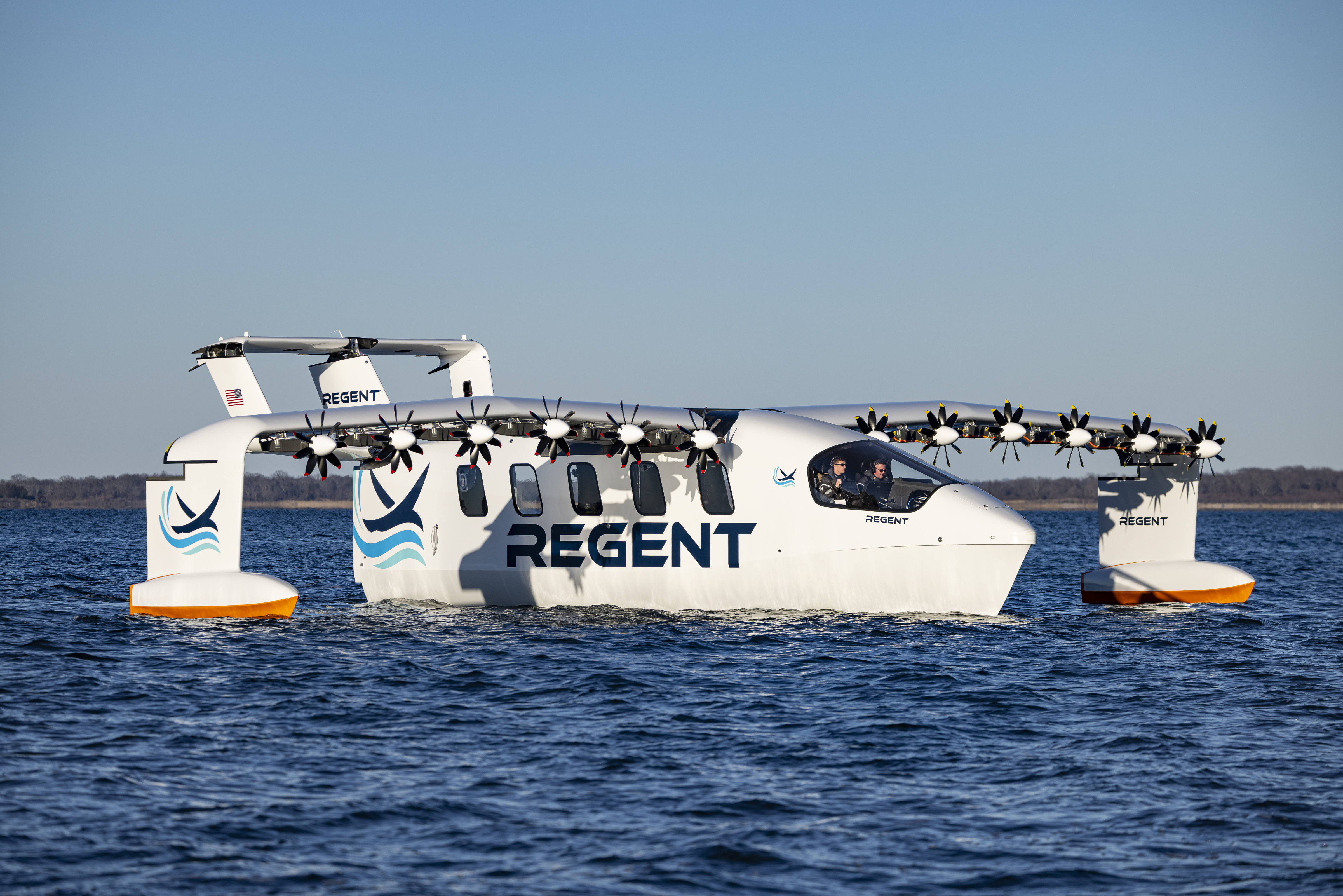
On September 2, 2026, two captains took a vessel above Narragansett Bay. It stayed airborne for 30 seconds, covered 1,956 feet and flew roughly 33 feet above the water. For REGENT, they marked the first human-crewed flight of its full-scale Viceroy seaglider prototype.
- Three modes: float at the dock, foil near shore, fly over open water.
- Viceroy targets 12 passengers, 180 mph and 180 miles.
- First crewed flight: September 2026. First deliveries targeted: late 2027.
The curious part is how it got there. Viceroy begins on a hull, lifts onto hydrofoils, then leaves the water to fly close to the surface. A hydrofoil gives the vessel a way to travel from a crowded harbor to open water before attempting takeoff. The invention has a middle gear.
The water is doing some of the work
REGENT develops and manufactures wing-in-ground-effect vessels. Ground effect reduces induced aerodynamic drag near a surface; the company uses that advantage to pursue battery-powered coastal transport. Its electric Viceroy is designed for 12 passengers plus two crew, speeds up to 180 mph and routes up to 180 miles. These are product targets, rather than the performance demonstrated by that September hop.
Look closely at the prototype and the arithmetic becomes visible: a 65-foot wingspan, a 55-foot body and 12 electric propellers. Air blown over the wing helps generate lift at lower speeds. The hydrofoils retract after takeoff.
That sequence addresses a problem older ground-effect vehicles struggled with. In REGENT’s account, earlier designs had poor wave tolerance, awkward harbor maneuvering and demanding manual controls. Hydrofoiling creates separation between dock operations and flight. Digital controls handle stability. The captain directs speed and heading while software manages the delicate business of staying close to the sea.
Dock + low speed
Harbor + transition
Open-water ground effect
An old idea meets a new control system
Co-founders Billy Thalheimer and Mike Klinker started REGENT in December 2020. Both are MIT-trained aerospace engineers; Thalheimer leads as CEO and Klinker as CTO. Their respective backgrounds in aircraft design and flight-control software help explain why they approached maritime transport with wings and code.
Thalheimer’s technical explanation identifies a nasty feedback loop: entering ground effect changes the airflow reaching an aircraft’s tail. That can push the nose down, bringing the craft closer to the surface and intensifying the effect. Earlier designers pursued unusual wings and large tails to manage stability. REGENT argues that modern digital flight controls allow a more efficient conventional wing.
The development sequence was patient, even when the forecasts were not. A quarter-scale prototype demonstrated float, foil and fly in 2022. Full-scale on-water testing began in March 2025. A 2023 financing announcement had anticipated crewed flight in 2024; the achieved milestone arrived in September 2026. The calendar moved before the commercial service did.

The customer buys a vessel, then invents the journey
REGENT’s commercial proposition is to sell vessels to operators serving coastal cities, islands and offshore destinations. The operator supplies the service around the machine: terminals, crews, charging, schedules and ticket prices. A passenger would eventually use a seaglider much as they use a ferry, boarding at the waterfront for a faster crossing.
Its first announced U.S. delivery and launch partner is The Twenty Five, a luxury coastal travel membership business. By June 2026, that customer had expanded its order to up to 60 Viceroys and planned to work with Hornblower on operations. Proposed routes include New York to the Hamptons and Palm Beach to Miami. Early adoption, it seems, may arrive wearing very good sunglasses.
The applications extend beyond a weekend escape. DHL Express signed an exploratory agreement in November 2025 to assess seagliders for regional and coastal cargo logistics, initially in the Middle East. In June 2026, Mitsui O.S.K. Lines, Japan Airlines, Lloyd’s Register and REGENT announced a certification project for Japan, aiming toward commercialization around 2030. An exploration agreement and a certification project are steps toward service; neither puts passengers aboard today.
The Marines pay for a different kind of crossing
The defense customer values movement between dispersed maritime locations without a runway. REGENT’s Marine Corps Warfighting Lab agreement began with $4.75 million for feasibility work. A $9.5 million phase supported full-scale demonstrations. September 2026 added another $5 million, bringing the total to $19.25 million. The next phase includes operational demonstrations and command-and-control integration.
The product family now includes Squire, an autonomous seaglider drone whose ground-effect flight REGENT announced in April 2026. Its planned missions include surveillance, tailored logistics and search and rescue. Hybrid configurations are also under development for defense. The commercial electric vessel and a longer-range military concept answer different requirements; “electric” cannot serve as a blanket description of every future model.
“Sea trials are just the beginning.”Billy Thalheimer / March 2025
A flight is short. A production line is expensive.
The capital has become substantial. October 2023 brought a $60 million Series A co-led by 8090 Industries and Founders Fund. August 2026 brought a $240 million Series B package: $120 million of equity and $120 million of debt. Mare Liberum and AE Ventures co-led the round; Erebor Bank supplied the debt. REGENT reported $340 million raised across equity and debt.
On September 30, the company opened a 255,000-square-foot factory at Quonset Business Park. Its stated eventual annual capacity is 75 Viceroys and 300 Squire drones, with first Viceroy customer deliveries possible in late 2027. The company’s reported multibillion-dollar commercial order book likewise measures demand on paper, rather than revenue collected from delivered vessels.
Copy the middle gear, respect the coastline
The practical lesson is to study transitions. REGENT combines established technologies so that a vessel can leave the dock, navigate a harbor and only then fly. Other builders can copy that question: what must happen between the impressive demonstration and the ordinary customer’s day?
The conditions matter. A useful route needs water, suitable terminals, charging and enough travelers or cargo. Rough weather and wind still determine the operating envelope. Electric hydrofoil ferries, including those from Candela, offer another approach; conventional ferries and regional aircraft remain alternatives. For a short crossing, flight’s extra complexity may buy little.
REGENT’s stated values put human safety first and emphasize decisions based on data. The middle gear got the prototype away from the harbor. Making the timetable boring will be the more interesting achievement.