The most revealing object in Red Bull’s universe is not a Formula One car or a capsule dangling above the stratosphere. It is the refrigerator beside a convenience-store register. Cold, bright and within reach, it turns decades of spectacle into a three-second decision. The can is small. The system behind it is not.
Red Bull GmbH reported selling 13.969 billion cans in 2025, up 10.2 percent from 2024. Group turnover reached EUR 12.196 billion, and the company employed 21,924 people across a business sold in 178 countries. Those numbers describe a beverage operation of unusual scale. They do not explain why a drink company runs a media house, owns racing teams, guides a network of football clubs, backs a WorldTour cycling team and can make a cliff dive or breakdance final feel unmistakably its own.
The short explanation is marketing. The better explanation is that Red Bull designed a loop in which distribution, entertainment and identity strengthen one another. The drink pays for the stories. The stories load meaning into the drink. Retail puts the symbol close enough to buy.
A Thai idea, rebuilt for an Austrian shelf
The origin begins with Krating Daeng, a Thai functional drink created by Chaleo Yoovidhya. Austrian marketer Dietrich Mateschitz encountered the product in Asia and partnered with Yoovidhya. They founded Red Bull GmbH in 1984. For nearly three years, Mateschitz worked on the formula, packaging, position and marketing concept. Red Bull Energy Drink launched in Austria on April 1, 1987.
That three-year interval matters. Red Bull was not simply translated. It was reformatted for a new market: carbonated, presented in a narrow silver-and-blue can, priced above ordinary soda and introduced as a category with its own use cases. The package communicated difference before a customer tasted anything. Its modest volume made the premium less punishing at the register, while the slim shape looked unlike the cans surrounding it.
The original US 8.4 fluid-ounce can contains 80 milligrams of caffeine, plus taurine, B-group vitamins, sugar and water. Sugarfree and Zero widen the core offer. The Editions add flavors and seasonal releases, turning a stable formula into a recurring news cycle. Watermelon, Tropical, Coconut Berry and Juneberry can share a refrigerator with temporary summer and winter arrivals. Novelty happens around the product, not through a wholesale reinvention of it.
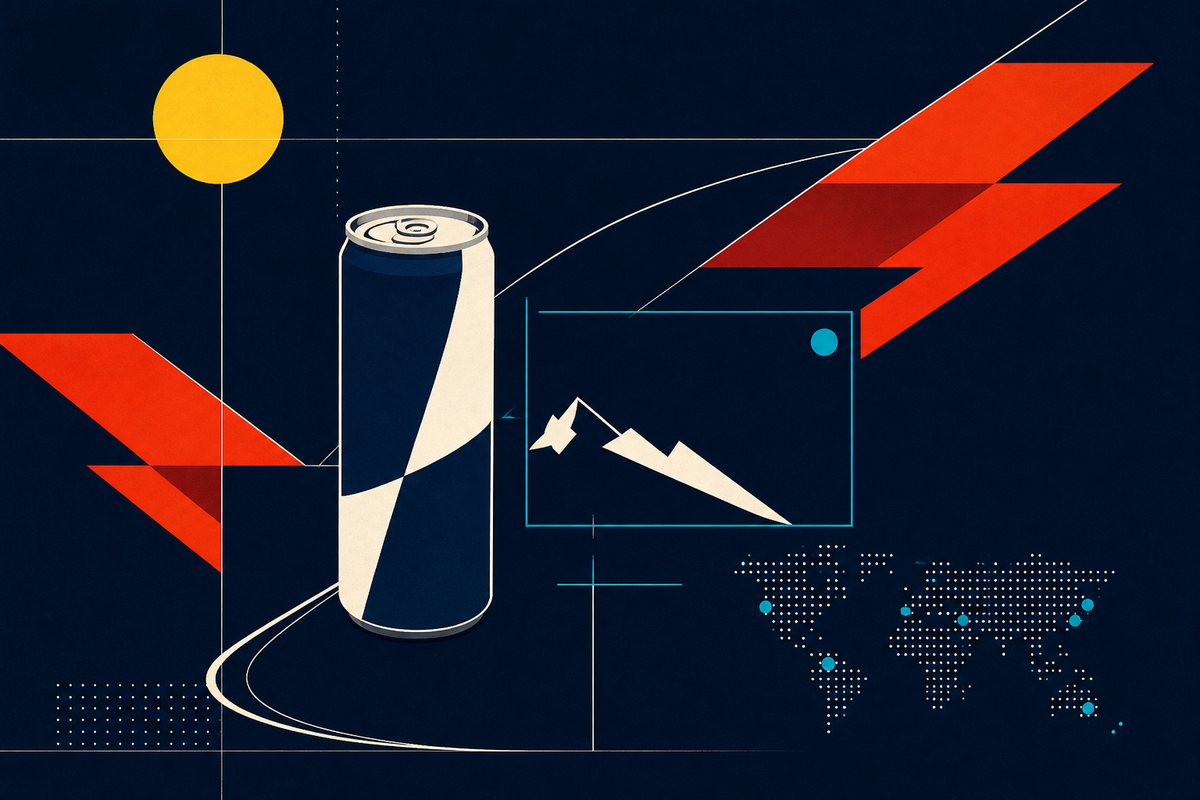
The can is the transaction. The world around it is the retention layer.A useful way to read Red Bull’s business
The audience is built around occasions
Red Bull’s customers are not one tribe. They are students facing a late library hour, professionals meeting a deadline, drivers on a long road, gamers in a tournament, travelers crossing time zones, bar patrons extending an evening and athletes choosing caffeine before competition. The common problem is simpler than the brand’s most elaborate footage: people sometimes want alertness in a portable, predictable form.
This places Red Bull in a much wider market than energy drinks. It competes directly with Monster, Celsius, Rockstar and local brands, but also with coffee, caffeinated soda, energy shots, pre-workout powders and an expanding shelf of functional beverages. Consumers compare taste, price, sugar, caffeine, ingredients, identity and availability. Red Bull’s answer has been consistency at the center and variety at the edge.
The company’s public materials mention athletes, busy professionals, university students and travelers. Its physical channels reveal the rest of the strategy. Supermarkets drive planned multipack purchases. Convenience stores and petrol stations capture impulse. Bars and hospitality venues attach the drink to nightlife. Ecommerce supplies cases at home. The brand can be globally coherent while local sales teams fight for the least cinematic asset of all: cold shelf space.
When sponsorship grows an afterlife
A conventional sponsor buys proximity to somebody else’s event. When the banners come down, the inventory is gone. Red Bull often goes further. It creates formats, supports athletes over time, owns teams and retains the ability to film, edit, distribute and revisit what happened. That gives the event an afterlife.
Red Bull Media House, founded in 2007, is the formal expression of that capability. It produces and licenses sports, culture and lifestyle content across television, mobile, digital, audio, print and film. The operation says it works with more than 700 athletes, covers more than 100 disciplines, activates more than 1,250 events a year and reaches more than 160 countries. Its business-facing offer includes conventional advertising, a brand studio, post-production, editorial services and a network of more than 1,000 distribution partners.
The spectacular proof remains Red Bull Stratos. On October 14, 2012, Felix Baumgartner stepped from a capsule 38,969.4 meters above Earth and reached Mach 1.25 in freefall. It was a scientific and engineering project, a live global broadcast and a brand event in one package. The logo was present, but the event did not need a sales pitch. People watched because a human being was falling from the edge of space.
That principle scales down. A mountain-bike edit, a dance battle or a behind-the-scenes racing film works when the subject is interesting without the product. The transferable lesson for smaller companies is not “fund a space jump.” It is to create something useful, surprising or watchable inside a world the customer already values. Advertising becomes easier to tolerate when it arrives carrying its own reason to exist.
Teams are laboratories with scoreboards
Red Bull’s sports investments also create expertise that ordinary sponsorship cannot. Red Bull Racing began competing in Formula One in 2005 and won its first constructors’ and drivers’ titles in 2010. In 2026, Red Bull Ford Powertrains made its race debut, bringing power-unit development alongside chassis work. Oracle extended its title and technology partnership, supporting cloud infrastructure, simulation and AI. A beverage company had moved from placing decals on race cars to developing one of the most technically demanding parts inside them.
Football follows a network logic. Clubs associated with Red Bull operate in several markets, while Jürgen Klopp became Head of Global Soccer in January 2025 to advise on playing philosophy, talent and development. Red Bull also took a minority investment in Leeds United alongside a shirt and energy-drink partnership. In cycling, it became majority owner of BORA - hansgrohe before the 2024 Tour de France. The team earned its first Tour podium in 2025 through young rider Florian Lipowitz.
Ownership brings control and learning, but it also brings scrutiny. Supporters may resist a commercial identity placed over local sporting history. Results are public, weekly and impossible to smooth with a campaign. That tension is part of the model’s cost. Red Bull gets stories that competitors cannot casually purchase; it also assumes the operational risk and cultural argument attached to them.
The moat is a system, not a recipe
Caffeine is abundant. Taurine is not exclusive. Flavors can be copied, and giant beverage systems can match distribution. Monster competes with a broad product portfolio and Coca-Cola distribution relationships. Celsius presents itself through fitness and functional cues. Coffee owns ritual, aroma and an enormous range of price points. Red Bull’s differentiation rests on the combined system: premium packaging, a recognizable promise, cold availability, disciplined extensions and a media-and-sports network accumulated over decades.
The model is not frictionless. Energy drinks face changing health preferences and debate over caffeine and sugar. The Editions and sugar-free range address some consumer demand, but do not make the category neutral. The environmental arithmetic is equally physical. Billions of cans require materials, manufacturing and transport. Red Bull emphasizes aluminum’s recyclability, says it has sourced only Aluminum Stewardship Initiative-certified material for cans since 2025, and has committed to net-zero emissions by 2040. The commitments are meaningful; the scale makes execution the important part.
For marketers, Red Bull can look like permission to be extravagant. The more practical lesson is restraint. One primary product carried the company for years. The brand entered adjacent worlds where energy, risk, concentration and performance made intuitive sense. Its stories kept a consistent visual and emotional grammar, while local teams adapted execution to their markets.
For customers, the proposition remains plain: a portable caffeinated drink in original, sugar-free and flavored versions. Nothing about a Formula One power unit changes the liquid. It changes the frame around the liquid. Red Bull made that frame entertaining enough to attract an audience, specific enough to build memory and broad enough to cross borders. Then it made sure the can was waiting nearby.