Vince Broady had a perfectly reasonable objection to a racing game: too many hands on the keyboard. In June 1996, reviewing Micro Machines 2, he liked the short races, the intuitive controls and the tiny vehicles tearing around household obstacles. Sharing the controls with other players was another matter. “In my book, three pairs of hands on a keyboard is two too many.” It is the sort of complaint that gives a critic a face. You can admire a game and still wish the person beside you would move their elbow.
The review takes its pleasures seriously. Broady describes a game that is easy to start and harder to master, with computer opponents happy to shove you off course. His attention goes to what happens when someone actually plays. The graphics receive their due; the experience gets the deciding vote. Read it now and there is a useful introduction to a career that would move through publishing, entertainment and enterprise software: he is interested in what the machinery makes possible for the person using it.
From the review desk to the portfolio
Before GameSpot, Broady was executive editor of IDG’s Multimedia World. He co-founded the games publication with Pete Deemer and Jon Epstein; GameSpot launched on May 1, 1996. Its initial emphasis was PC games, with console coverage following through a companion site. The founding history sits comfortably beside his early bylines. Here was someone helping build the publication and doing the work of filling it.
A games website needs more than a pile of opinions. Readers want reviews, previews and news to meet in a place they can navigate. GameSpot’s early expansion made that organizing work concrete: different machines, different releases, different audiences. Broady’s later responsibilities would put more kinds of information under his care. The scale changed, but the editorial question remained recognizable. What belongs together, and how will somebody find it?
At ZDNet, his work included product development and management of the consumer group. He also developed online destinations for magazines and wrote an Anchordesk newsletter column. At CNET, he managed mySimon, a comparison-shopping service, before overseeing entertainment businesses including GameSpot and MP3.com. Shopping comparisons and music destinations expanded the territory considerably. A reader could be choosing a game, a song or a purchase; the information had to help that choice.
By 2006, he was heading to Yahoo to oversee games, entertainment and youth properties. The role brought him into a company whose media ambitions stretched across several forms of entertainment. It was a considerable distance from miniature cars on a kitchen counter. Yet the counter had supplied a useful standard: a service ought to be judged by the experience it delivers, including the parts that a polished presentation would prefer to leave out.
Graphics, gamer food and relevance
Broady also occupied an interesting position in the public conversation about games. In June 2004, he moderated a Computer History Museum panel with Jordan Mechner, Rand Miller and Will Wright. Their games included Prince of Persia, Myst and SimCity. The subject was the development of computer graphics, from simple pixels to elaborate three-dimensional worlds. The event invitation promised historical artifacts, cutting-edge demonstrations and gamer food. Intellectual seriousness could apparently survive refreshments.
The discussion took up the relationship between technical advances and design. Broady asked about game-making, teams and what richer graphics meant for the people creating these worlds. It is a useful scene in his story because it puts him between the technology and the people deciding how to use it. Better graphics make new things possible. Whether those things make a better game remains a question someone has to ask.
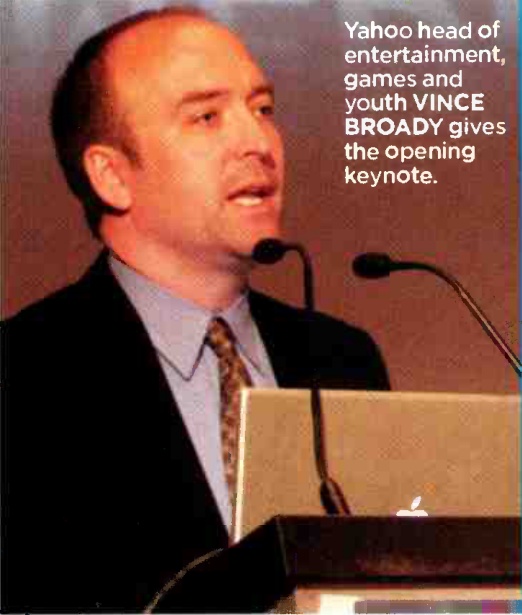
At the DEMMX conference in Los Angeles in November 2006, he addressed a related problem in online entertainment. Content was becoming something consumers could interact with, gather and use in their own ways. The sentence was brief enough to outlive the platforms surrounding it. An abundance of material creates a new kind of scarcity: finding the piece that matters to you.
“One of the things in short supply these days is relevance.”
Vince Broady / DEMMX, 2006
A place to put a moment
Thismoment’s early consumer service approached that scarcity through memory. When it entered public beta in 2009, it offered people a way to assemble meaningful experiences from photos, videos and other media. A moment could gather material from several services and sit in a chronological sequence. It could be public, shared with friends or private. Users could even include events still to come, giving anticipation a place beside recollection.
The organizing unit was unusually human. A photograph on one service and a video on another could belong to the same experience. Bringing them together restored something their separate storage had obscured. The service invited people to add the feeling attached to the moment, too. The files became parts of a story someone recognized as their own. For a founder coming from large entertainment properties, it was a turn toward the scale of an individual life.
There is an appealing modesty in that problem. Anyone who has hunted through old folders knows that possessing a file and being able to find it are separate accomplishments. Thismoment gave the collection a shape. Its later enterprise business would face a related organizational task, although the customers, permissions and commercial purpose were different. The personal moment eventually shared a company name with a much more formal marketing workflow.
The photograph needs permission
By 2014, Thismoment’s Content Cloud was helping organizations gather, manage and distribute material created by users alongside their own professionally produced content. Its October funding announcement described a $17.6 million Series D backed by Sierra Ventures, Trident Capital and UMC. The ambition was to make this material useful across the enterprise, extending beyond individual promotional campaigns. Marketing, customer support and recruiting could all become destinations for it.
A customer’s picture, however, carries a complication that a corporate asset library may conceal: someone else made it. Finding an image does not settle its use. Content Cloud put monitoring, moderation and rights clearance inside the process, with connections to existing enterprise systems. That turns a loose collection of attractive posts into something a team can work with. Permission is part of the product’s usefulness, rather than an inconvenient conversation postponed until publication.
Inside the Content Cloud idea / 2014
- DiscoverFind material across platforms.
- ClearRequest and record usage rights.
- CurateCombine user and brand content.
- DistributePublish into connected experiences.
A published patent application offers another view of this work. Broady is named among the inventors on Systems and methods for cloud-based digital asset management, published in May 2015. The application describes managing assets across platforms, tracking associated information and requesting an owner’s permission. It also describes blocking publication while that permission is pending. This is the practical machinery beneath the pleasing idea of a stream of content: records, states and decisions about what may happen next.
The recruiting use case made the human connection especially clear. In July 2014, Thismoment partnered with TMP Worldwide to combine its content tools with talent-acquisition software. Employee-created material could help employers show what working at a company was like. The pitch gave existing employees a role in communicating workplace culture. A company description can be carefully written. An employee’s contribution gives a prospective colleague another kind of detail to consider.
The long clock at Brown
Broady’s education supplies a different clock for this career. A Texas native, he earned a B.A. in Religious Studies at Brown University. Discussing the liberal arts in 2014, he connected his studies with an interest in commitment and lasting value. “Their impact is measured across hundreds and thousands of years.” He was describing people devoted to their faith, while considering what that perspective might mean for building a company.
He questioned the preference for failing fast and encouraged students drawn to the humanities to take their interests seriously. That is a specific position in a business culture fond of quick verdicts. It also brings an unexpected vocabulary to the software résumé: duration, devotion, value over time. An enterprise product has to work today. A company also has to decide what is worth continuing to build after the first enthusiasm wears off.
A different kind of track
Management Controls added an industrial chapter, with a family connection. In July 2017, the company announced that founder Bob Harrell was retiring and passing control to longtime investor George Broady and his son Vincent. Vince was named as the incoming CEO, while Ken Naughton would become president. The company’s current biography dates Vince’s takeover to 2018. Its Track software addressed contractor costs, contract compliance and visibility into work at industrial sites.
The setting had changed again: contractor labor, equipment and materials, with customers in industries such as energy, mining and chemicals. The company's description of his priorities emphasizes client satisfaction, investment in the platform and its global reach. The information here has a different consequence from a game review or a brand photograph. It helps organizations understand work and spending while operations are underway. The usefulness has to survive contact with an actual working day.
Recent company activity gives that chapter a present tense. In February 2026, Management Controls announced two senior appointments supporting Australian and broader Asia-Pacific growth. In April, it announced a CIO 100 award for its automated vendor onboarding project. Foundry’s honoree list confirms the recognition. The award belongs to the organization and its team, an appropriate distinction for software whose results depend on many people doing the work behind the screen.
Reported change with the Vendor Onboarding Agent. Company-reported times, not an independent benchmark.
MCi’s chief technology officer Michael Lewis described the project in terms of time saved: a process that once took four hours could be completed in fifteen minutes. It is a wonderfully ordinary measure for a software story. Someone gets an afternoon back. Across Broady’s changing markets, that ordinary person has remained a useful place to look. The early reviewer knew exactly where an experience could become awkward. All those years later, there is still value in making room for the hands at the keyboard.