A charity with a fixed budget received a government subpoena. Its lawyers at Sidley Austin faced more than a million documents and a small team. This is the sort of assignment that makes the phrase “just read everything” sound like a particularly expensive joke. The interesting question was how to reserve scarce attention for material that actually required it.
The team used OpenText Axcelerate, the eDiscovery platform inherited from Recommind. It narrowed the collection with information about custodians, communications and domains, tested searches through samples, and used predictive coding to suggest similar documents. The software also helped flag disagreements with human privilege decisions for another look. In OpenText’s account, the team met its document obligations while keeping staffing lean.
Here is Recommind’s business in miniature: take a large collection of human information, identify patterns, and help a professional decide where to begin. The documents remain documents. The legal questions remain legal questions. What changes is the order in which expertise reaches the evidence.
- Recommind turns unstructured information into searchable, reviewable evidence.
- Its customers include law firms, corporations and regulators.
- OpenText acquired it in 2016; Axcelerate continues as OpenText eDiscovery.
A search company finds an expensive reader
Recommind was founded in 2000 by Jan Puzicha, Thomas Hofmann and Derek Schueren. Its roots lay in machine learning and information retrieval. Hofmann’s own academic biography lists his role as co-founder and chief scientist; it also includes a spell directing engineering at Google Zurich. Search was a serious technical discipline for this team, rather than a box added to the corner of a screen.
Enterprise information gives search a peculiar assignment. The useful material lives in emails, documents and agreements, rather than tidy database rows. People describe related things with different words. They repeat messages, forward them, attach files, and accumulate versions. A keyword search can retrieve a great deal while leaving the reader uncertain about what deserves attention.
Recommind applied concept-based analysis and its Context Optimized Relevance Engine, or CORE, to this disorder. Its historical range included Decisiv for enterprise information access, Axcelerate for eDiscovery review and analysis, and Perceptiv for contract analytics. The shared commercial idea was straightforward: make unwieldy information useful to someone with a decision to make.
Legal work supplied a receptive market. Company-listed customers included Clifford Chance, Morgan Lewis and White & Case, alongside corporations such as BMW and Cisco. The SEC’s own assessment described Axcelerate as a repository for enforcement material and case files. That is a rather demanding audience for a search result.
The next document gets smarter
Predictive coding is easiest to understand as a feedback loop. A reviewer makes decisions about documents. The system learns from those decisions and ranks other material for review. As more decisions arrive, the ranking changes. OpenText describes Axcelerate’s approach as continuous machine learning, with support for rolling data loads and multiple review issues.
The distinction between a keyword and a judgment matters. A keyword captures something a reviewer already knows to ask for. A review decision supplies an example of what that person considers relevant in context. Combining searches, metadata and concept groups can give the model useful starting material; checking inconsistent decisions can help improve that material.
This is also where enthusiasm needs a seat belt. A ranking cannot compensate for a badly framed issue or unreliable human labels. In practical terms, a team still needs knowledgeable reviewers, sampling and quality checks. Sidley’s workflow is instructive precisely because it combined those methods. Anyone copying the process should copy the checks as enthusiastically as the automation.
Buyers should resist treating “AI” as a distinguishing feature by itself. Everlaw also offers predictive coding that learns from review decisions, and Relativity offers AI-assisted review. Recommind’s case rests on its particular integration of analytics, review tools, deployment options and services. A useful comparison asks how the whole matter runs, including the awkward parts.
The bill was also a workflow problem
At Pillsbury, the problem included dependence on several outside providers and their processing and hosting fees. The firm consolidated discovery in Axcelerate and brought the function in-house. Its team handled processing, hosting, analysis, review and production through a common platform, using a cloud environment it controlled.
OpenText’s customer account describes a small team working with on-demand computing capacity. Professional services helped with AWS infrastructure, while data scientists assisted with workflows and metrics. The firm reported reduced costs and a more standardized process. Those are customer-reported outcomes; they do not establish a percentage saving that every buyer will receive.
The business lesson is portable. Before shopping for a clever algorithm, map where a project changes hands, where data gets processed again, and where expertise disappears between vendors. Consolidation can remove friction, but bringing work inside also requires people who can run it. A firm without that capacity may need managed services instead.
Recommind sold enterprise software, SaaS and managed services, with historical options spanning on-premises, on-demand and self-service cloud. The economics therefore include software, infrastructure and professional labor. For a buyer, the useful question is the total cost of a matter under a specified workload. An acquisition price, however impressive, tells you nothing about your hosting bill.
“Some firms find it daunting to leverage machine learning; we do it every day.”David Stanton · Pillsbury
The chart that lost its menu
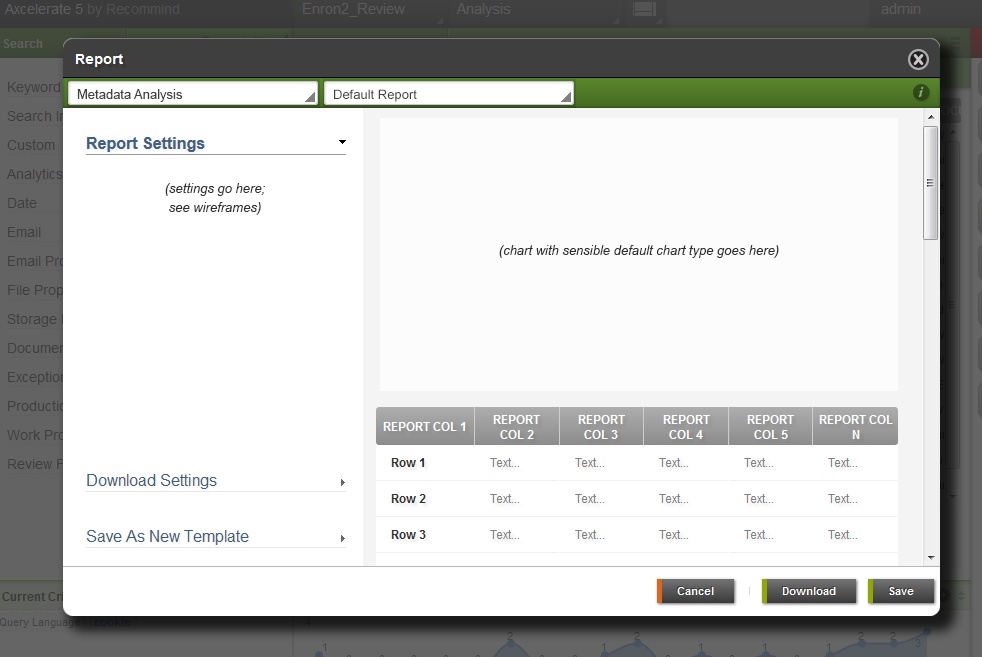
A small design episode makes the company less abstract. In a project published in July 2016, designer Debra Tjoa described updating Axcelerate’s legacy reporting system. The reports shared some settings but also needed individual controls. Some were simple tables; others crossed one set of values against another, with counts in each cell.
The early designs let users change chart types. After conversations with subject experts and the team, the designers moved the settings, combined report, download and save controls into one column, and removed chart-type selection. Users could show or hide a predetermined chart instead. Tjoa reported that the finished functionality closely followed the prototype.
That is a useful glimpse of product judgment. Enterprise software can become a museum of options, each preserved because someone once requested it. Here, consultation produced fewer choices. The reader can copy the method: sketch the possibilities, put them in front of people who understand the work, and ask which decisions deserve to survive into the interface.
Contracts brought a different kind of evidence
Perceptiv extended the same analytical ambition into agreements. In 2015, Recommind and Deloitte introduced a managed SaaS offering for investment banks dealing with over-the-counter derivatives contracts. The service combined Recommind’s technology with Deloitte’s work, helping extract usable information from ISDA master agreements.
An agreement is information with obligations attached. Terms concerning collateral, netting or thresholds have to become something an institution can find and compare. Leaving them buried in prose makes the document archive a poor substitute for usable operational data. This was a specific application for banks, rather than an invitation to throw every contract at a general-purpose assistant.
Across these products, the expertise was both technical and occupational: understanding text, understanding the task, and designing a workflow around the two. The SEC’s privacy assessment adds a practical limit. Investigatory material can be incomplete or inaccurate, and staff must exercise due diligence before adverse action. Faster access does not make the underlying record infallible.
The name changed. The queue kept moving.
In June 2016, OpenText announced an agreement to buy Recommind for approximately $163 million. It expected the acquired solutions to produce $70 million to $80 million in annualized revenue. That was a projection at the time of the deal, rather than an audited statement of Recommind’s results. OpenText wanted eDiscovery, analytics and cloud expertise that complemented its information-management business.
The acquisition closed on July 20. Later filings recorded an acquisition amount of approximately $170.1 million. Keeping those figures separate is a modest act of documentary hygiene: the announcement and the subsequent accounting describe different reported stages of the transaction.
OpenText now maps Axcelerate to OpenText eDiscovery, Decisiv to OpenText Legal Knowledge Management and Perceptiv to OpenText Perceptiv. The May 2026 eDiscovery update describes improvements to Aviator Rapid Exploration, chronology, multilingual processing and ingestion, plus a cloud-only Flex beta for custom AI prompts. These are developments in the successor platform, rather than announcements from an independent Recommind.
The newer tools can generate and organize information; the older insight remains useful. A professional confronting a mountain of records needs a way to ask better questions, test the answers and direct attention. Recommind made that problem commercially concrete. Its most transferable idea is pleasantly unglamorous: improve the next decision about what to read.
Announced acquisition price
June 2016 · approximately
Later acquisition accounting
SEC filing · approximately
Both figures are in US dollars. Neither is a software subscription price.
Follow the product trail
Explore the current platform, the inherited company profile and the people putting the software to work.