April Marty's route to the marketing office begins in the sort of place marketing biographies usually hurry past: technical analysis. When she joined TCDI in 2012, the work in front of her was not a campaign brief. It was the complicated machinery of legal technology, where files, deadlines, clients and software meet, usually without the courtesy of arriving in a tidy order.
From there, she moved into project management and then client data services. Only later came the leadership titles in corporate communications, sales and marketing operations, and, in 2025, chief marketing officer. The sequence is the story. Marty learned what TCDI did by moving through the rooms where it was done. By the time she became responsible for how the company spoke, she had already spent years learning what its promises cost to keep.
That is a useful education in any business. In eDiscovery, it is almost a survival skill. The field asks legal teams to make sense of huge stores of email, documents, chats and device data. The work must be efficient, secure and defensible. The language around it can grow cloudy very quickly. A marketer who has lived near the workflow has fewer places to hide, and fewer reasons to want to.
analysis
management
services
communications
officer
A résumé with two operating systems
Marty's academic starting point was the University of North Carolina at Chapel Hill, where she studied psychology and communications from 1993 to 1997. The pairing looks almost tailored for marketing: how people think, and how ideas travel between them. Yet her later credentials lean in another direction. She became a Certified E-Discovery Specialist and completed Lean Six Sigma Black Belt training.
Put those halves together and the career stops looking like a series of departmental transfers. Psychology and communications sharpen the human questions. eDiscovery certification and process training sharpen the operational ones. What does the client need? Where does the workflow fail? Which handoff adds friction? Can the claim in the brochure survive contact with the project?
Before TCDI, Marty was vice president of marketing at AroundCampus Group, formerly University Directories. A former colleague remembers working with her to recruit campus brand ambassadors and build promotions across the country. The recollection is precise: organized, detailed, executed to plan. Another colleague points to curiosity, analytical thinking and a knack for finding efficiency. Those are endorsements, naturally, but they rhyme with the certifications and the later career choices. The consistent character is a marketer who likes a process she can inspect.
The campus work offers a revealing first chapter. Recruiting ambassadors means giving many people, scattered across many places, enough structure to represent one organization without making every interaction sound manufactured. National promotions require a central idea that can survive local execution. That is marketing as a distributed system. Years later, the nouns changed from campuses and directories to data and litigation, but the management problem remained recognizable: set a clear standard, give people room to act and make the handoffs dependable.
At TCDI, the progression can also be read as a widening circle of responsibility. A technical analyst studies the system. A project manager coordinates the work. A client data services director owns a consequential piece of delivery. A communications leader decides how the organization explains itself. The CMO must hold all of those views at once, while aligning the marketing team with broader business objectives. Marty's biography is less a leap into a new discipline than a slow accumulation of vantage points.
“Success will come from combining technology with disciplined processes and expertise.”April Marty, after Legalweek 2026
The human side is not decoration
Marty's public vocabulary, however, is not all belts, workflows and governance. Asked in 2025 what a people-centric company meant to her, she chose three words: “valued, heard, and empowered.” She described trust and collaboration as engines of innovation and shared responsibility as the way a team tackles difficult problems. Her conclusion was cheerfully unfashionable for a technology executive: “When you focus on people, everything else has a way of falling into place.”
The sentiment lands because her remit spans marketing, sales operations and corporate communications. These functions can be treated as funnels and dashboards, but every arrow in those diagrams conceals a person making a decision. Marty's language restores the missing nouns: colleagues, clients, voices, trust. Process may remove waste; it cannot manufacture trust on its own.
That broad remit also makes translation part of the job. Sales operations needs definitions and clean movement through a pipeline. Corporate communications needs coherence across audiences. Marketing needs an honest account of what the company can do and why anyone should care. In a specialist field, those functions can drift into separate dialects. Marty's operating background gives her a practical dictionary. She has worked close enough to delivery to know when a phrase conceals a hard problem, and close enough to communications to know that technical accuracy is useless if nobody can follow it.
In a 2023 International Women's Day essay, she made that point from a more personal angle. Marty wrote as a working mother balancing several roles, grateful for flexibility and support, and joked about managing it with a smile and some coffee. She celebrated the number of women then serving on TCDI's executive team and highlighted the company's program creating flexible legal-industry work for military spouses, a population largely made up of women.
Listen closely. Map the process. Make the promise only after both are understood.
There is no grand theory announced in the essay. Instead, there are games to reach, homework to help with, dinners to make and long hours to finish. It is management seen from ground level. Flexibility is not a poster word there. It decides whether the day's pieces can coexist. Marty's final note was equal parts fatigue and resolve: “We may be tired, but we are never defeated.”
When the AI conversation grew up
By Legalweek 2026, the legal-technology conversation had moved onto generative AI. Marty noticed a change in tense. The industry was no longer speaking only about experiments or future possibilities. The technology was entering everyday workflows, bringing immediate questions about transparency, data governance and whether an AI-assisted process could be defended.
“Overall, the gap is widening between those operationalizing AI and those still exploring it,” she said. It is a compact diagnosis of a noisy market. Buying access to a model is simple. Building it into a repeatable legal workflow, with governance and professional judgment intact, is much harder. The real competition starts after the demo.
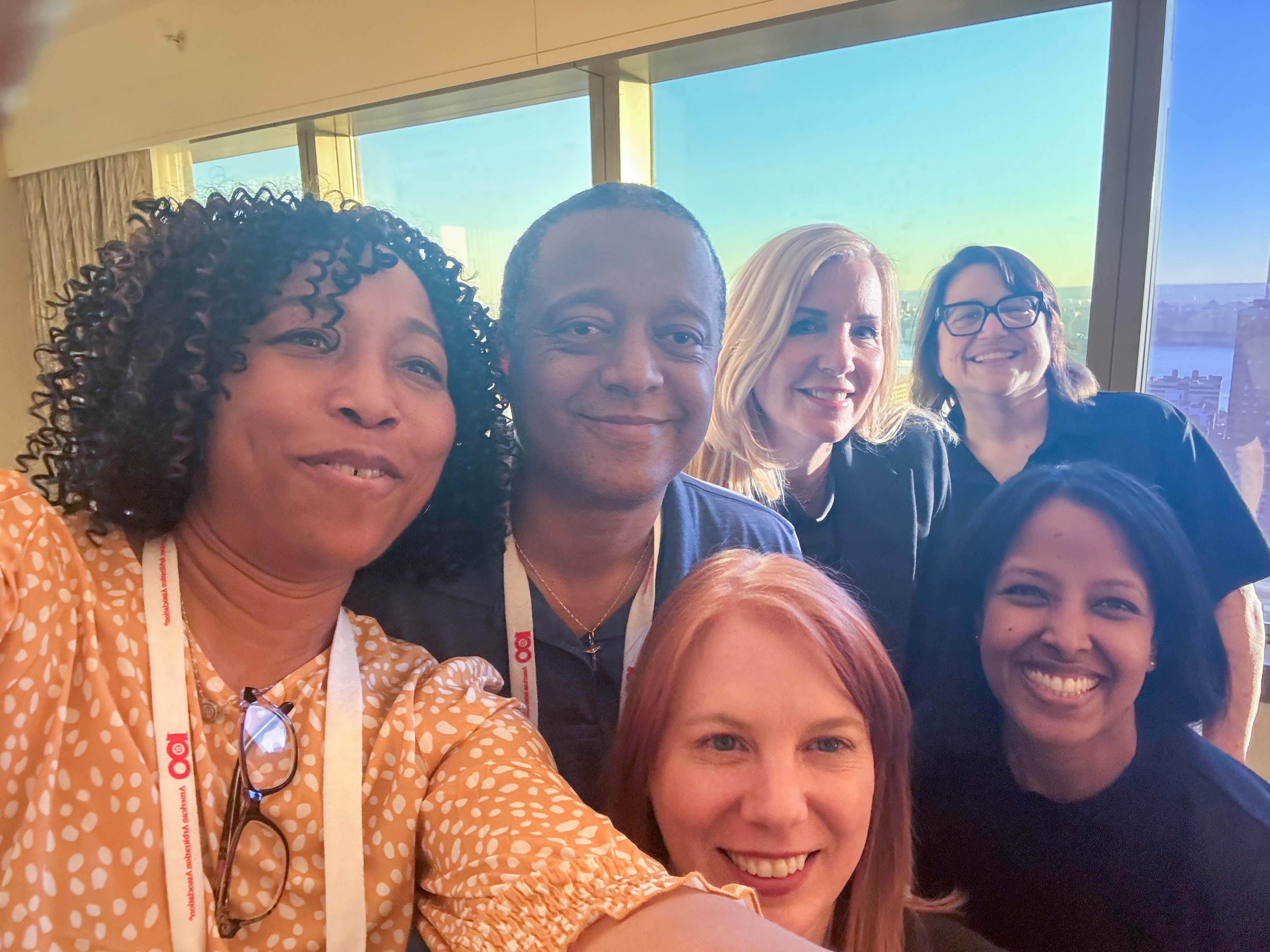
Her own Legalweek dispatch also lingered on meetings. She valued seeing clients she worked with frequently but rarely met in person. The conference was packed with sessions, hallways, impromptu gatherings and the happy disorder of an industry assembling in one place. That detail is small but revealing. Even at an event dominated by AI, Marty's memory returns to the humans who usually appear as names in an inbox or squares on a screen.
The conference gave her both halves of the subject in one week. Onstage and in the exhibit hall, an industry argued about models, workflows and governance. Between those programmed moments, clients and colleagues renewed the relationships that make difficult projects possible. Marty's account gives equal weight to each. The future may arrive through software, but adoption still travels through conversation. A client has to believe the advisor understands the stakes, not merely the feature list.
Her response to AI follows the same pattern as her career. Get close to the actual work. Test what changes. Keep people with judgment in the loop. Explain the result without pretending that novelty has dissolved risk. A Lean Six Sigma vocabulary can sound chilly, yet in Marty's telling, discipline is what makes room for trust. The process is not the opposite of the human relationship. Done well, it protects it.
The advantage of having been there
Marty's rise is easy to summarize as loyalty: more than a decade at one company, followed by a C-suite appointment. That misses the motion inside the tenure. Technical analyst. Project manager. Director of client data services. Corporate communications leader. Sales and marketing operator. Each role changes the view. Staying put can be its own form of travel when the work keeps moving beneath you.
It also gives Marty a rare claim in marketing: she has met the product as a practitioner, the deadline as a project manager and the customer need as an operations problem. She does not have to borrow fluency from the experts down the hall. Her job now is to organize that fluency into a story the market can understand.
Legal technology will supply no shortage of new nouns. Generative AI has already crowded the conference banners. The sturdier questions are verbs. How is the tool used? Who checks it? Where does it fit? What does it save? Marty has built a career around those connective questions, the humble joints between capability and outcome.
Perhaps that is why her sharpest line about the future is not a prediction. It is a standard: technology, disciplined process and expertise, combined. The sentence has no fireworks. It sounds like someone who has seen projects up close and knows fireworks are rarely listed in the statement of work.
In an industry selling speed, Marty's story makes the case for sequence. First learn the machinery. Then listen to the people around it. Only after that do you write the promise. Marketing arrives last in the sentence, but it is stronger for the wait.