Imagine disconnecting a telecom circuit, then seeing it return on the next bill. The network team has closed the job. Finance has an invoice. Somewhere between the two, a perfectly sensible instruction has lost its financial consequence. The circuit has acquired a second life, and this one collects rent.
RazorFlow works in that awkward interval. Its software joins the commercial records of network services: the order that requested them, the inventory that describes them and the charges that arrive afterward. Its proposition is easiest to understand through a modest question. Can the people paying for a connection establish what happened to it?
- ConnectNX handles the order: buying, selling and tracking telecom services across suppliers.
- ExpenseNX checks the money: invoice capture, validation, claims and inventory reconciliation.
- The connection matters: ordered, provisioned and billed records can be compared rather than investigated separately.
- The buyers are operators: the business serves telecom providers, not people shopping for a cheaper mobile plan.
Three records walk into a meeting
In RazorFlow’s account of telecom operations, different departments can maintain accurate records and still disagree. Procurement knows the contract and order. Network operations knows the service. Finance knows the charge. Their systems use different identifiers, update at different times and answer different questions.
Consider that disconnected circuit again. A charge continuing after a change might deserve a dispute. It might also reflect an ordinary billing cycle, a pending supplier confirmation or an update that has reached one system before another. Automatically declaring every mismatch an error would merely automate the argument.
The useful work is tracing the same service across its history. RazorFlow describes matching orders and charges with consistent identifiers and ongoing validation. That gives a reviewer context: when the change occurred, what was requested and whether the bill has caught up. A row on an invoice becomes something a person can investigate.
The order is evidence
ConnectNX manages the buying and selling of network services. The distinction matters because an operator can occupy both sides of a transaction: procuring capacity from one provider while supplying connectivity to another customer. cNX Buy and cNX Sell organize those respective workflows.
The buying product offers a common interface that translates an order into the format a supplier expects. RazorFlow lists LSOG, ASOG, MEF Sonata, APIs and proprietary formats among the supported approaches. It also lists service types ranging from older TDM connectivity to dark fiber, broadband and SD-WAN. This is software for a market where yesterday’s infrastructure and tomorrow’s interface routinely share a desk.
Configurable rules govern the process; integrations connect it to other enterprise systems. The wider suite includes TNPort for pre-port validation and number-porting workflows, and Ticket for electronically bonded carrier trouble reports. Ordering a connection, transferring a number and reporting a fault each require structured exchanges with another organization.
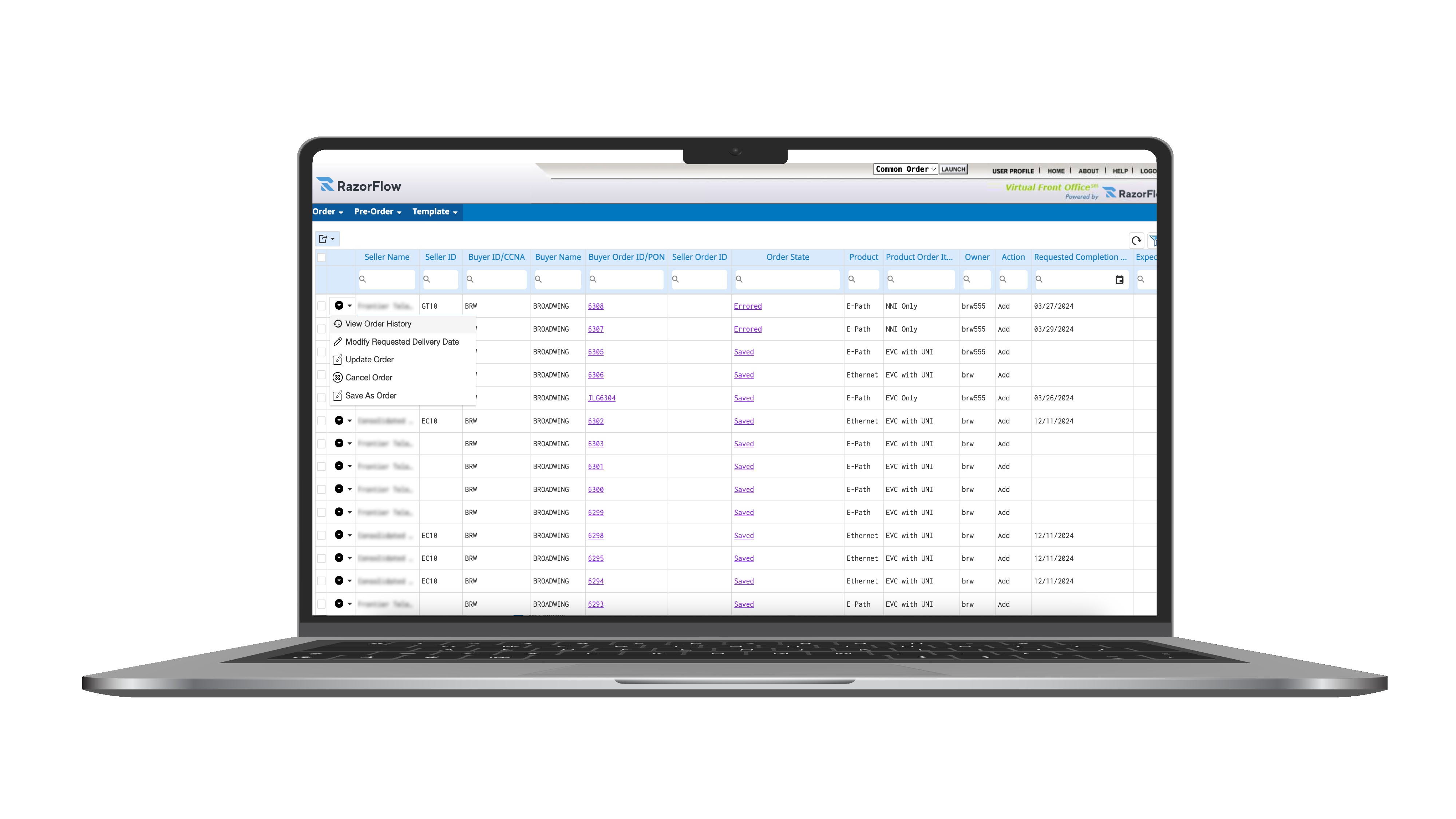
The September 2026 company article on delayed service orders makes the operational problem plain: missing details, unclear ownership and dependencies can stall delivery. A central queue helps teams locate the next action. That is a useful improvement even before any algorithm enters the room.
The invoice gets cross-examined
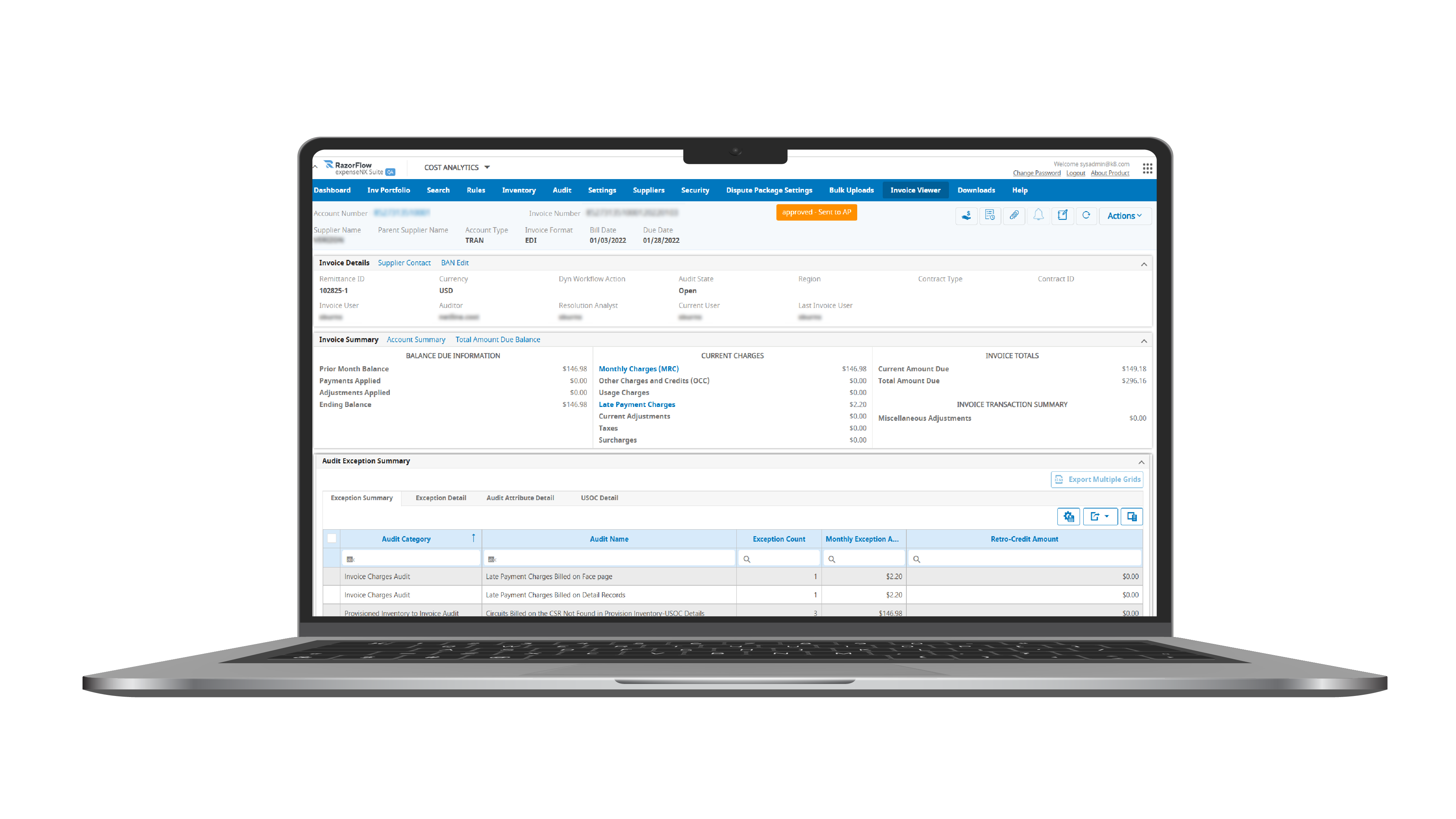
ExpenseNX approaches the same transaction from the financial side. Capture retrieves and converts invoices into structured data, including through robotic access to vendor portals. RazorFlow offers this ingestion product as a managed service, with quality checks and configurable output formats. The first task is making unlike documents comparable.
Invoice and Claims Management then organizes validation, audits, accounting and disputes. Its published capabilities include general-ledger coding, accounts-payable connectors, machine learning for potential disputes and claims reconciliation, and generative AI for recommended dispute outcomes. These are the company’s feature descriptions; they are best understood as tools supporting review rather than promises that every contested charge will be recovered.
The integration with cNX Buy supplies an especially useful piece of evidence: the original order. A charge can be checked against what the operator requested, alongside contract and usage information. That handoff is the heart of RazorFlow’s positioning. Procurement establishes an expectation that finance can later test.
“Making Sense of the Economics of Your Network”RazorFlow’s own description of its work
Inventory Analytics adds another comparison. It brings together provisioned records, billed costs and other data sources, using AI and pattern matching to reconcile circuits. The interface provides match-confidence information and lets users assign batches for further investigation. Uncertainty is part of the workflow: an imperfect match becomes a review task.
A young name with older machinery
RazorFlow’s current corporate story begins with a divestment. Its technology has roots in the late 1990s and early 2000s, but the company says RazorFlow was created after Lumine Group acquired assets from Synchronoss in late 2023. Software age and company age describe different things here.
The October 31, 2023 transaction covered Synchronoss’ Messaging and NetworkX businesses, with announced consideration of up to $41.8 million. That amount covered the combined sale. Treating it as a price tag for RazorFlow alone would give a very precise answer to the wrong question.
Synchronoss explained the sale as a way to sharpen its focus on its cloud business and improve its capital structure. RazorFlow subsequently became a specialist in Lumine’s communications and media software portfolio. The explanation supports a change in corporate focus, rather than a story about a product failing and finding redemption.
The specialist model includes enterprise software and managed and professional services. Buyers arrange customized demonstrations, and the company offers flexible deployment options. The sensible purchasing conversation therefore starts with the operator’s systems, suppliers and workflows, then moves to a commercial proposal.
Large numbers, small handoffs
Scale figures reported by RazorFlow; transaction volume is not company revenue.
RazorFlow says it serves more than 40 operators and partners worldwide. Its homepage displays names including Comcast, Cox, Lumen, TELUS, Colt and Ziply Fiber. Lumine identifies the customer market as telcos, mobile network operators, virtual operators, cable operators and internet service providers.
The company sits in business support systems, specifically the commerce between network providers. There are overlapping alternatives: TEOCO’s SmartCOGS also addresses wholesale telecom costs through software and managed services. An operator can also keep existing ordering tools, supplier portals and internal reconciliation processes. RazorFlow’s distinctive pitch is the link between service procurement and expense validation; the public material does not establish a performance ranking against those alternatives.
One anonymous Tier-1 operator case study advertises a 20-30% reduction in errors and 50% workforce consolidation. Those are vendor-reported results for a particular deployment, rather than a forecast for the next buyer. Their relevance depends on the original fragmentation and the work required to bring systems together.
Before the clever part, agree on the circuit
The company’s 2025 review offers a useful glimpse of priorities. ExpenseNX Cost Analytics moved to a microservices-based platform with an updated interface. Customer feedback was guiding further improvements. Teams also reviewed Capture’s design for future AI capabilities. A plan for an enhancement deserves to remain a plan, even when the domain ends in .ai.
There is a practical lesson anyone managing suppliers can borrow. Identify the records that describe the same purchase. Standardize their identifiers and definitions. Keep checking them as changes occur, and assign someone responsibility for exceptions. RazorFlow sets out those steps in its January 2026 guidance on bringing inventory, spend and orders into one view.
The conditions matter. If records cannot be reliably linked, updates arrive without ownership or exceptions sit untouched, a unified screen will still contain unresolved questions. The payoff comes when someone can follow a service from request to payment and act on what the comparison reveals. For the circuit that keeps collecting rent, that is the beginning of an eviction notice.