Nine years is a long time to wait for a business to grow. At Openserve, Telkom’s wholesale network arm, the wait ended in the financial year to March 2026. Revenue rose 2.3%. In another company, that might earn a shrug. Here, it marked the point at which a fibre business could finally pull ahead of the telephone business it was replacing.
That is the useful way into Telkom. Forget the tidy division between old companies and new technology. This South African group has been selling tomorrow’s connection while maintaining yesterday’s network, carrying the expense of both. The results now look better. The route there involved billions of rand in write-downs, a tower sale and a great deal of unglamorous work.
In its FY2026 results, Telkom reported R44.5 billion in revenue and R3.1 billion in free cash flow. Data supplied 59.8% of revenue. The old telephone company increasingly gets paid for what happens when people stop talking and start streaming, working, shopping or sending files.
COMES FROM DATA
The mix has changed.
The maintenance bill remains.
Year ended 31 March 2026
A monopoly’s unusually crowded second act
Telkom has no garage-founder legend. It emerged in 1991 when South Africa separated its postal and telecommunications operations. It listed on the Johannesburg Stock Exchange in 2003. The government remains a major shareholder: its June 2026 statement put the holding at 40.5%. Commercial performance and national infrastructure policy therefore meet inside the same company.
The mobile history has a pleasing wrinkle. Telkom once owned half of Vodacom, sold that interest in 2009, and launched its own mobile operation, 8ta, in 2010. The newcomer became Telkom Mobile in 2013. Its corporate timeline also records the arrival of fibre to the home in 2012 and the acquisition of BCX in 2015.
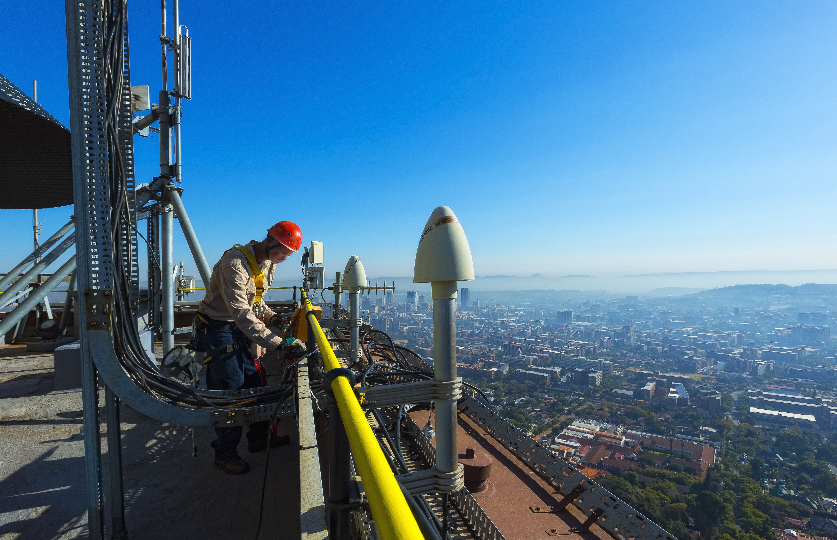
Today, Telkom competes with Vodacom and MTN for mobile customers, and with rain in wireless broadband. Its position is unusual because it also owns the wholesale network business Openserve and enterprise technology provider BCX. A household buying internet from another retail provider may still be sending its traffic through the Telkom group’s infrastructure.
The bill arrived before the recovery
The first thing to weaken was the economic promise of the legacy business. Copper-based services could still produce income, but customers and spending were moving elsewhere. In 2023, S&P described a difficult mismatch: newer services were not yet compensating fully for the decline of high-margin legacy revenue. Power interruptions, inflation and constrained household budgets made the transition harder.
Telkom’s FY2023 impairment was R13.017 billion across Openserve and Consumer. That was an accounting reduction in asset value, not R13 billion leaving the bank that year. The distinction matters. Separately, it recorded R1.065 billion in restructuring costs after a process affecting more than 1,700 employees. The financial report makes those two costs explicit.
There was no single conversion on the road to fibre. Telkom had already launched it years earlier. What changed was the urgency and the valuation of what remained. Its impairment explanation cited economic pressures, technological change and a share price persistently below asset value. Management accelerated migration; the accounts acknowledged that the old assumptions no longer held.
This is the awkward part of infrastructure renewal. The replacement must be built before every customer has left the old system. A company can make the sensible long-term decision and still report painful short-term numbers. Calling the process a digital transformation does not pay for the overlap.
A cable past the gate is only halfway there
Openserve’s business makes that tension measurable. At March 2026, its fibre footprint passed about 1.54 million premises, while 817,540 homes were connected. The reported connectivity rate was 53.1%. “Passed” means the network is within reach; “connected” measures take-up. Those are different achievements, and the second is essential to earning a return on the first.
Reach is potential.
Connection puts it to work.
53.1% connectivity rate • Openserve, FY2026
“Homes passed” is the company’s footprint measure; connections are active take-up.
In FY2026, connections grew 17.7%, faster than the footprint’s 11.6% expansion. Openserve also reported an entry-level symmetrical 30 Mbps prepaid fibre offering and flexible recharge bundles. That is product design aimed at affordability: reaching a street does not ensure its residents can commit to a conventional monthly package.
The wholesale model gives Openserve several ways to sell capacity. Retail internet providers bring their own brands and customer relationships; enterprise and carrier customers have different demands again. Openserve invested R2.719 billion in infrastructure and related programmes during FY2026. Its operating review describes both network expansion and efforts to improve utilisation.
The lesson for other businesses is straightforward: measure adoption alongside distribution. A new branch, delivery area or software feature can look impressive on a map or release note. The harder question is how much of that capacity customers actually use. Telkom’s connected-versus-passed distinction makes a useful habit portable beyond telecoms.
Prepaid is doing the heavy lifting
On mobile, Telkom’s FY2026 subscriber total reached 25.7 million, including 22.6 million prepaid subscriptions. These are subscriber counts, not a census of unique people. The company reported stable prepaid average revenue per user of R60. Small payments, repeated across a large base, are central to this business.
Telkom’s consumer report says its Mo’Nice and Mo’Town customer offers contributed more than half of prepaid service revenue. It also describes targeted acquisition and stronger growth outside metropolitan areas. The practical work is segmentation, distribution and matching an offer to what someone can spend, rather than assuming every customer wants the same monthly contract.
Consumers can buy voice and data bundles, phones on contract, and home broadband. The retail website offers account management through MyTelkom, recharges and coverage checking. For a household, the first useful decision is whether fibre reaches the address or a wireless connection is suitable. For a mobile buyer, bundle validity and where the phone will be used matter alongside the headline allowance.
Telkom launched 5G using Huawei technology in October 2022, initially emphasising fixed wireless access. That provides another route into homes and businesses. Radio performance still depends on coverage, equipment and local conditions. A promising speed on a product page is a starting point for comparison, not a measurement from your living room.
Sell the tower. Keep the connection.
Telkom also changed what it owned. Its disposal of Swiftnet became effective on January 31, 2025, with roughly R6.6 billion in proceeds received in March. The buyer consortium brought together Actis and Royal Bafokeng Holdings. The transaction had been announced with a R6.75 billion base value; that figure and the eventual proceeds should not be used interchangeably.
Swiftnet owned telecoms towers. Selling the company released capital while access arrangements supported continuity for network users. Telkom could reduce financial pressure and concentrate resources on its core operations. This was an asset disposal, not a venture funding round, and its proceeds were not recurring customer revenue.
The decision illustrates a distinction worth copying: owning an asset and needing its service are separate questions. It works only if access remains dependable and the long-term commercial terms make sense. A sale can improve today’s balance sheet while creating obligations tomorrow. The transaction description explicitly addressed continued access for Telkom and other operators.
New money follows
new traffic.
FY2026 asset-addition allocation in financial statement note 5.1. Remaining 7%: property, compliance, shared services and other programmes.
The enterprise business still has homework
BCX takes Telkom beyond the SIM card and broadband router. It provides enterprise IT, managed services, cloud and communications. Its role is to connect technology that organisations already use, keep it operating and help move workloads to new environments. Customers include enterprises and public-sector organisations with requirements more complicated than choosing a home data package.
Its Alibaba Cloud relationship shows the local angle. The companies signed a South African distribution agreement in 2022. BCX’s ALP Cloud offers local hosting, local support and billing in rand. Those details address practical procurement concerns: where data sits, who answers a support call and which currency appears on the invoice. BCX also works with AWS and Microsoft Azure.
But the group’s recovery is uneven. BCX revenue fell 7.6% to R11.412 billion in FY2026, with declining converged communications weighing on the result. Newer capabilities do not instantly replace old contracts. The case for buying services from BCX rests on the fit of its technical expertise, integration work and support, not simply its membership of a recovering telecom group.
“Seamlessly connecting our customers to a better life”
Telkom’s stated corporate purpose
The work after the turnaround headline
Telkom’s workforce disclosures offer a view of the people behind the network: 9,463 permanent employees, R132 million spent on training in FY2026, and a survey identifying both commitment and continuing work and financial stress. Its OneTelkom approach asks business units to cooperate more closely.
The strategy has conditions attached. Affordability must support take-up. Networks need power, maintenance and protection against theft. Enterprise customers must keep spending. Investment has to produce enough cash to finance the next round of upgrades. Openserve itself flags rising energy costs, continuing voice decline and stronger competition as challenges.
Still, nine years gives the modest growth figure its meaning. Telkom has produced evidence that a replacement network can begin to outweigh the business being retired. The next test is familiar to anyone who has ever waited for an installation: get the connection working, keep it working, and make the bill worth paying.
Follow the connection
Shop Telkom & check coverage ↗ Explore BCX ALP Cloud ↗ Telkom Intouch blog ↗ Results & company updates ↗
LinkedIn · X · Instagram · Facebook · YouTube
WATCH / THE CEO’S VIEW60 seconds on FY2026 results: Serame Taukobong ↗From the archive: Taukobong’s 2022 SABC News interview ↗