Rayne Steinberg had spent years helping people invest passively when he announced that he was taking up a sword. The weapon was figurative, the cause was active management, and the declaration appeared in a 2019 essay about cryptocurrency. For someone who had helped build WisdomTree’s ETF business, this was an interesting change of equipment. Low fees and broad baskets of securities had been part of his education. Now he was arguing that a young, uneven market needed investors willing to examine what things were actually worth.
Two years later, Arca, the digital asset firm he co-founded, introduced a passive Bitcoin trust. The apparent reversal becomes more revealing when you look at his explanation: Bitcoin had matured, investors understood it better, and they wanted more control over their allocations. Steinberg was choosing a structure to suit a problem. A career can look inconsistent from a distance and quite practical up close.
The wrapper comes first
His earlier business had given him a reason to think carefully about structure. In the early 2000s, Steinberg worked with Jonathan Steinberg on the ETF business that became WisdomTree. Rayne’s responsibilities included capital raising, intellectual property and distribution. The combination put him on both sides of a demanding exercise: help devise the offering, then persuade somebody else that it deserved a place in a portfolio.
An ETF gives an investment strategy a form that people can buy and sell. That makes the package consequential. WisdomTree developed indexes that weighted companies using fundamentals, offering an alternative to the familiar approach of weighting them by market size. There was intellectual work behind the products, followed by the commercial work of explaining what the distinctions meant.
Steinberg earned a degree in economics at Wharton. But the work at WisdomTree also supplied an education in adoption. A prospective investor could understand a strategy and still have questions about the vehicle carrying it. Fund design and distribution had to meet somewhere. His later move into digital assets would put that meeting under a rather brighter light.
A passive investor picks up a sword
Steinberg left WisdomTree in 2011. His own early experience with Bitcoin exposed a different kind of difficulty. He bought coins, disliked the operational demands of holding them, and sold 150 before the Mt. Gox theft became public in 2014. An attractive idea had come attached to an awkward experience. That gap gave him something to think about beyond the next price move.
Arca was founded in 2018 with Jeff Dorman and Phil Liu as fellow co-founders. Dorman brought the investment perspective; Liu brought the legal perspective. Steinberg’s role combined strategic direction with securities structuring and risk management. The firm’s first offering was an actively managed hedge fund for digital assets.
In his March 2019 argument for active management, he acknowledged his debt to Jack Bogle and the case for inexpensive, diversified investing. He then asked how passive strategies could work well before a market had enough investors doing the work of valuation. Crypto’s uneven information and developing infrastructure changed his answer. Borrowing a useful tool from an older market still required judgment about when to use it.
“This is why I am picking up my active management sword.”
Rayne Steinberg, 2019
A Treasury fund with a different kind of share
Arca’s business developed along two connected paths. Arca Investments managed money. Arca Labs worked on products using blockchain technology. That division matters because investing in digital assets and making an investment product digital are different undertakings. Steinberg’s interest encompassed both.
On July 6, 2020, Arca launched the Arca U.S. Treasury Fund, a registered closed-end fund with digital shares called ArCoin. Each ArCoin represented a share in the fund. The launch specified that 80 percent of portfolio assets would be invested in interest-bearing, short-duration U.S. Treasury securities. Shareholders could transfer the digital shares using blockchain technology.
The underlying investment was deliberately familiar. The experiment concerned the share and its movement. A Treasury security did not acquire a new personality because its fund used a blockchain; the ownership machinery was being reconsidered. For Steinberg, this extended the concern with financial wrappers that had run through the ETF years. It also made his blockchain thesis easier to inspect. You could ask what had changed for the investor rather than simply admire the technology.
The cost of explaining
In January 2021, Steinberg announced a $10 million Series A led by RRE Ventures. The announcement connected expansion with hiring, product development and education. It also described a pipeline with products “two, three and five years out.” In a business so often discussed through daily prices, that was a conspicuously long calendar.
It helps explain the kind of company he was trying to build. A trading strategy and a financial product do not necessarily advance at the same speed. The product needs operational arrangements, a legal structure and a customer who understands what participation involves. A compelling market thesis cannot fill in every one of those boxes.
Arca’s October 2021 update reported that the firm had passed $500 million in assets under management. That was a dated milestone, rather than a number to carry forward indefinitely. The same update emphasized regulatory work, new funds and partnerships. Growth created more work around the investment decisions, including the work of making the offerings legible to institutions. The machinery tends to receive less applause than the milestone. It still has to run.
Arca’s January 2021 Series A, led by RRE Ventures. Company financing, separate from fund assets under management.
Bitcoin gets its own lane
The passive Bitcoin trust arrived in that period of expansion. In March 2021, Steinberg described a client base with increasingly specific views about Bitcoin. Some wanted exposure; others did not. Their allocation decisions varied. Giving them a separate vehicle let them make that choice more directly.
His explanation also dealt with custody and cost. Acquiring and storing Bitcoin could be complicated for institutions that managed money on behalf of others. A convenient vehicle had to address that burden. For Bitcoin, he argued, there was less value to add through active management than in other parts of the digital asset market.
This is the useful connection between the sword and the trust. His 2019 argument was about a developing market. His 2021 product decision was about a particular asset and a more knowledgeable customer. The old lessons from passive investing remained available. He had changed the circumstances in which he thought they applied. An investment philosophy earns its keep when it helps make that distinction; otherwise it risks becoming a rather expensive membership badge.
A taste for history, a suspicion of theater
Steinberg’s public writing regularly reaches outside finance. Newton appears in the active-management essay. Aesop’s ant and grasshopper open his October 2022 discussion of downturns and preparation. The references give his arguments a longer horizon than the market’s immediate commotion.
There is a family precedent. Growing up, he says, the household read a book a week and discussed it over dinner. Saul Steinberg’s admiration for Benjamin Franklin came with a practical lesson: begin with the tasks you least want to do. Even inherited advice, it seems, can arrive with homework.
His writing also shows an interest in how financial narratives acquire authority. In a January 2019 essay, he considered the relationship between market prices, central-bank communication and political power. The claims were his interpretation of the time, but the underlying preoccupation is clear: what happens when a persuasive story starts doing the work that evidence ought to do?
A 2021 comment about Elon Musk’s influence on the Bitcoin debate returned to that concern. Steinberg questioned the habit of letting a famous person’s changing opinions determine the conversation. It is an apt question for a business that needs to explain difficult subjects to investors. Attention gets people into the room. It offers no guarantee about the quality of the discussion once they sit down.
Who gets a say?
His interest in digital assets reaches into governance. In Arca’s Imagine If series, Steinberg considered a hypothetical Amazon organized as a decentralized autonomous organization. The proposition was a thought experiment about company structure, not a report of something Amazon had done. Its scale made his ambition visible: blockchain could alter participation and decision-making as well as the transfer of value.
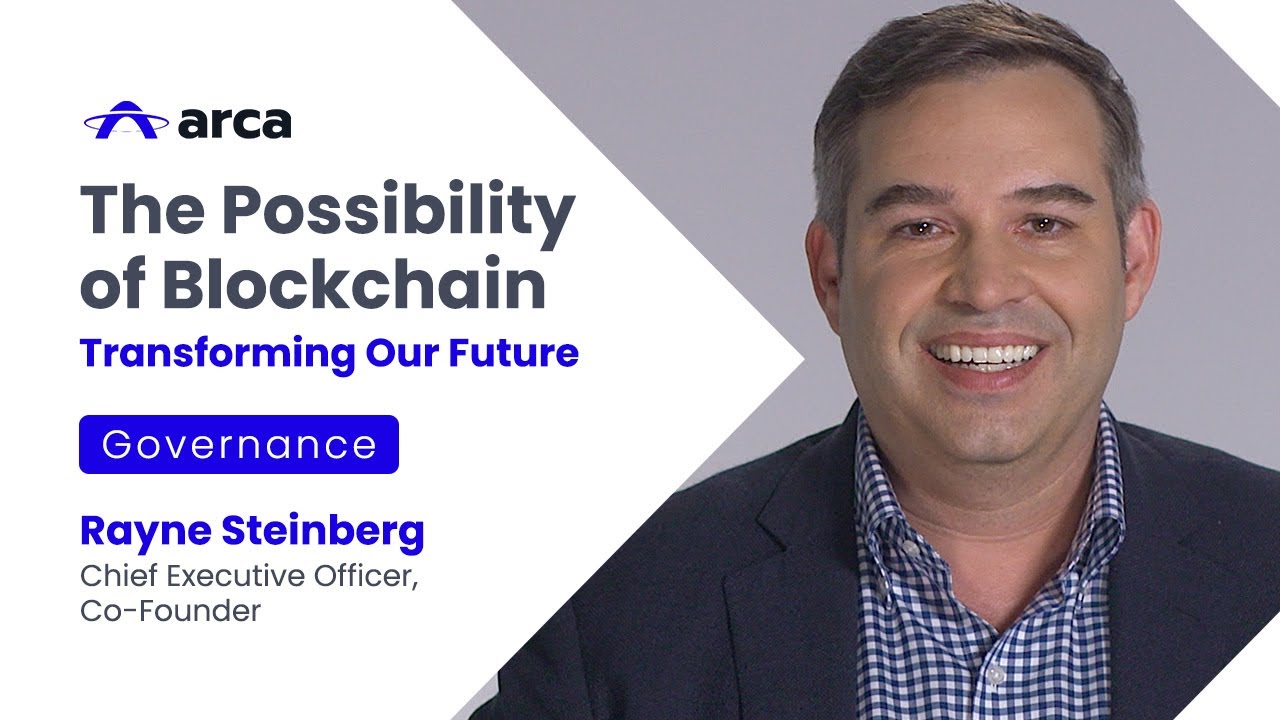 Watch the thought experiment ↗
In November 2024, Arca and BlockTower announced a letter of intent for an all-equity merger. BlockTower’s venture capital business would remain independent under the proposed arrangement. Steinberg framed the combination around broader investment options and the resources needed to provide them.
Discussing the proposal, he also spoke about productive uses for tokens and the possibility of activist investors improving governance. It was a continuation of the same interest: a token’s design affects what holders can do and what they can reasonably expect. The announcement established the intended transaction. The ambition it expressed was to bring more capabilities together for sophisticated investors.
The next room
His work now also includes public-company board responsibilities. Steinberg joined Willow Lane’s board in November 2024 and became an independent director of Willow Lane II in February 2026. Boost Run’s investor-relations biography lists him as an independent director and an audit committee member.
Those roles sit alongside his continuing leadership of Arca. They extend a career spent around the design, management and oversight of financial businesses. The recurring question is practical enough to survive a change in technology: how does an idea become an arrangement that other people can understand, use and assess?
Steinberg’s answers have included indexes, active funds, a passive trust and digital shares. Each choice carries a different account of what the investor needs. That is what gives the story its interest. A good idea may begin with a white paper or an elegant model. Eventually, somebody has to make it work for the person on the other side of the desk.