Ram Hari went to a restaurant-supply company in Columbus, Ohio, for a temporary programming job. The trial was supposed to last two months. He stayed fourteen years. There are shorter ways to discover whether an employer likes your work, but this one gave him something valuable: time to learn what a business asks of its software after the installation party is over.
He would eventually build SrinSoft, a group whose interests stretch from enterprise applications to engineering design and artificial intelligence. The recurring business problem is wonderfully unglamorous. A company has useful systems. Its employees need those systems to do something new. Somewhere between the two, information gets stranded.
In September 2026, that problem produced a visible milestone. Autodesk completed an acquisition of selected technology and intellectual property from BIMDeX, SrinSoft’s interoperability business. Some BIMDeX engineers joined Autodesk. The work involved helping design data travel across applications without losing the meaning that made it useful.
A drawing, it turns out, can have quite a demanding itinerary.
A two-month audition, a fourteen-year education
Hari’s early career belonged to the era when the year 2000 was a programming assignment. He began working in 1995, took on RPG and AS/400 projects, and moved from India to the United States in 1996. Banking systems and business applications offered an education in the consequences of small technical details.
At Wasserstrom, the Columbus restaurant-supply business, the temporary programmer progressed into technology leadership. “I was with them for 14 years,” he recalled. He also began SrinSoft alongside his employment there. Wasserstrom later became a customer, asking for an offshore team rather than building that operation itself.
That sequence gives the founding story its particular texture. His experience as an employee became relevant to a business relationship. The systems, the workload and the people requesting help were already familiar. Entrepreneurship arrived with an understanding of the customer’s working day.
His education crossed institutional boundaries too: Annamalai University and an Executive MBA at Ohio State’s Fisher College of Business. Technical training and business training appear side by side in his career. The combination suits a field where a technically elegant answer still has to make sense to the organization paying for it.
His LinkedIn profile lists four languages: English, Hindi, Tamil and Telugu. It also records an IEEE presidency during his time at Annamalai University. These are small details beside the company milestones, but they put a person back into a story crowded with application names. Before the group, the partnerships and the connector portfolio, there was a student taking part in an engineering community.
Three people, two kinds of engineering
SrinSoft began in 2005 with three people, an Ohio headquarters and a development center in Chennai. In 2006, the business established an IBM iSeries center of excellence and began engineering design services. The pairing is worth pausing over. Business transactions and engineering drawings usually live in different conversations. Hari’s company put both on the agenda early.
Ohio + Chennai.
interoperability tool.
technology joins Autodesk.
The company’s next steps included application development, engineering automation, testing and cloud services. It released its first interoperability tool in 2013 and established BIMDeX products in 2016. Those dates give the engineering business a history longer than the latest enthusiasm for AI.
The practical connection is easier to see than the list of services suggests. In each case, the customer has accumulated something valuable: operating rules in an application, geometry in a model, knowledge in a workflow. Changing tools should let that work continue. Recreating it by hand is an expensive form of nostalgia.
Hari now leads the SrinSoft group across IT, engineering, BIMDeX and Heliosz.AI. The range follows the different places where enterprises need help making existing information useful again. His work has expanded across those places while retaining an interest in the connections between them.
The drawing has to survive the journey
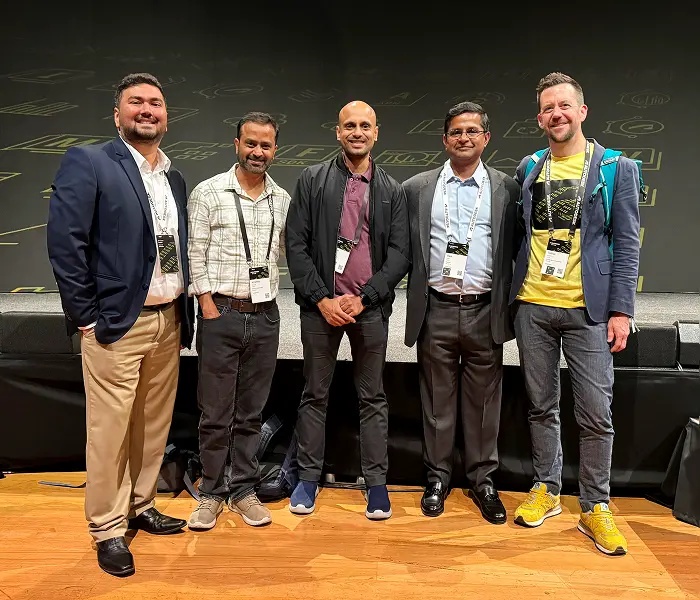
In his 2025 Autodesk University presentation, Hari described experience in both engineering and computing as a reason for starting the group. He presented alongside Srinivasan Venkatakrishnan, the engineering leader who heads the product-development work behind BIMDeX.
Their subject was native interoperability. Behind the phrase lies a familiar frustration: one person creates information in a specialized tool; the next person needs to use it somewhere else. A model that looks right on arrival may still be awkward to edit or poor at conveying the original design decisions.
Consider the distinction between receiving a picture of an object and receiving information you can work with. Both can look convincing on a screen. Only one may give the next engineer the structure and properties needed to continue the job. That distinction explains why moving a file and transferring useful engineering knowledge can be very different accomplishments.
BIMDeX works in the territory between computer-aided design and building information modeling. The challenge is to let people collaborate across tools while preserving useful design information. Hari’s business sits in the middle of that exchange, where differences between applications become somebody’s daily workload.
A partnership measured in working connectors
In October 2024, Autodesk announced a partnership with SrinSoft around BIMDeX, Data Exchange and Autodesk Platform Services. Its purpose involved sharing engineering information across applications and organizations. The collaboration included permission-controlled exchanges of selected model data rather than requiring every recipient to receive every file.
That is a useful distinction for a founder selling connections. Sharing more information does not automatically make collaboration better. People need the relevant part, in a form they can use, with a way to keep it current. The engineering problem includes judgment about what should cross the boundary.
By May 2025, the collaboration had progressed through technical work connecting Plant 3D, Tekla Structures and Revit to the Data Exchange ecosystem. The announcement coincided with DevCon in Amsterdam. A partnership was becoming a set of specific routes through which customer data could move.
The conference setting fits Hari’s public working life. He appears on event team lists with engineering colleagues, including the BIMDeX team listed for Amsterdam’s 2026 DevCon. The subject at these gatherings is specialized, but the reason for attending is straightforward: meet the people whose work exposes the next problem.
Then came the August 2026 agreement and the September close. Autodesk acquired selected technology assets and IP and brought over a subset of the team. The transaction placed some of the engineering developed within Hari’s group inside the platform company with which it had already been collaborating.
Hari has also described a less visible part of this business: teaching new recruits the systems their customers still use. Developers arriving with newer programming languages needed instruction in IBM i and its database. SrinSoft built training capacity around that gap. It is a revealing operational detail. A company can have customers ready to modernize and still need to prepare the people who will do the work. Hiring and education become part of delivering the technical answer.
The customer still needs an answer
Hari’s announcement to BIMDeX customers had a celebratory subject and a practical center. Existing contracts, relationships and support would remain with SrinSoft. At the agreement stage, he reassured customers that “nothing changes today.” The later closing update confirmed where those responsibilities would sit.
“Enterprise modernization is rarely a clean-slate exercise.”
Ram Hari, February 2026
The same practical concern appears in SrinSoft’s February 2026 announcement of its Microsoft Solutions Partner for Business Applications designation. Hari described modernization as work inside an existing environment. Customers have established infrastructure, and improvements must fit the operations that depend on it.
There is a certain discipline in that view. A new tool cannot excuse a broken working day. The commercial promise has to include what happens to the business while the technology changes.
His CData Foundations 2024 appearance with technical lead Devendra Bhatt addressed another version of the same concern: ERP integration and electronic data interchange. The session paired SrinSoft’s implementation experience with CData’s self-managed EDI platform, considering control, costs and support.
Here the information is a business exchange rather than a design model. Yet the service requires understanding both the software and the organization using it. The person buying an integration wants it to work reliably after the demonstration ends. That mundane requirement is a substantial business opportunity.
What comes after the connection
Hari’s published outlook for 2025 considered digital twins, smart manufacturing, BIM adoption and AI in construction. He anticipated wider use of virtual representations of physical systems to simulate operations and examine problems. These were forecasts about where the work could go.
Heliosz.AI brings data engineering and applied AI into the group’s portfolio, including work for consumer-goods and retail businesses. The prospect of better decisions depends on the underlying information being accessible and usable. That requirement keeps the less glamorous integration work close to the newer ambitions.
In his New Year message for 2026, Hari emphasized the effects of technology: quicker innovation, better decisions and different ways to serve customers. The emphasis offers a useful measure for the next chapter. A system’s value becomes clearer when somebody can accomplish something with it.
His career began with software facing a calendar deadline. It has since moved through enterprise applications, engineering models and connected data. The recurring task is to help valuable work survive a change of environment. Somewhere, another application is waiting to receive it. Hari has made a business of helping it arrive ready for use.