Rajnish Kumar was accustomed to modest city driving. Then came a day with 600 kilometres of road, seven hours behind the wheel and, for roughly half the drive, torrential rain. He and two colleagues had gone to a remote palm oil mill near Ipoh to sign up workers for Instapay. A financial services career had acquired a rather literal field trip.
The workers he met were mostly from Nepal and Bangladesh. Some were receiving a payment card for the first time. Sending money home through an app offered an alternative to travelling 15 kilometres to the nearest city. Kumar recalled the pleasure of talking with them and understanding their difficulties. In his telling, the weather lost its claim to be the day’s main event.
The visit gives his business a human scale. A salary can arrive on time and still leave its recipient with errands to run before it becomes useful. Distance sits between the worker and the service. Rajnish Kumar, co-founder and CEO of Instapay Technologies, has made those everyday arrangements the subject of his next career chapter.
Two different journeys in his account. One shared question: how does a useful service reach its customer?
From portfolios to payroll
Kumar arrived at entrepreneurship with years inside financial institutions. His earlier work included HSBC and Standard Chartered. He joined Fullerton Securities in 2008 as a founding member, and in April 2012 became chief executive of its Indian securities and wealth advisory business. Before the promotion, his responsibilities had included equity research, customer services and product management.
Those are jobs that bring together the product and the person buying it. They also put an executive close to the less theatrical parts of finance: how a service is sold, how questions are answered, how an operation handles the demands placed upon it. A promising idea must survive all three.
His education includes engineering at the National Institute of Technology, Jamshedpur, and management studies at the Indian Institute of Management, Lucknow, from 1992 to 1994. He is also a CFA charterholder. A later role at Dunia Finance placed him in charge of the affluent segment. His move into migrant-worker finance brought that experience to customers facing a different set of obstacles.
Kumar began his role as Instapay’s co-founder and CEO in December 2017. The company dates its Malaysian market operations to 2019. The distinction matters: putting a financial business together and putting it into customers’ hands are separate stages. Between them sit the operating arrangements that make a product usable.
The employer holds the first key
Instapay’s entry point is payday. Employers can send salaries to workers’ digital accounts, with a linked Mastercard and an app providing ways to use the balance. The model gives Kumar two audiences to persuade. A worker needs access to money. An employer needs a workable way to pay a workforce.
He made the employer’s side concrete with an example from a janitorial services company. Delivering cash salaries to employees across office buildings had cost it nearly RM25 per employee. That figure was a particular company’s experience, described in 2020. It captures the kind of problem his payroll approach addresses: even handing over wages has a logistics bill.
For workers, he identified barriers including language, unfamiliarity with conventional banking and difficulty reaching a branch. These are practical restrictions on an ordinary activity. The person has earned the salary. The next challenge is getting access to services that make it possible to spend, withdraw or send that salary.
- EmployerDisburses wages digitally
- Salary accountReceives the worker’s pay
- WorkerPays, withdraws or remits
A simplified view of Instapay’s model. Each step has to work for the next one to matter.
Instapay subsequently added a corporate portal for paying and tracking salaries, with controls for employees, locations and approvers. Kumar thanked corporate customers for their feedback on the product. The portal belongs in his story because the app’s usefulness begins upstream, in the employer’s decision to change its payroll routine.
An account has to reach its owner
The palm oil mill visit also points to a problem that software alone cannot wish away. An account must be opened before it can receive anything. The early operation included teams visiting workplaces to complete employee checks. Kumar’s drive was part of that work, rather than a decorative excursion attached to a finished product.
Instapay later selected identity-verification provider Onfido to support digital onboarding. Kumar connected the decision to customers working long shifts and in remote locations. Letting them complete documentation at a convenient time addressed a specific obstacle. A process can be technically available yet awkward to fit into a working day.
Language received similar attention. The service launched with a multilingual app, and Kumar described a multilingual call centre alongside it. A translated screen and a person who can answer a question perform different jobs. The first helps someone navigate. The second gives them somewhere to turn when navigation becomes a little more interesting than intended.
His public writing has ranged across sales productivity, corporate training and communication in financial services. These interests fit the operational questions around Instapay. How do people understand a service? How does a team deliver it? A payment product needs answers that remain useful after the presentation has ended.
The money needs a way home
For a migrant worker, a salary account is also the beginning of a cross-border journey. Instapay announced its Mastercard relationship in July 2020, pairing wallet accounts with cards. An October partnership with IME Ria added remittance delivery channels. The arrangement described access to a network reaching 160 countries through the app.
That number referred to the partner network described at the time. The personal significance lies in the connection: wages received in one country can be sent toward people in another. The customer’s financial life already crosses a border, whether or not their salary provider is organized to help it do so.
Kumar’s subsequent partnerships continued the same work. Instapay announced a collaboration with Mastercard Move to strengthen cross-border payments. Different partners supply different parts of the service, from the card in a worker’s hand to the arrangements carrying money onward. Building relationships is part of building the product.
There is an operating side behind the screen, too. In discussing Alibaba Cloud, Kumar emphasized cybersecurity, data sovereignty and the capacity to handle busy transaction periods. The vocabulary is less photogenic than a new card. Yet payroll services have to keep working when customers need to use them. Reliability has very little appetite for an elegant excuse.
Growth, with working capital attached
Instapay raised a $4.75 million Series A in 2022. In June 2025 it announced a further $3 million Series A2, led by U.S.-based family offices with participation from existing investor ACA Investments. Kumar’s explanation concentrated on working capital and the needs of a growing remittance business.
“We are a profitable and cash flow positive company.”
Rajnish Kumar, on Instapay’s Series A2 financing
His statement placed additional funding alongside profitability. The capital would help the company expand faster, including planned B2B remittance within its Glyd corporate expense management platform. Glyd had launched in October 2022, powered by Instapay and using NymCard’s card platform. It extended the company’s work into business expenses.
The financing gives a useful view of Kumar as an operator. Working capital is a plain phrase for a consequential requirement. A company can see demand for its services and still need funds to support the business as it grows. His account of the round focused on that requirement and the products it would support.
Recognition followed. On October 23, 2025, Instapay announced its inclusion in CB Insights’ Fintech 100. The selection was a company achievement, alongside the team’s continuing work on payroll and payments. For a founder, such milestones give the outside world a convenient date to notice progress that has accumulated over years.
Cash makes a return appearance
In July 2026, Kumar’s company signed a memorandum of understanding with Reachful Malaysia. The parties proposed connecting Instapay wallets with Reachful’s cash recycling machines, allowing cash deposits and cardless withdrawals. The agreement set out a collaboration to explore. Its signing should be read as that stage of the work.
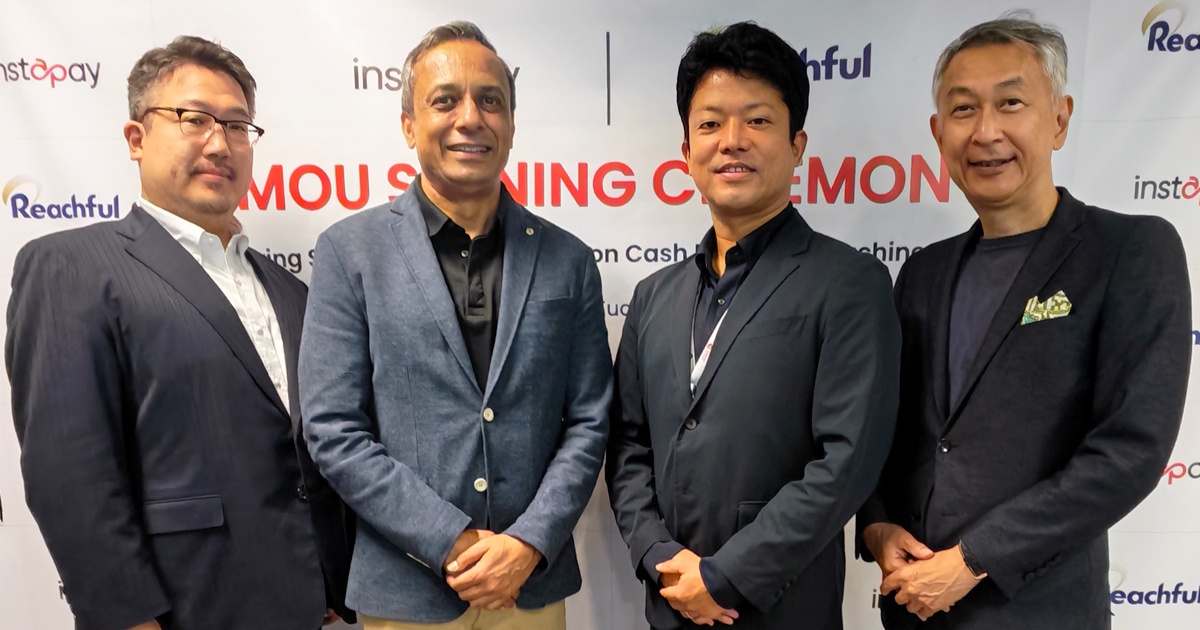
The proposal is consistent with his customer focus. A digital wallet becomes more useful when people can move between it and the cash they encounter in daily life. Designing for that movement accepts the customer’s existing circumstances. No one receives a salary in the abstract; it arrives amid bills, purchases and familiar ways of paying.
The ceremony included Seven Bank president and representative director Masaaki Matsuhashi. Reachful’s chief executive, Jin Sudo, described the potential for more accessible cash services. Kumar’s part in the agreement again involved connecting organizations around a practical customer need. The physical access point still has a role beside the phone.
A familiar problem in another country
Kuala Lumpur remains Instapay’s headquarters. In December 2024, the company announced a partnership with Commercial Bank International for migrant-worker banking and payroll services in the UAE. Kumar welcomed the prospect of spending more time in Dubai, a place he described as a second home.
Japan is another developing chapter. Instapay Japan was incorporated on April 27, 2026, with Kumar named representative director. Its stated remit includes developing partnerships and digital financial infrastructure for foreign workers. Incorporation establishes a company; the local service still requires the detailed work of development and collaboration.
Those plans take the business into different markets while keeping the same customer focus. Country by country, the arrangements change. The question connecting them is recognizable: how can a worker receive money, use it and send it onward with less difficulty?
Kumar’s long drive near Ipoh offers an apt place to leave him. He had gone to open accounts and returned with a story about the people using them. The details were ordinary enough: rain, road, conversation, a payment card. Together they explain why the distance between payday and home has occupied so much of his working life.