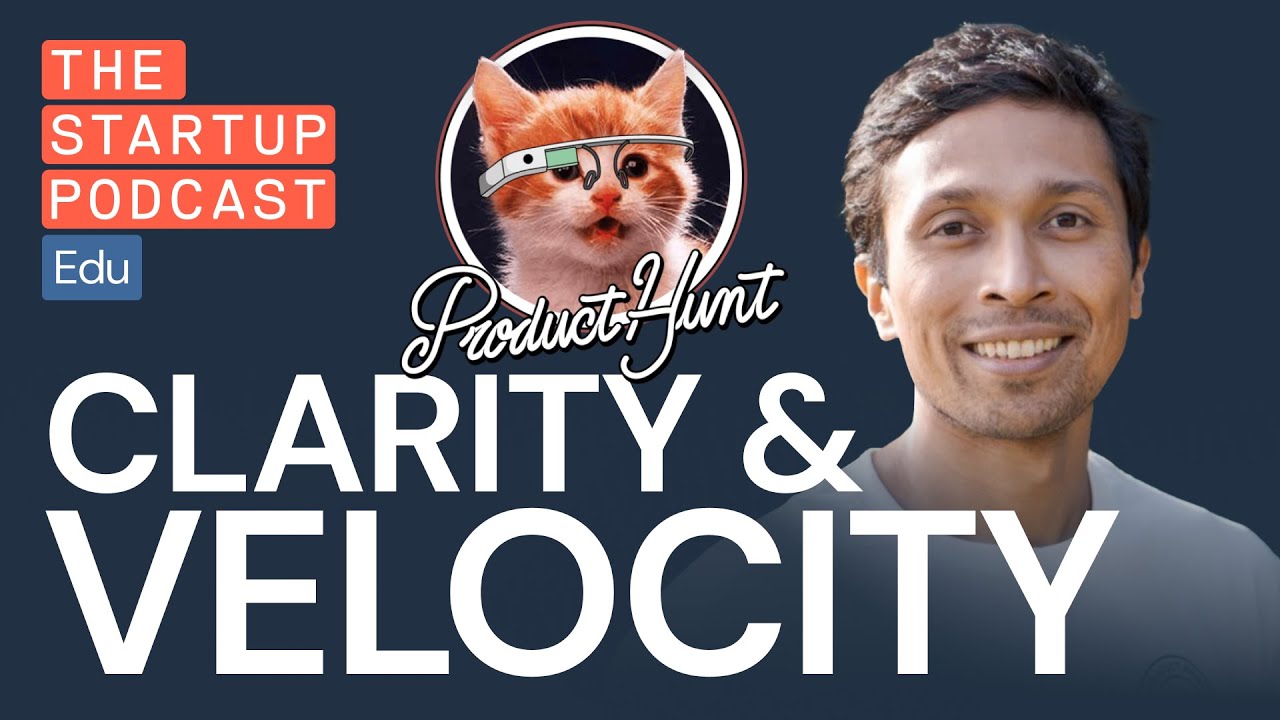
The first Product Hunt pitch Rajiv Ayyangar ever received happened on a bus. It was 2014, and he was commuting on the Yahoo shuttle with his friend Bernat Fortet when Fortet spun a laptop around. On the screen sat a new daily email: a list of interesting products, crowned by the absurdly memorable image of a cat wearing Google Glass. Fortet’s review was brisk and profane. The list, he told Rajiv, was brilliant.
The moment stuck because it made the act of making feel social. Here was a place where a half-formed product could meet curious strangers before it had earned a sales team, a famous founder, or even the right to look inevitable. A few months later, Ayyangar left Yahoo for a startup and launched a social wine app on the platform. More experiments followed. Years later, after a founder’s tour through crypto, personal finance, remote work, fundraising, and an unusually thoughtful wind-down, Product Hunt founder Ryan Hoover arrived in Ayyangar’s messages with a proposal: “I have a crazy idea.” Would he be interested in taking over as CEO?
There are tidy careers, and there are careers that return you to the scene of your first useful obsession. Ayyangar’s belongs to the second kind. He has called it wandering through a forest. The description fits, with one qualification: he leaves trail markers.
01 / Before the leaderboardA useful education in changing direction
Ayyangar graduated from Princeton in 2009 after studying chemical engineering, bioengineering, and technology entrepreneurship. The early résumé moves from operational work at Fairchild Semiconductor to data science at Aviate and Yahoo, then toward product roles at Delectable and Yakit. It looks eclectic on paper: semiconductors, mobile discovery, wine, speech. In practice, it gave him repeated exposure to the awkward seam where technology meets an ordinary human habit.
Wine supplied one of the more charming detours. Ayyangar worked on Delectable and launched Banquet, a mobile wine shop. He also passed the Certified Sommelier exam. This is useful biographical evidence, not because product strategy resembles a tasting note, but because both reward attention. You have to notice what is actually present, then find language clear enough to make the observation useful to someone else.
Climbing sharpened a similar instinct. In a 2013 essay, Ayyangar described working one route for more than 30 days, slowly joining difficult moves into longer sequences. He liked climbing because it made him hyper-aware: texture, balance, momentum, the extra fraction of a second needed to place a hand correctly. The startup version of that practice would become familiar later. Make an attempt. Observe where it breaks. Adjust one thing. Return to the wall.
“The feedback they give is like oxygen.”Rajiv Ayyangar on early Product Hunt users
02 / The idea mazeThree friends, several products, one honest metric
At Yahoo, Ayyangar, Fortet, and Tim Su became friends. They began meeting to trade startup ideas, then started building together. In 2017, their crypto portfolio tracker, Cryptagon, caught attention quickly. That early response supplied enough conviction to form a company. It did not supply a permanent idea.
The trio moved from crypto tracking toward an exchange, then into personal finance. They interviewed users and explored ways to make financial decisions feel less overwhelming. Yet people did not consistently use what the team made, and the founders could not find a convincing path to revenue. Rather than manufacture optimism, they watched their own rate of discovery.
The weekly learning loop
Traction mattered. So did the speed at which uncertainty was becoming knowledge.
Each week, they rated learning as low, medium, or high and wrote down why. The measure was subjective, which was part of its usefulness. It forced a conversation about whether activity was producing new understanding. A couple of low-learning weeks in a row often meant the team had stopped making progress. The point was not to worship velocity. It was to prevent busyness from dressing up as evidence.
Then family life changed the founders’ working pattern. The births of Fortet’s and Su’s children pushed the trio into remote work. The connection they had enjoyed in person became sluggish. Their early responses were delightfully overbuilt: a Discord configuration called Round Table, a walkie-talkie, an answering machine for voice messages, and a collaborative document editor with video attached. Users disliked some features and played with others. The shared cursors were fun. The sense of presence mattered. The complexity did not.
They stripped away brittle documents and a browser extension. Signup conversion quadrupled. At Y Combinator, repeated questions about what they were building forced a plain answer: a virtual office for remote teams, where people could see who was around and talk in one click. The sentence did more than market the product. It exposed the product’s center.
If the promise becomes shorter, the product may need to become simpler too.
03 / Promise meets marketThe exhilarating danger of being early and right
Tandem reached number one on Product Hunt in 2019. Hacker News sent teams. A public endorsement from Stripe co-founder Patrick Collison brought enough traffic to crash the app. Fundraising turned surreal: seven term sheets in ten days, a blue tandem bicycle sent as a gift, and a $7.5 million seed round led by Andreessen Horowitz. Ayyangar’s father supplied the best counterweight to the celebration: “Congratulations! Now the work really begins.”
When the pandemic arrived, Tandem’s timing looked uncanny. Usage leapt 30 times within weeks. On one day, active users doubled. Thousands of companies installed the app, and the young team met the demand with outages, failed calls, and a wall of complaints. Ayyangar later borrowed a useful phrase for the experience: what looked like product-market fit also felt like getting punched in the face repeatedly.
The company improved. It rebuilt call infrastructure, refined the interface, raised three-month retention by 2.5 times, and logged more than three million call hours. Half of those calls lasted less than 15 minutes, evidence that Tandem could create the quick, informal exchanges it promised. Then demand flattened. Slack introduced Huddles. People tired of video. Some teams returned to offices. Others chose remote work partly for the autonomy that a persistent virtual office gently complicated.
04 / The difficult editPreserving a product without preserving the fantasy
Tandem tried growth experiments, direct sales, and a bold hardware pivot that imagined remote colleagues moving through a physical office. The market did not follow. The founding team reached the end of its runway and, more quietly, the end of its shared appetite to begin again from zero.
This is where Ayyangar’s story becomes more useful than the common founder fable. Tandem had built something real. Hundreds of companies valued it. The market was simply smaller than a venture outcome required. He did not pretend the distinction was painless. He described feeling that when the world did not want Tandem, it did not want him. He also examined his own habits, including the defensive desire to be right, and the value of replacing that armor with curiosity.
The team considered selling. Offers would likely have shut down the product and stranded customers, so the founders chose a less theatrical exit. They created a separate LLC and gave it to two team members, Akash and Billy, to operate as a small business. Tandem continued serving customers. In Ayyangar’s ordering of obligations, the priority was team, then customers, then investors. It is difficult to put that hierarchy on a victory banner. It is easier to recognize it as stewardship.
After Tandem, Ayyangar became an entrepreneur in residence at Dropbox and worked with Vikrum Nijjar, Sam Odio, and Drew Houston on productivity and calendar ideas. The period was another walk through the forest. Then Hoover’s message arrived.
05 / Back to the launch pageRunning the room that once let him in
Ayyangar became Product Hunt’s CEO in September 2023. The appointment made biographical sense without being predictable. He knew the site as a maker who had used it repeatedly, not as a spectator admiring a leaderboard. Product Hunt had introduced his products to demanding early users. It had also shown him how fast a clear promise could travel.
His challenge is larger than keeping a daily ranking lively. Software has become easier to produce, especially as AI lowers the cost of prototypes. Attention has not become easier to earn. More products arrive, often wrapped in nearly identical language, while users still need a way to decide which one deserves an afternoon. Ayyangar has argued for Product Hunt as both launch platform and durable discovery layer: a community where product pages can accumulate advice, comparisons, and knowledge after launch day.
His practical advice to makers begins with clarity. Write a short tagline that states a specific outcome. Make a straightforward demo instead of a brand film. Bring a real community, remain present in the comments, and treat the launch as a live series of user interviews. Launch again when the product has changed enough to ask a better question. The method sounds modest because it has been cleaned of theater.
Clarity and velocity reinforce each other. A simple promise makes feedback easier to interpret. Faster iterations create more chances to test the promise. Public launches produce the social pressure needed to finish, plus the surprise of discovering who cares. The loop does not guarantee a large company. Tandem is proof that honest signals can still be ambiguous. It does, however, give a builder more reality per unit of time.
“For a builder, those early Product Hunt users are essential.”Rajiv Ayyangar
06 / The next tideBuild a hull worth lifting
In August 2026, Ayyangar proposed a new test for AI products: buoyancy. Some software improves automatically when its underlying model improves. Other software is loaded with scaffolding built to compensate for weaknesses the next model may erase. A buoyant product keeps a durable hull - context, data, users, distribution - and lets improving intelligence lift it.
The idea describes more than architecture. Ayyangar’s own career has accumulated a hull: engineering discipline, product taste, close observation, a sommelier’s vocabulary for distinctions, a climber’s patience with repeated attempts, and a founder’s memory of what market signals feel like before and after the applause. New tools can raise the water. Those assets keep the work distinct.
The cat in Google Glass has long since surrendered the front page to newer curiosities. The essential exchange remains. Someone makes a strange thing. Someone else turns a screen around and says: look at this. Ayyangar now runs the room where that exchange happens. His path there offers a clean invitation to builders: keep launching, keep noticing, and let the next attempt be informed by everything the last one refused to become.