Hudson Liao's first office had a fire pole downstairs. At UC Davis, he joined the student firefighting program and lived in the dorm-like quarters above the campus station. Housing came free in exchange for shifts. The arrangement delivered roommates, responsibility and a career opening he had not carefully diagrammed in advance. After graduating, he spent a season with Cal Fire in Mendocino County. Then he did what any sensible young firefighter with degrees in economics and sociology might do: he went into finance.
From a distance, the career looks like somebody clicked shuffle. Fire service gave way to wealth management and private-equity investing, which gave way to fintech, then biotech, then SaaS and consumer technology. Liao sees a cleaner line. Each field asked him to process incomplete information, find a usable framework and make a decision while conditions were still moving. The scenery changed. The habit survived.
Today he is the CEO and co-founder of The Hog, a San Francisco company in Y Combinator's Fall 2025 batch. The name is less barnyard than job title: HOG stands for Head of Growth, a role Liao held repeatedly across nearly 15 years. He says he was the first growth and marketing hire at five startups. The product began as a bracingly literal founder exercise. He tried to automate himself.
01 · Useful zigzagsThe firehouse and the spreadsheet
Finance was not an accidental detour. Liao interned around real estate and financial firms in college, then learned to evaluate businesses for investment. Looking at private companies pulled him toward questions that a balance sheet could not answer alone: Does this solve a real problem? Does the team know how to sell it? Is there a market hiding behind the product? He earned the CFA designation, but became more interested in building companies than selecting them.
A friend connected him to the world around IndieBio, the San Francisco biotech accelerator. The scientists he met could spend formidable hours in a lab and still resist the phone call required to explain their work to a customer or partner. Liao was not the scientist. He could make the call. In that division of labor, he found his side of the startup table.
He began building go-to-market playbooks, finding users and translating technical ambition into a reason for somebody else to care. Growth was not yet the tidy job label it later became. The work sprawled across business development, marketing, sales and the many awkward tasks between them. The sprawl suited him. A recommendation on his LinkedIn profile from former colleague Alex Mehr describes Liao taking charge amid shifting ad platforms, customer demands, creative briefs and recruiting. Another former colleague remembers him as upbeat and positive. The picture is of someone comfortable when the neat org chart has not arrived yet.
02 · A different kind of launchThe morning after the drinks
Liao's most public work before The Hog began with a night of frustration. On March 17, 2021, he and friends met for drinks as reports of anti-Asian attacks accumulated around the country and in San Francisco. They talked about fear, anger and the temptation to feel powerless. The next day they started planning. Asians Are Strong grew from that decision.
The organization's early premise was plain: physical safety creates the footing for confidence, participation and collective action. It offered free self-defense instruction, bystander education and public rallies. Liao, worried about his mother going out alone, framed personal safety as the beginning of a longer effort against anti-Asian racism and stereotypes. The ambition was enormous. The first action could still be concrete.
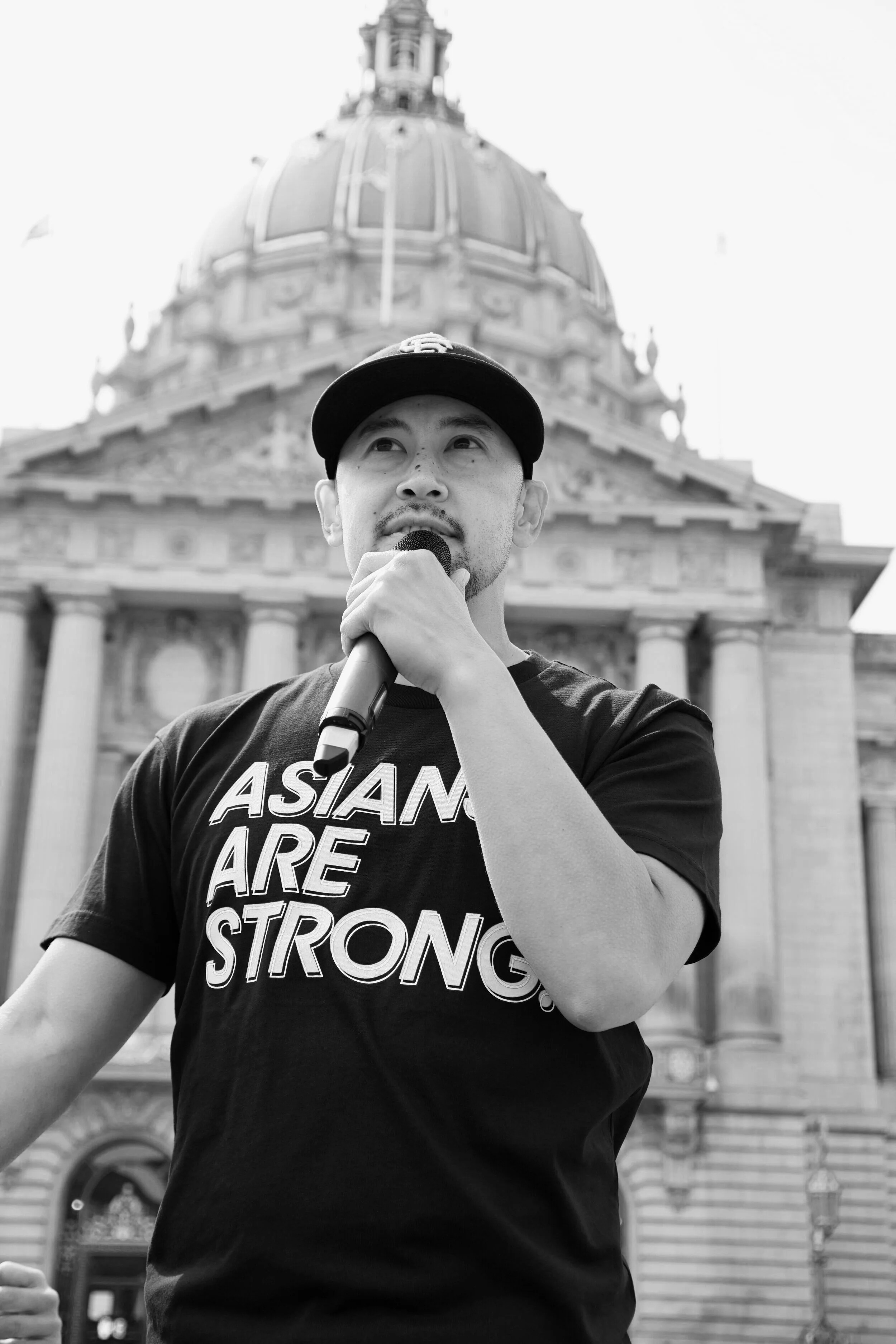
At a July 2021 rally outside City Hall, when organizers knew people were tired of showing up, Liao argued that fatigue made continued action more important. The line could pass for startup counsel, but its stakes here were not software metrics. In 2022, speaking at another rally against attacks on Asian elders, he dismissed the idea that donations and social posts alone were enough. He wanted bodies, voices and useful participation.
There is also an anecdote with more motion than metaphor. After a free self-defense workshop in Japantown in May 2021, Liao and colleague Jeremy Jong were eating at a nearby restaurant when staff noticed an attempted tourist car break-in. The pair and others gave chase, interrupting the robbery. The episode became local news. It also compressed the organization's identity into a few unruly minutes: instruction had ended, intervention had not.
03 · Compounding commitmentsThe session that stays on the calendar
Community work did not arrive suddenly in 2021. A friend had invited Liao to volunteer with KEEN San Francisco as a birthday activity in 2010. He became hooked on KEENquatics, the group's recreation program, and kept coaching. KEEN says he plans his month around the session. He later served on its board, adding a quiet, recurring obligation beside careers that changed names and industries.
This is the less theatrical version of persistence: show up again next month. Liao's 2020 essays about growth flywheels make a similar argument in business language. A company does not depend on one miracle action. Momentum comes from connected systems and repeated turns, with the customer at the center. He was skeptical of the seductive simplicity of the funnel, which celebrates acquisition and then rudely forgets retention.
The volunteer calendar, the nonprofit and the growth framework all resist the glamour of the single big moment. Push after push. Turn after turn. The repetition is where his two public identities, operator and organizer, meet without requiring a clever slogan.
04 · Product as autobiographyPutting fifteen years behind one API
The Hog emerged after Liao met co-founder Paulo Nascimento while working at another AI software company. Liao had already begun constructing agents to handle parts of his own job. Together they saw a broader problem. AI could produce content quickly, but go-to-market systems were still collecting stale, scattered context from a cupboard full of vendors.
The company's public shape has sharpened since its YC launch. It now presents itself as one API for searching, enriching and monitoring the web. People data, company data, news, social signals, sentiment, search and scraping sit behind a common interface with fallback logic among providers. The pitch is pragmatic: an agent cannot reason well from shabby context, and a small team should not spend its week maintaining the plumbing.
YC's profile credits Liao with helping one startup move from roughly $900,000 to more than $7 million in annual recurring revenue in three months, and another from two months of runway to profitability. Those are company-reported outcomes, but they explain the confidence behind the product. He is not approaching growth as a spectator who recently discovered a prompt box. He has felt the manual seams.
Those seams include CSV shuffles, audience rebuilding, media launches, proposal creation, CRM updates and the context switching between marketing and sales. Liao argues that AI can compress much of this glue work into hours. Research can arrive clustered. Variants can launch across channels. Calls can become summaries and next steps. Reports can assemble overnight.
His boundary is equally important. Strategy, positioning and prioritization remain human decisions. In his phrase, AI multiplies good judgment; it does not replace it. This is a more interesting founder thesis than a generic promise to do more with less. It asks what experience becomes once its repetitive motions can be encoded, and what cannot be encoded without losing the point.
05 · Keeping the person in the loopThe useful residue of experience
Liao entered YC at 39 and publicly addressed the obvious question about imposter syndrome. His answer was cheerful and qualified. Being around admired people can provoke doubt, he wrote, but he remained confident about the value of experience. Time teaches nuances that cannot be hurried into existence. Technology can amplify them.
The line lands because his experience refuses a clean founder archetype. He is a non-technical CEO who learned company building beside researchers. He has a finance credential and a growth operator's suspicion of tidy financial funnels. He has trained in Muay Thai and MMA, once as often as six times a week, though the YC schedule reduced that considerably. He is an emphatic 49ers, Warriors and Giants fan. He builds a web intelligence layer while running a nonprofit born from the physical reality of his hometown.
In 2026, the company and nonprofit still occupy the same calendar. The Hog is hiring around a thesis that future GTM systems will depend on real-time signals from across the web. Asians Are Strong continues public programming, and Liao has been exploring how practical AI support might help nonprofit volunteers too. The technology travels between his worlds, but purpose determines the use.
The clever summary is that Hudson Liao automated his own job. The honest version is less complete and therefore more useful. He automated the parts that looked repeatable after nearly 15 years of repetition. What remains is choosing the question, reading the room, caring about the outcome and showing up again. A firehouse can teach some of that. So can a laboratory, a rally, a pool and a stubbornly unfinished startup.