In a 2023 interview at his Delhi residence, Rajeev Misra showed off a pair of diamond cufflinks bordered by rubies. He had designed them himself. He designs jewellery for his wife, the architect Shalini Misra, too. There was talk of parties; an aide mentioned his occasional turns as a DJ. The financier associated with enormous cheques had some rather precise interests in small things.
It is a useful place to begin with Misra, whose public identity can disappear behind a single number: $100 billion. As the founding chief executive of SoftBank Investment Advisers, he helped turn Masayoshi Son’s plans for the Vision Fund into an institution with investors, employees and money to spend. The scale made him conspicuous. The subsequent losses made him answerable.
Now he is co-founder and chief executive of One Investment Management, or OneIM. The shift invites an easy redemption story, with the old mistakes packed away and a fresh business card doing the work of absolution. His actual career is more interesting. Credit, technology investing, property and industrial manufacturing all appear in it. So does a question that a new firm cannot settle by itself: what does experience change?
Before the vision came the balance sheet
Misra’s education crossed subjects as well as countries. After schooling in Delhi and a period studying chemical engineering at IIT Delhi, he moved to the University of Pennsylvania. His qualifications there were a bachelor’s degree in mechanical engineering and a master’s in computer science. An MBA at MIT Sloan followed. It was an unusually technical preparation for a career that would depend so heavily on people.
His professional route ran through Merrill Lynch, Deutsche Bank, UBS and Fortress Investment Group. At Deutsche he held senior credit and commodities responsibilities; at UBS he led fixed income, currencies and commodities. These were businesses concerned with the price of money, the reliability of borrowers and the awkward possibility that events might refuse to follow the forecast.
He joined SoftBank in 2014. His initial brief in strategic finance drew on that earlier work: financing, tax, financial technology and the recruitment of international talent. Before the Vision Fund made his name familiar in startup circles, he was helping a sprawling Japanese group think about how to fund its ambitions. The engineering degrees did not turn into a conventional engineering career. They became part of a financier’s toolkit.
That background matters when looking at the partnership with Son. A technology thesis has to survive contact with a financing agreement. Someone has to decide how capital enters the enterprise, on what terms and with what obligations. Those decisions can look like plumbing when everything is rising. When conditions tighten, everybody becomes interested in the pipes.
- Before 2014Merrill Lynch · Deutsche Bank · UBS · Fortress
- 2014-2024SoftBank: strategic finance, then the Vision Fund
- 2022 onwardsOne Investment Management
A future big enough to finance
The Vision Fund’s first major close in May 2017 brought more than $93 billion of commitments. Its backers included SoftBank, Saudi Arabia’s Public Investment Fund, Abu Dhabi’s Mubadala, Apple, Foxconn, Qualcomm and Sharp. This was a coalition of sovereign money and corporate money, assembled around the belief that technology companies would need much more capital to build the next stage of their businesses.
The fund’s size changed the practical meaning of a startup investment. It could support investments measured in hundreds of millions of dollars and take substantial positions in companies approaching public markets. For founders, that offered room to expand. For the manager, it created an obligation to find opportunities large enough to absorb the money without allowing the size of the fund to become the investment argument.
The construction was more complicated than a pot of venture capital. The first Vision Fund included preferred equity carrying a fixed annual distribution of 7 percent, alongside ordinary equity. The preferred capital had priority in distributions. Such terms put different investors in different economic positions, even while they shared exposure to the same portfolio. A futuristic proposition arrived with a very present-tense payment mechanism.
Misra’s public language in those early days matched the ambition. He expected computing power and connectivity to alter work and business. Yet he also spoke about the need to keep learning, and about recruiting people with technical understanding and appetite. The promise of a fund rested partly on things that could not be entered as a commitment figure: judgement, curiosity and the ability to recognise a business worth owning.
Committed capital from sovereign and corporate investors.
A fundraising milestone. Committed capital is distinct from money invested or investment returns.The cheque clears. The work continues.
Ownership brought jobs that a funding announcement could not perform. By late 2019, the Vision Fund had an operating group of about 40 full-time people, originally built to help companies enter new countries, prepare for listings and work with one another. Some were also helping businesses in difficulty, including the vehicle-leasing company Fair. Capital had acquired a rather extensive to-do list.
WeWork became the conspicuous failure associated with the fund. Wag and Zume also figured among the disappointments. These were reminders that a convincing account of how an industry might change was insufficient protection against a poor investment. Money could extend the period in which a company tried to make its economics work. It could also extend the period before the problem became impossible to overlook.
The portfolio contained consequential businesses too, including Coupang and DoorDash. A fair account has to hold the operating businesses and the failed bets in the same frame. The presence of a recognisable company is no substitute for a calculation of returns. Neither is the collapse of one investment a complete statement of what happened to every other dollar.
For Misra, the experience made the relationship between raising money and returning it painfully concrete. He retained connections with Gulf investors through the difficult period and went back to some of that network for OneIM. That continuity is central to his second act. The people financing it had already seen what the first act cost.
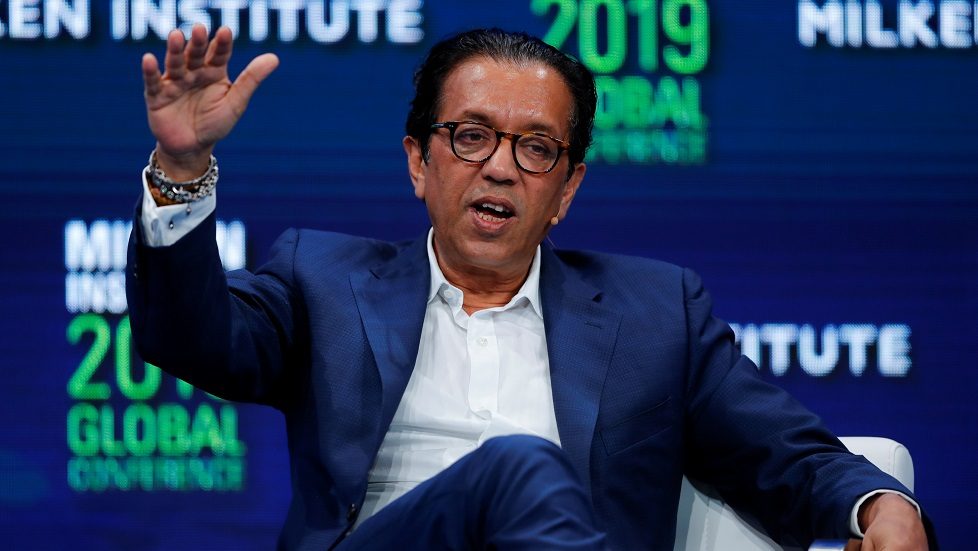
Leaving in stages
His departure from SoftBank took more than one announcement. In August 2022, he relinquished his corporate officer and executive vice president positions at SoftBank Group while continuing as chief executive of the adviser managing Vision Fund 1. OneIM was founded that year. For a time, the new enterprise and responsibilities for the original portfolio occupied overlapping chapters of his working life.
In November 2024, his departure from the remaining Vision Fund leadership role was announced, leaving Alex Clavel as sole chief executive. The distinction is useful: stepping back from the parent company in 2022 and completing the handover in 2024 were separate events. A biography that stops at either date alone misses how slowly a large investment institution can release its people.
OneIM brought familiar colleagues into a different setting. Co-founders Yanni Pipilis and Munish Varma had worked with Misra before; the firm describes its founders as having worked together for more than 25 years. That offers an answer to one institutional problem, the difficulty of assembling a team while money is already waiting. Familiarity still has to earn its keep in each new investment.
By July 2025, the new firm’s property activity included a German residential portfolio and a multifamily project in Jersey City, alongside financing transactions. These were tangible places with tenants, buildings and capital requirements. The range made clear that OneIM’s remit would extend beyond the technology companies that had defined Misra’s most visible job.
“I have learned my lessons.”
Rajeev Misra · January 2024
Magnets, mezzanine and another map
The 2026 transactions make that breadth easier to see. In January, OneIM put $200 million into a $215 million Series C financing for Noveon Magnetics, a US rare earth magnet manufacturer. The round was intended to expand domestic manufacturing capacity and enabled some existing shareholders to sell. OneIM would appoint two Series C board members. Here was an investment in the physical components behind an increasingly technological economy.
Magnets sit inside motors, robotics and data storage applications. Manufacturing them requires equipment, technical knowledge, reliable inputs and customers. For a financier educated in mechanical engineering and computer science, the subject offers a pleasing return to material things. It also demands its own underwriting. An industrial supply chain has ample ways of disappointing an investor without any assistance from a software valuation.
In June, OneIM signed a memorandum of understanding with SMBC Nikko Securities for a proposed Japanese joint venture focused on mezzanine and private credit. The plan involved junior debt financing for buyouts and other private capital transactions. It paired OneIM’s investment capabilities with a Japanese institution’s local relationships. The firm had already established an office in Tokyo, adding another practical connection to a country central to Misra’s career.
By October 2026, OneIM reported $11.8 billion in assets under management, more than 70 people and four offices: Abu Dhabi, London, New York and Tokyo. Those figures describe an organisation with substantial resources. They do not supply a verdict on its investments. That will require realised outcomes, measured over time.
Different transactions, different risks. These examples describe activity, not performance.
What carries over
There is another, quieter connection between Misra’s interests in people and capital. He is a patron and board member of Vahani Scholarship Trust, founded by Reeva Misra. Its work combines financial support for education with mentorship and career guidance. In June 2025, he and Shalini joined its tenth-anniversary gathering. The commitment sits alongside his university connections and his recurring interest in how people acquire the skills to move forward.
His own advice to engineers in 2017 was blunt: “You have to continually educate yourself, otherwise you will become redundant and obsolete.” It reads differently after the Vision Fund. Continuing education can come through a degree, a new technology or an investment that refuses to behave. Finance is unusually efficient at sending the tuition invoice.
The jewellery, the occasional DJing and the long relationships keep this from becoming merely a sequence of fund sizes. Misra has tastes outside the investment committee and a working life that has repeatedly crossed disciplines. At OneIM, he has room to choose a broader range of transactions. The next chapter will turn on which arrangements deserve his attention, and how carefully he puts them together.