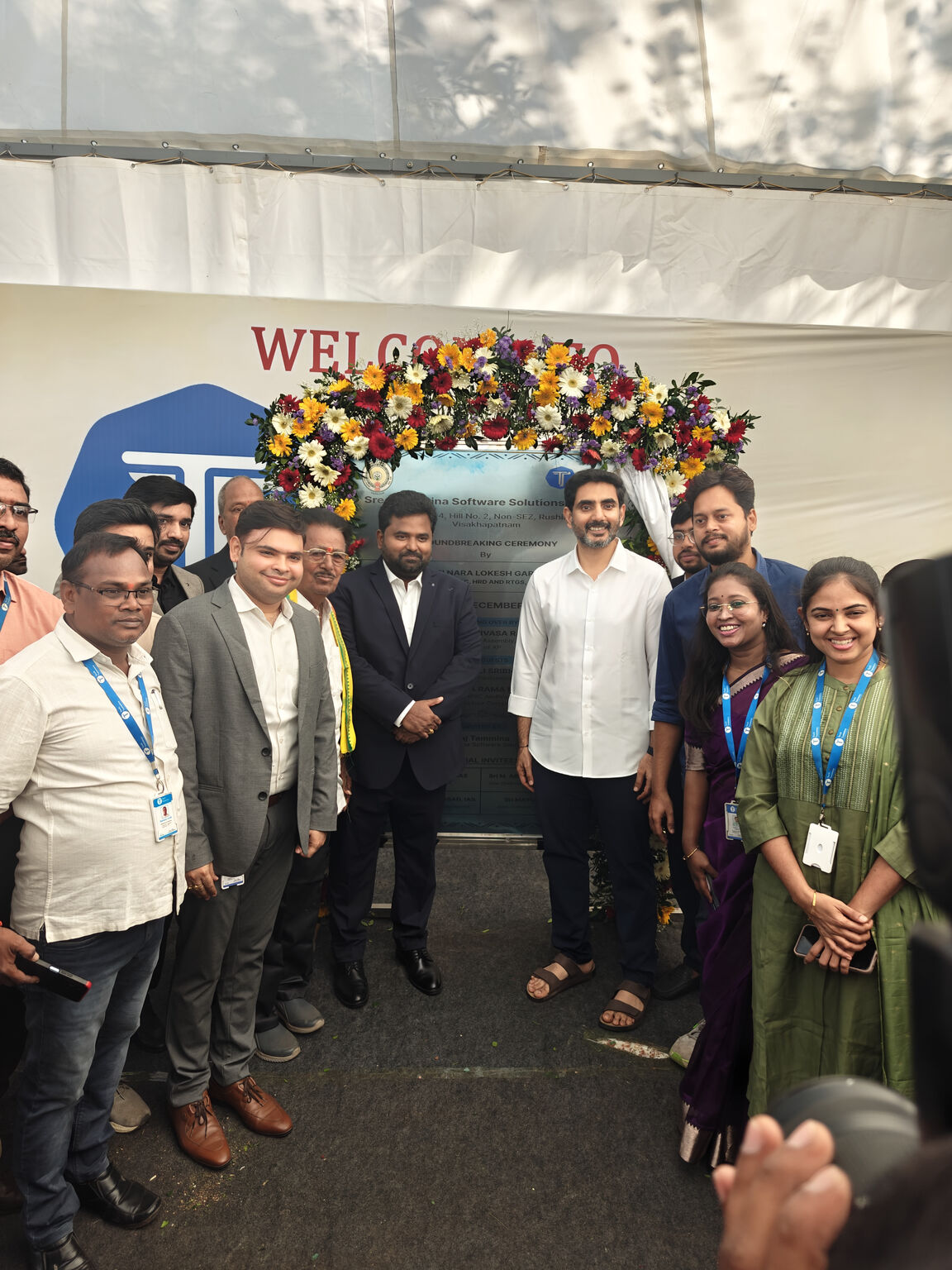
At Hill No. 2 in Visakhapatnam, the business of making work less physical acquired a foundation stone. There were flowers around a plaque, employees gathered for photographs, and a ceremony led by Andhra Pradesh minister Nara Lokesh. Raj Tammina, the CEO and founder of TechTammina, attended the December 2025 groundbreaking. The proposed campus carried two especially concrete numbers: ₹62 crore in planned investment and 500 projected jobs.
For a founder whose company sells automation, it was an intriguing scene. So much of the product language concerns removing repetitive effort: extracting information, comparing documents, moving a task along. Here was the same enterprise making room for people. Software, it turns out, still requires somewhere for its makers to put their chairs.
Tammina founded TechTammina in 2005. His career includes automation-testing work at Securities America and the College Board; his education spans Andhra University and the University of New Orleans. Those details give his story a useful shape. Engineering, testing, then a company built around the practical difficulties of getting business software to behave. By the time of the campus ceremony, that company had been operating for two decades.
Announced campus commitments, December 2025. These figures describe plans.
A career with a checking function
Tammina's engineering education began at Andhra University, where his undergraduate years were 1993 to 1997. He later studied engineering at the University of New Orleans, with dates of 2001 to 2002. The two institutions locate his education on opposite sides of the world, years before the Virginia business would establish its own international operations.
His professional record includes the title Automation Test Lead at Securities America and the College Board. Testing is a particular vantage point from which to encounter technology. A developer can admire what an application is meant to do. A tester has to investigate what happens when somebody uses it differently, supplies awkward information, or asks it to work alongside another system.
The connection to his current business is visible in the work itself. Quality assurance remains part of TechTammina's offering: functional testing, performance testing, regression testing, compatibility testing and user acceptance testing. The vocabulary of checking runs through both Tammina's career and his company's services.
That continuity matters because the company's business reaches beyond writing a new application. It includes the less photogenic work surrounding one: establishing requirements, testing behavior, integrating systems, and supporting a deployment. A launch gets a date on the calendar. Keeping the thing useful gets considerably more dates.
The company with his name on it
TechTammina began in 2005 and combines software development with staffing and automation services. Tammina remains its CEO and founder. He is based in Herndon, Virginia; the company's US office is in nearby Chantilly. The distinction is small on a map, but useful in understanding a business whose founder and headquarters sit within the same Northern Virginia technology economy.
The company's work includes Appian and Mendix development, robotic process automation, custom applications, and testing. These are tools and services for organizations that already have systems, employees, documents, and established ways of doing things. The assignment begins with an existing business, including all the parts that refuse to fit neatly into a demonstration.
One sentence in TechTammina's own description is unusually plain: “We will work as an extension of your team.” It is a substantial promise for a services business. An outside team has to understand the customer's habits well enough to change a process without making the people using it wish for the old one.
“We will work as an extension of your team.”
TechTammina's company statement
Tammina's enterprise also gives that promise a geographical dimension. Its listed locations include Chantilly, Visakhapatnam, Hyderabad, Amsterdam, and Dubai. Coordinating expertise across those places is part of the operating task. Geography creates choices about delivery, communication, and where the work happens.
The paperwork has a plot
Consider the policy-checking application sold by Tammina's company. An insurance document arrives. Its contents must be checked against the agency's management system. Matching information is useful; differences demand attention. A document can be complete as a file and still leave an employee with a substantial job.
TechTammina's application uses Appian document processing to extract relevant information and robotic process automation to retrieve corresponding system records. A checklist shows matches and discrepancies, alongside an errors-and-omissions summary and an audit trail. The attraction lies in bringing the comparison together, where somebody can review it.
The company's product description includes user reconciliation: people can modify or select missing information from the extracted data. That feature gives the process an escape route when documents are untidy. An application that anticipates a correction has a better claim on everyday usefulness than one that assumes the paperwork will arrive on its best behavior.
- 01ReadExtract document details
- 02CompareCheck the system record
- 03ResolveReview discrepancies
A simplified view of TechTammina's policy-checking workflow.
This is a revealing example of the business Tammina has built. Its unit of value is something office workers recognize immediately: one awkward task made more manageable. There is engineering underneath it, but the result has to make sense at the desk where the document lands.
Recruitment supplies an earlier example. In May 2019, TechTammina released Intelligent Recruitment Process in Appian's marketplace. The application organizes job requisitions, candidate shortlisting, and interview scheduling, with automation for routine sourcing tasks. Staffing, already part of the business Tammina founded, had become an area in which the company offered software as well as people.
That combination gives his company an interesting perspective on automation. A recruitment process contains decisions about people alongside repetitive administration. Organizing interview slots and passing information between participants are recognizable coordination problems. Solving them requires attention to the sequence of work, including what has to happen before somebody else can proceed. The same concern reappears in policy checking, where extracted information still needs comparison and review.
Five cities, several ways to work
TechTammina describes onshore, offshore, and hybrid delivery models. In the onshore arrangement, a team works at the client's premises, allowing close coordination and feedback. Offshore delivery places development elsewhere, with communication through an on-site lead. The hybrid model combines elements of both.
The company's explanation makes a useful distinction: offshore delivery suits projects whose requirements and deliverables are established in advance. That qualification is worth lingering over. When instructions keep changing, distance adds another thing to manage. The choice of delivery model therefore involves the stability of the assignment as well as its price.
For Tammina, the five listed cities represent more than a set of addresses. They provide the physical settings for a business that offers different ways of assembling a project team. The customer's location, the developer's location, and the person responsible for resolving a question may all need to be considered together.
The proposed Visakhapatnam campus belongs within that operating picture. TechTammina already lists an office in the city, under Sree Tammina Software Solutions (I) Pvt Ltd. The campus announcement adds a planned facility to an existing presence. Expansion here has a local setting as well as an international audience.
What a foundation stone commits you to
The ceremony took place at Hill No. 2 in the Rushikonda IT SEZ. Lokesh led the groundbreaking, with legislator Ganta Srinivasa Rao presiding. The gathering also included MP Mathukumilli Sribharat and APIIC chairman Manthena Rama Raju. Tammina attended with senior company leadership, including Santosh Kumar and KVSJV Sastry.
TechTammina thanked the Andhra Pradesh government for allocating land. The public occasion placed the company within the state's effort to develop Visakhapatnam's technology economy. For the founder, it also gave an expansion plan a specific location, a ceremony, and a set of commitments people could remember.
The ₹62 crore and 500-job figures belong to that announced project. A groundbreaking marks the start of a building story; the hiring and operating story has to follow. Keeping those stages distinct allows the ambition to stand at its actual size, without borrowing achievements from the future.
There is a practical connection between the planned jobs and the company's existing employment pitch. TechTammina promises regular training, seminars, and technology workshops. A delivery business needs people who can learn a platform, understand a customer's problem, and keep adapting as both change. The campus plan puts a physical address beside that continuing need.
Still checking, in October 2026
The company's recent software releases offer another view of its direction. In May 2026, TechTammina released SmartMeta Extractor, an Appian plug-in for retrieving document metadata. Its HTML-to-Excel tool handles another familiar office requirement: getting structured information into a spreadsheet somebody can use.
On October 22, 2026, its COI Compliance And Management solution was first released in Appian's AppMarket. The application extracts certificate-of-insurance information, checks it against requirements, identifies deficiencies, and routes submissions to analysts. Reviewers can record decisions and justified overrides. The task has expanded, while the checking function remains recognizable.
These are company releases, with team effort behind them. Alongside the campus proposal, they place Tammina's current role between two kinds of construction: software that organizes work, and a proposed workplace for the people who build it. One deals in records and rules. The other requires land.
Return to that flower-framed plaque in Visakhapatnam. A founder whose career includes testing has attached his company's next chapter to commitments that can themselves be checked: investment, a campus, jobs. After more than twenty years in business, Raj Tammina's story has acquired a very tangible next assignment.