The interview was difficult to arrange. In 2012, Venkat Machavolu needed to assess a Big Data Architect for a customer, and time zones were making a nuisance of themselves. He recorded a telephone interview with the candidate’s permission and passed it along. The customer could hear the answers without attending the conversation. A scheduling problem had produced a product idea.
There is something pleasingly unglamorous about that beginning. No elaborate unveiling. Someone needed to hear someone else explain their work. The recording let that happen. Machavolu traces the thinking behind iQua.ai to that encounter, and to the possibility that a fuller video interview could give a reviewer more to work with.
That question remains interesting even as the technology changes: how much of a person’s ability can travel ahead of them? A résumé compresses a career into declarations. An interview supplies a different kind of material: an explanation, a response, a demonstration of how someone approaches a question. Giving that material a life beyond one appointment changes the transaction.
An engineer responsible for the whole system
Machavolu is the founder, CEO and CTO of iQuadra Information Services. His public professional history dates the company’s beginnings to January 2006. His own education was in chemical engineering at Sri Venkateswara University, where he belonged to the 1992-1996 batch. The route into software leadership was hardly written in the name of his degree.
The two current titles put him close to both the commercial promise and the engineering needed to deliver it. A chief executive can talk about a customer’s problem; a chief technology officer has to consider what happens when the solution meets real users. Holding both jobs makes it harder to send the awkward questions down the corridor.
His technical work has included databases, infrastructure management and service-oriented systems. At iQuadra, his responsibilities extend to technology strategy and the company’s innovation and research work. These are the less photogenic parts of software: the machinery beneath a useful screen, the relationships between systems, the work required after the demonstration ends.
His collaboration with fellow founder Kirti Patel also belongs in the story. The pair were behind iQuizUAnswer, and Machavolu appeared in the Transform 2024 speaker programme under that product’s name. The public description of his role combined company leadership with research and development. The business and its experiments were sharing an address.
“I always wanted to be on my own.”
Venkat Machavolu
That wish for independence has a practical expression in a product business. An idea has to become something people can use repeatedly. The founder gets room to pursue it, along with responsibility for the unromantic details. Freedom, in software, still comes with maintenance.
The candidate has something to show
iQua.ai gives job seekers a way to take AI interviews, receive performance feedback and share interviews with recruiters. Its features also extend to recruitment teams and educational institutions. The intended sequence is straightforward: practise answering questions, examine the response, and make a piece of that performance available to someone considering a hire.
A recorded answer changes what can be passed from one person to another. Instead of asking an employer to infer everything from a list of skills, a candidate can offer an example of speaking about those skills. The reviewer can return to it. The candidate’s explanation survives the first viewing.
The attraction is easy to understand. Interviews ask people to do several things at once: remember what they know, organise it, judge what the question requires and communicate it to a stranger. Preparation can involve each of those tasks. A useful practice session gives the learner something more specific to consider than a vague instruction to be confident.
For Machavolu, the product sits between groups whose working days look quite different. A recruiter is reviewing applicants. A student is preparing to become one. A college is trying to help a whole class approach the transition. Software that serves all three has to translate between their needs without assuming they are identical.
That makes the founder’s campus appearances especially relevant. They place him near the questions around the software: how students introduce themselves, how institutions prepare them and how employers might evaluate what they see. The interview has a social life before it becomes a file.
Nellore gets a place in the room
Machavolu’s public profile places him in Marietta, Georgia. He calls Nellore his hometown in India, and identifies it as a base for iQua.ai’s product development. The connection crosses borders while remaining attached to a particular place. Nellore is part of the work, rather than a passing biographical detail.
At the IQonnect Summit on July 12, 2024, held at Minerva Grand in Nellore, his message to students was succinct: “Be Rural, Go Global.” The phrase works because its two halves are compatible. A local beginning does not settle where a piece of software can be used, or who might eventually encounter the person building it.
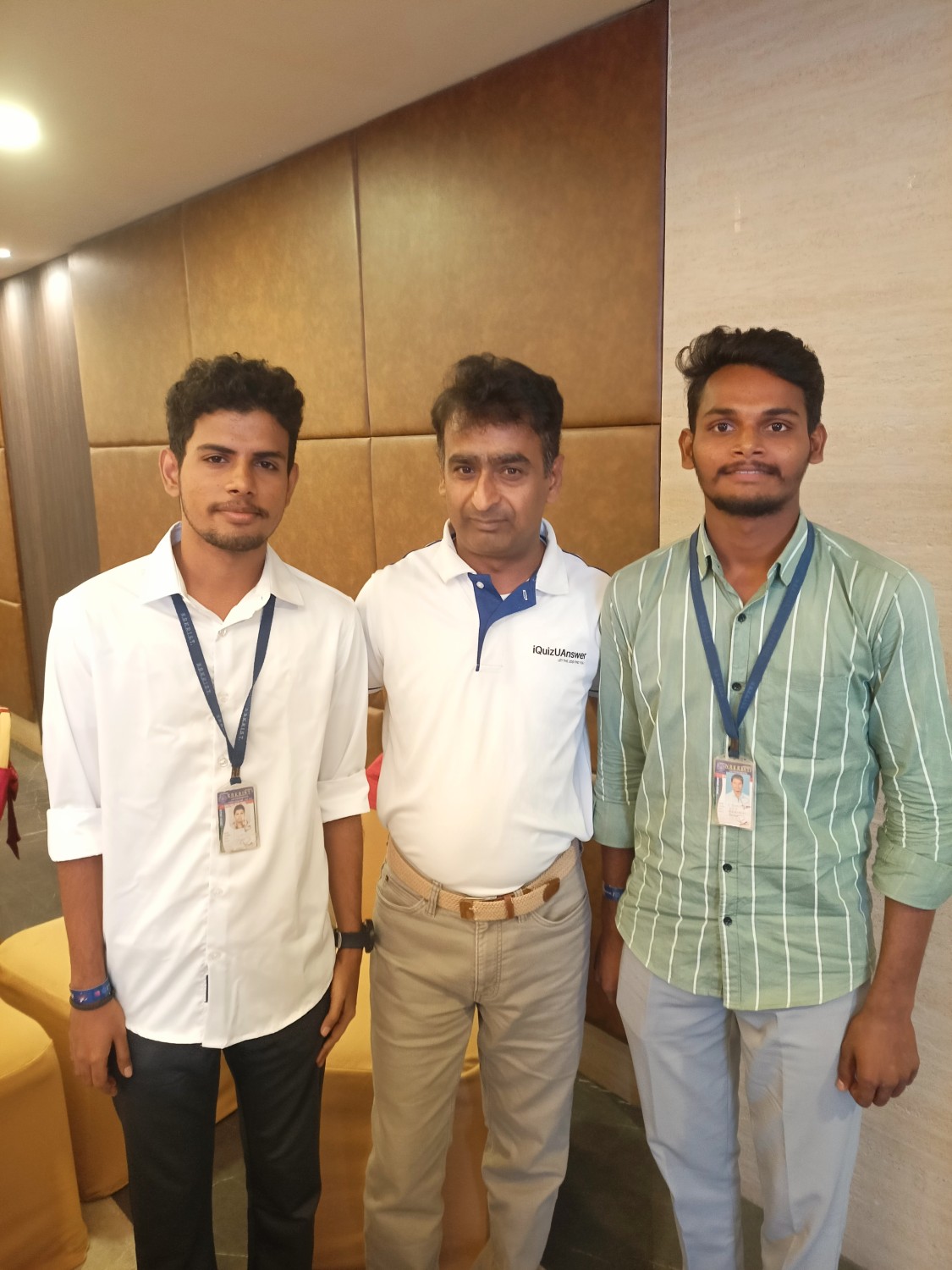
The day mixed technical discussion with advice on presenting oneself. Students saw a product demonstration, took part in a quiz and heard sessions on professional communication. Machavolu also discussed the platform’s origins with an attendee. The product had a face in the room, and its founder could be asked how it began.
Another student’s account describes Machavolu and Viswanath Hemanth Chadalawada discussing software architecture, including client-server, N-tier and serverless approaches. Alongside those ideas came discussions of scalability, integrity and security. It is an unusually useful combination for an event about careers: the infrastructure behind a product and the conversation required to get a first job near it.
The photograph from the summit catches a modest part of that exchange. There are no diagrams in the frame, just three people standing together. The technical ambitions of the day ultimately depend on encounters of this size: a student asking something, a professional answering, a future piece of work becoming a little easier to imagine.
A campus is also a product conversation
By December 2024, Machavolu was discussing iQua.ai with the training and placement officer at NRI Institute of Technology in Vijayawada. The conversation covered interview simulations, performance analysis and sharing interviews. Those subjects put the college’s work of preparing students beside the platform’s proposed tools for doing it.
There is a concrete distinction between a recruitment platform being available and an institution knowing how it might use one. Someone has to connect the features with the placement office’s responsibilities. A demonstration can make that connection tangible: here is the interview, here is the feedback, here is what another person would receive.
In April 2025, he visited Vignan and spoke with MBA students about technology’s effect on business operations. The discussion addressed innovation, efficiency, customer experience and the relationship between business strategy and changing technology. His audience was studying management, which placed the emphasis on what technology does inside an organisation.
The visit also included conversations with academic leaders and demonstrations of iQua.ai. His lecture connected academic learning with industry practice. That connection is visible in the subject itself. A tool has to be understood in terms of the decision it helps someone make.
These visits give his role a dimension beyond supervising development. He is also explaining the work, taking it into institutions and discussing how it fits their aims. A founder can learn something from the questions a demonstration attracts. The person expected to use the product often has a refreshingly direct interest in how it will help.
The settings also bring different kinds of questions into view. A management classroom can examine the business process. A placement office can examine what a student needs before meeting an employer. A technical discussion can examine the system that holds it together. Taken together, those conversations show the range of work around an interview platform. The software is one part; helping people understand where it belongs is another. Machavolu’s appearances put him in each of those settings, discussing a product whose users approach it from different directions.
The portfolio widens into AI governance
In July 2026, Machavolu announced that iQuadra had acquired HelixCloud.ai. He described the acquisition as an extension into AI governance, cybersecurity, compliance, cloud infrastructure management and cloud costs. The announcement also said HelixCloud co-founder Srinivas “Srini” Yamujala would continue as a board advisor.
The platform is described as running within a customer’s own AWS, Azure or Google Cloud environment. That detail places control of infrastructure alongside the work of adopting AI. It widens the company’s product concerns from the interview experience to the rules, resources and oversight surrounding enterprise systems.
The company’s current services span AI platforms and enterprise technology work, including Oracle Cloud ERP, software development, data science and DevOps. Against that background, governance belongs to a recognisable set of questions. Once software becomes part of an organisation’s operations, someone must decide how it is managed.
For Machavolu, the recorded interview remains a useful place to understand the larger career. A practical obstacle prompted a change in how information could move. The candidate spoke once; the customer could listen later. Years of product work sit beyond that moment, but its appeal is still plain: a person’s answer should have the chance to reach the person who needs to hear it.