A customer has paid. The order still needs fulfilling. Suppliers, staff and rent still need paying. But the business owner cannot reach the proceeds. That gap between making a sale and controlling the money is the problem Railbed exists to address.
In its account of why it exists, Railbed describes legal merchants whose payment access can disappear after a review, leaving balances inaccessible for months. The deeper concern is dependence: a business can satisfy its customers and still depend on a financial intermediary’s continuing willingness to serve it. For the owner, payment infrastructure becomes a question of whether the business can keep operating.
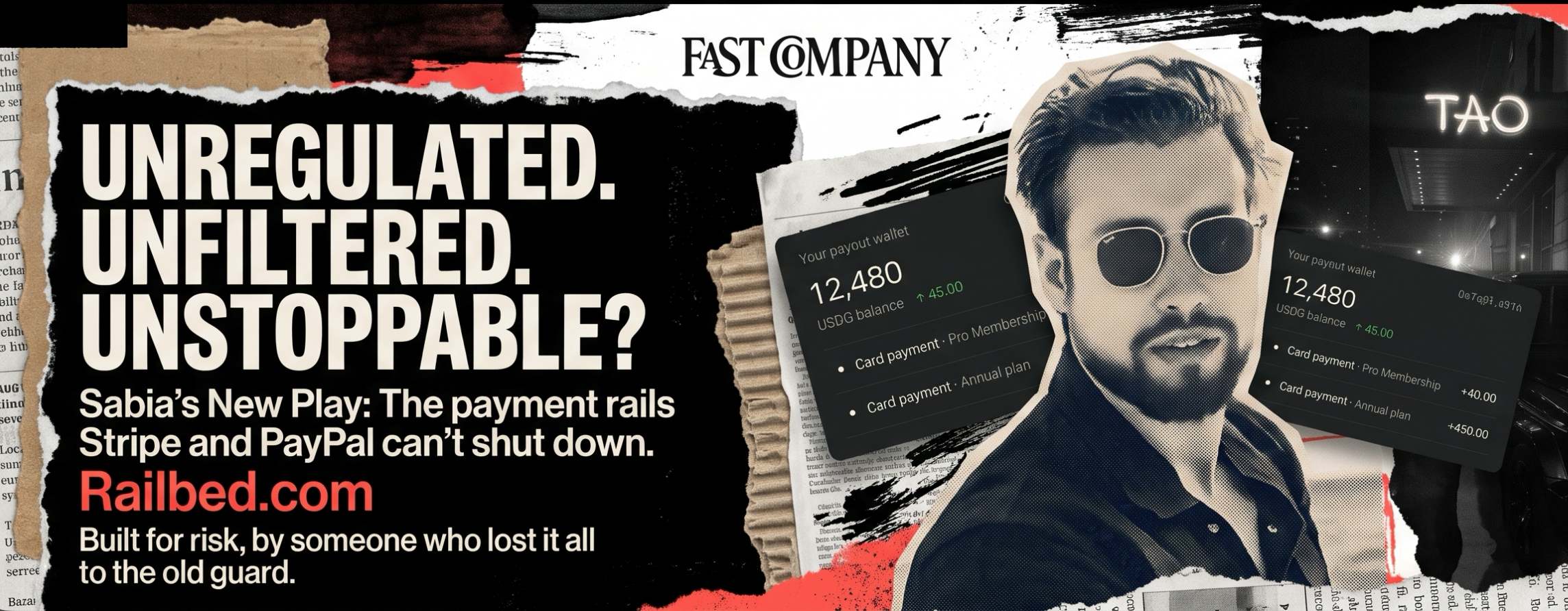
When a payment decision becomes a business decision
Railbed’s stated audience includes supplements sellers, adult creators, dating platforms, licensed gambling operators and digital-goods businesses. These categories differ considerably, and legality depends on the product and jurisdiction. What connects them in Railbed’s positioning is the difficulty of building a dependable business around processors that may restrict or refuse their category.
The practical stakes extend beyond a checkout button. A merchant may need proceeds from today’s orders to buy tomorrow’s stock, pay collaborators or issue refunds. If those proceeds become unavailable, obligations continue. In that sense, the ability to accept a payment and the ability to use its proceeds are two separate forms of access.
Railbed’s homepage dramatizes the problem with an account-closure email to a fictional merchant named Alex, showing $48,210 held for up to 120 days. That is a sales illustration, not a verified customer incident. The scenario makes the company’s concern concrete: the intermediary holding the balance also holds considerable power over the business that earned it.
The inspiration is control over earned money
The idea behind Railbed, as its public explanation presents it, is to reduce that power by changing where the proceeds go. A promise of sympathetic treatment still leaves a merchant relying on the institution making the promise. Railbed instead designs its checkout around having no merchant balance of its own to hold.
“If we cannot hold your money, we cannot freeze it.”
Railbed’s explanation of its design
That is the connection between the company’s motivation and its technical choices. Customers can use a familiar card payment, while merchants receive USDC in wallets they control. The stablecoin is the settlement mechanism; the intended benefit is greater control over the proceeds once they arrive.
For the legal businesses Railbed targets, this amounts to an argument about economic independence: earning revenue should give the owner a usable resource with which to keep building. The company’s approach seeks to make that independence part of the payment path. Its published account explains this design rationale, but does not establish a verified personal incident that prompted its creation.
- Serve legal merchants that mainstream processors restrict or refuse.
- Keep card payment available to buyers through independent providers.
- Deliver USDC proceeds to a merchant-controlled Polygon wallet.
- Remove Railbed’s own custodial balance, with wallet and refund responsibilities resting with the merchant.
How the principle becomes a payment
Railbed, operated by MediaGlobe, provides payment links, hosted checkout, buy buttons and an API. An independent on-ramp provider charges the buyer’s card and converts the payment to USDC. Forwarding infrastructure then delivers the proceeds, less fees, to the merchant’s Polygon wallet. Railbed records and checks the payment and says it never holds, pools or controls merchant funds.
This explains why custody matters more to its story than the list of integrations. The product decision is where the money lands and who can control it there. Railbed cannot freeze a balance it does not hold. Receiving funds in a merchant-controlled wallet, however, does not remove every dependency elsewhere in the transaction.
Independence still has boundaries
Railbed’s Smart Routing seeks an available on-ramp provider for each buyer. Providers retain the final decision on acceptance and identity checks, and their restrictions still apply. Railbed’s acceptable-use policy requires goods and services to be legal in both merchant and buyer locations, with any required licences. The promise of more control over settled proceeds cannot guarantee that every payment will be accepted.
Merchants also need to understand the cost of that route. Railbed advertises a software fee from 0.9%, alongside a separate 1% network fee and variable provider fees and exchange spread. Moving USDC or converting it into a bank deposit can add costs. The starting rate is one component of the total.
Control brings operational work. Merchants secure their wallet keys, arrange conversion when needed and manage refunds themselves. Railbed cannot reverse settled funds; card disputes go through the provider that charged the card. Its documentation also tells sellers to verify settlement through payment notifications or authenticated status checks before fulfilling an order.
A different relationship with the payout
Railbed’s larger ambition is to give merchants a more dependable foundation for running a business: less exposure to a checkout company’s custody of their earnings, with proceeds arriving in a wallet they control. Its published architecture describes that approach; it does not by itself establish how reliably the service performs for merchants at scale.
The question it puts before an owner is useful beyond this particular product: who holds the money after a customer pays, and what happens to the business if access to it disappears? Railbed’s reason for existing lies in the consequences of that question. Its answer is to move control of the payout closer to the person whose work earned it.