A free app can have a surprisingly strict guest list. When Raghu Vir introduced Qural in India in 2019, he wanted people to join without paying a subscription. Yet he was particular about the businesses coming onto the platform. A bigger network was useful only if the people in it had a reason to deal with one another. For a founder preparing to expand beyond Hyderabad, that was a revealing condition to put on growth.
Vir was already running Saince, the software and services company based in Alpharetta, Georgia. He had experience selling to organizations, supporting customers and building a business across borders. Qural put a different question in front of him: could a platform make smaller, established businesses more capable without asking them to stop being themselves? The neighborhood shop would keep its counter. It would gain a digital doorway.
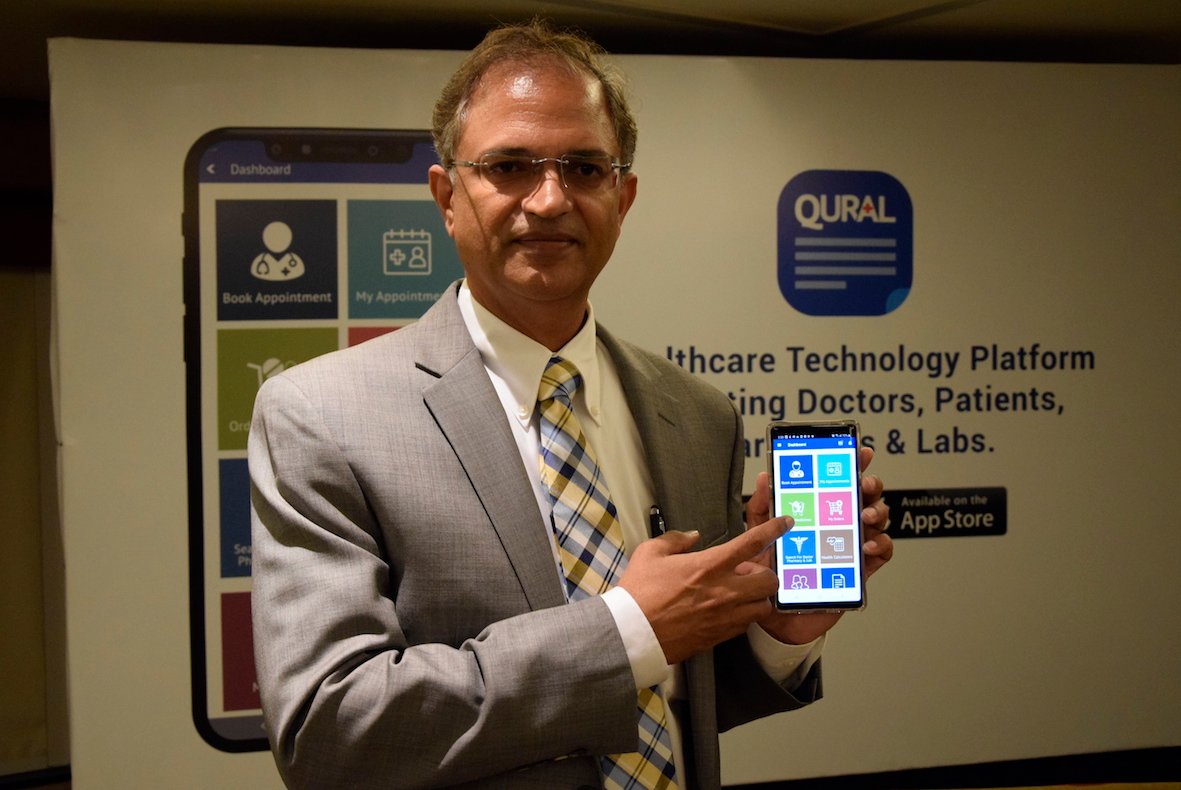
There is a familiar technology story in which a new company arrives to replace the old arrangements. Vir's pitch left room for the people already there. He wanted independent operators to have tools that let them compete with larger online businesses. That makes his 2019 launch an interesting place to meet him: holding a phone, explaining an interface, and making an argument about who should get to participate in a digital economy.
A doorway for the shop down the road
Qural's proposition included giving local retailers the ability to accept online orders, offer collection and arrange delivery. These were practical capabilities, the sort customers might soon expect regardless of the size of the business. A shop could retain its local relationships while adding another way to serve them. Software supplied the extra entrance.
The commercial idea deserves a moment. Local businesses often possess something expensive to manufacture from scratch: customers who know where they are and people who know whom to ask. An online interface can extend those relationships. In Vir's proposal, the technology helped existing participants transact directly with one another. The platform's usefulness rested on connecting activity that already had a place in everyday life.
He also emphasized ease of use. An interface that requires its own interpreter has a limited audience, however accomplished the engineering behind it. Vir made a specific promise about Qural: people without technical expertise should be able to use it. His explanation stayed close to ordinary actions and relationships. The sophistication was supposed to sit behind the screen, where it would trouble fewer people.
“Even non-technical people will find it easy to use”
Raghu Vir, on Qural in 2019
That promise gave the launch a useful test. A platform for small operators has to make sense to someone with a business to run and little patience for learning a second occupation. Vir's stated ambition was broad access. The product argument began at the much smaller scale of an individual trying to get something done.
Ten thousand people, then the next city
At launch, Qural reported an active subscriber base of 10,000 in Hyderabad during its testing phase. Treat that as a dated snapshot: a starting population around which the next stage was being planned. Vir's team wanted to take the platform into other major Indian cities. Hyderabad offered the first visible cluster of activity; the expansion plans asked whether that activity could travel.
One city is a useful unit for a business built around local relationships. Participants need other participants close enough to be relevant. A national download total may sound pleasant at a presentation, but a customer still needs someone available nearby. The underlying business question is how to turn scattered registrations into relationships that people actually use. Vir's emphasis on interconnection made that question central to his pitch.
Qural was offered for mobile and desktop use. At its introduction, the company said it aimed to enter major metropolitan markets within 90 days. That was the schedule it announced, rather than a tally of places it had already reached. For Vir, the launch combined a product people could begin using with a plan that still had to be carried out, city by city.
He spoke about selecting participants for the value they would add. That introduces a little friction into the seductive idea that every additional account is automatically good news. A useful network requires a reason for its members to return. Selective onboarding was part of the proposition he described, alongside the invitation to join for free.
His ambition extended to emerging economies, with India a particular focus. This was an expansion thesis expressed at launch, and its scale mattered: he was considering how a platform developed within an established American business might work in other markets. The design problem included geography, different kinds of participants and their ability to use the same system comfortably.
The money came from inside
The business also had a presence on each side of the expansion. Saince’s Indian arm operated from Hyderabad, while the parent company was based in Alpharetta. The launch therefore connected an existing American company with its operations in the city where Qural had been tested.
The financing detail gives this episode another dimension. In 2019, Saince described its growth as funded internally, with profits reinvested in the business. Outside funding remained something it might consider. For the Qural launch, the company presented an expansion supported by resources it already controlled.
That arrangement makes the older business part of the new product's story. Revenue earned from established work can become capital for a different kind of experiment. The connection is tangible: existing operations help finance the attempt to reach a new audience. Vir was approaching a new platform with a company behind him, rather than presenting the platform as the beginning of his entire entrepreneurial career.
- EarnEstablished operations
- ReinvestInternal resources
- BuildNew products and markets
It would be easy to turn this into a sermon about the proper way to finance a company. Vir's position was more flexible. He left open the possibility of raising money later. The notable decision was the one already made: pursue the launch using internal funding. It was an operating choice at a particular moment, with room for the next choice to be different.
The applause arrived before the app
Qural followed years of recognition for Saince. In May 2015, the company announced its third Pacesetter recognition from the Atlanta Business Chronicle. The award assessed fast-growing private businesses. Vir, speaking as president, framed the achievement around customer value, product quality and service. His explanation put the day-to-day obligations of running the company beside the celebration.
The distinction had entry conditions. The 2015 program required qualifying businesses to have grown sales by more than 50 percent over its assessment period, alongside age and revenue requirements. Those rules explain the kind of business being recognized. They also keep the award in proportion: it marked performance against a defined set of conditions in a specific period.
Saince subsequently appeared on the Inc. 5000 at No. 3,321 in 2015 and No. 2,506 in 2016. These are company rankings under Vir's leadership, and the dates belong beside them. Together, they establish that the later platform launch came after a period of externally recognized business growth. Qural was a new chapter inside a company that had already been making its way.
Awards have the advantage of looking tidy. Operations rarely enjoy the same privilege. Customers still expect the service to work after the photograph has been taken. Vir's emphasis on quality and customer service offered a less photogenic account of growth: keep providing something people value, then keep doing it as the organization gets larger.
His education had crossed disciplines, too. He studied chemistry, biochemistry and biology as an undergraduate, then earned a graduate qualification in business management. The combination places technical subjects and commercial training in the same background. By the time he was introducing Qural, his role required him to explain both what a product could do and why a business should make room for it.
A CEO has more than a balance sheet
In June 2020, Vir published an essay arguing that CEOs needed a wider set of skills. He criticized the pressure to deliver short-term shareholder gains while overlooking longer-term consequences. His concern was the growing social power of large businesses and the expectations placed on the people who led them.
He argued that a successful chief executive needed ethical judgment and social responsibility as well as business competence. That is a statement of his view, rather than a scorecard for his own company. It does, however, add another dimension to the executive explaining platforms and expansion: he was also thinking publicly about what corporate authority obliges a leader to do.
There is a modest local counterpart to that argument. Vir's company biography describes him as a regular volunteer with service organizations around Atlanta. His working base is Alpharetta, part of the same metropolitan area. International business and nearby commitments coexist in that account of his life. The map has room for both the next market and the place where he spends his time.
Return to the phone in the launch photograph. The device is ordinary; the commercial question behind it is substantial. Who gets tools that help them keep up? Vir's answer in 2019 included the small operator down the road. He proposed a way for that business to participate, put internal resources behind it and insisted that joining should be simple. The invitation was broad. The attention to who came through the door was deliberate.