A fax can arrive at a hospital perfectly intact and still be remarkably difficult to use. Someone must identify the patient, read the document, decide where it belongs and move its contents into another system. The information has arrived. The work has barely begun. This is the territory Saince occupies: the awkward distance between having a clinical fact and being able to act on it.
- The job: connect clinical documents, conversations, imaging and hospital operations.
- The twist: psychiatric AI sits alongside transcription and human review.
- The buying clue: Srava starts at $2.99 for a single note credit.
Pronounced “Science,” the company has roots in clinical documentation. Today its product list stretches from psychiatric note drafting to radiology scheduling and Indian hospital management. The names sound almost companionable: Srava, Sara, Prava, Krama, Ziva. Behind them sits a less charming problem. Healthcare information keeps changing format, department and purpose. Somebody has to manage the handoffs.
The record before the record
Consider Doc-U-Scribe. Its current pitch reaches beyond recording a doctor’s dictation. The platform takes in faxes, scanned material, narrative notes and legacy records, then organizes and routes information toward the electronic health record. It also offers a repository for historical material when organizations retire older systems. The useful distinction is between a document being stored and its contents becoming usable.
Saince explicitly positions this product alongside an existing EHR. A hospital can retain its main system while addressing the unruly inputs around it. That makes the company an infrastructure supplier as much as a documentation vendor. Its expertise lies in the vocabulary, routing rules and review habits that determine whether information reaches the right chart.
A simplified view of the document journey. The review step deserves its own square.
The company reports more than 1,200 customers worldwide, over 100,000 patient documents generated daily and more than one million medical images processed daily. Those are Saince’s figures. They describe its claimed operating footprint, rather than proving the effectiveness of any particular AI feature.
A psychiatric note has its own grammar
Srava narrows the assignment. Built into Doc-U-Scribe, it listens to psychiatric and behavioral-health encounters and produces structured drafts. Saince says it is trained for psychiatric language, including mood, affect and behavioral descriptions, and can organize material into a Mental Status Exam or History of Present Illness. Multiple speakers can participate without issuing dictation commands.
The clinician then reviews the draft. For complex or sensitive evaluations, the advertised workflow can route audio and AI output to human transcriptionists for verification. That option reveals something about Saince’s inheritance: a service organization’s review skills can remain useful when the first pass comes from software.
20 credits: $49
50 credits: $99
100 credits: $189
Listed at research time; confirm current terms.
The pricing is unusually tangible. A single credit is listed at $2.99; a 100-credit pack costs $189, or $1.89 per credit. Purchased credits are advertised as non-expiring. A clinic can therefore consider a modest batch of real encounters and compare the drafts with its existing process. The meaningful calculation includes the time spent correcting them.
A faster draft still needs a defensible record
Doc-U-Aide tackles what happens when documentation must support coding, reimbursement and review. Its inpatient and outpatient tools help specialists identify gaps, ask physicians for clarification and track risk-related conditions. The AI² product page adds automated worklist ranking, query drafting and supporting evidence trails. These are advertised capabilities; the financial results on a sales page remain vendor claims.
“AI can scale documentation ambiguity just as fast as it scales productivity.”
Saince company blog / July 6, 2026
That sentence makes an interesting counterweight to the product pitch. Saince’s July essay argues that clinical evidence and provider accountability must govern automated suggestions. Its June document-quality essay describes another friction point: clean benchmark documents differ from handwritten notes, degraded faxes and troublesome recordings. It advocates human validation and a staging queue before information enters the permanent record.
A practical lesson follows from that argument. Bring a vendor the documents that consume staff time, then inspect the corrections and approval path. A tidy demonstration says little about an untidy intake queue. Automation becomes less useful when reviewing its output costs as much effort as doing the task directly.
Pictures need paperwork, too
Radiology makes the handoff problem visible. Sara supplies cloud-based image storage and browser viewing for diagnostic centers, specialty clinics and teleradiology groups. Prava extends the imaging offering with advanced visualization and advertised AI assistance, including report drafting and a conversational agent called Ronti. Krama handles the operational sequence: appointments, patient tracking, modality worklists, reporting and billing connections.
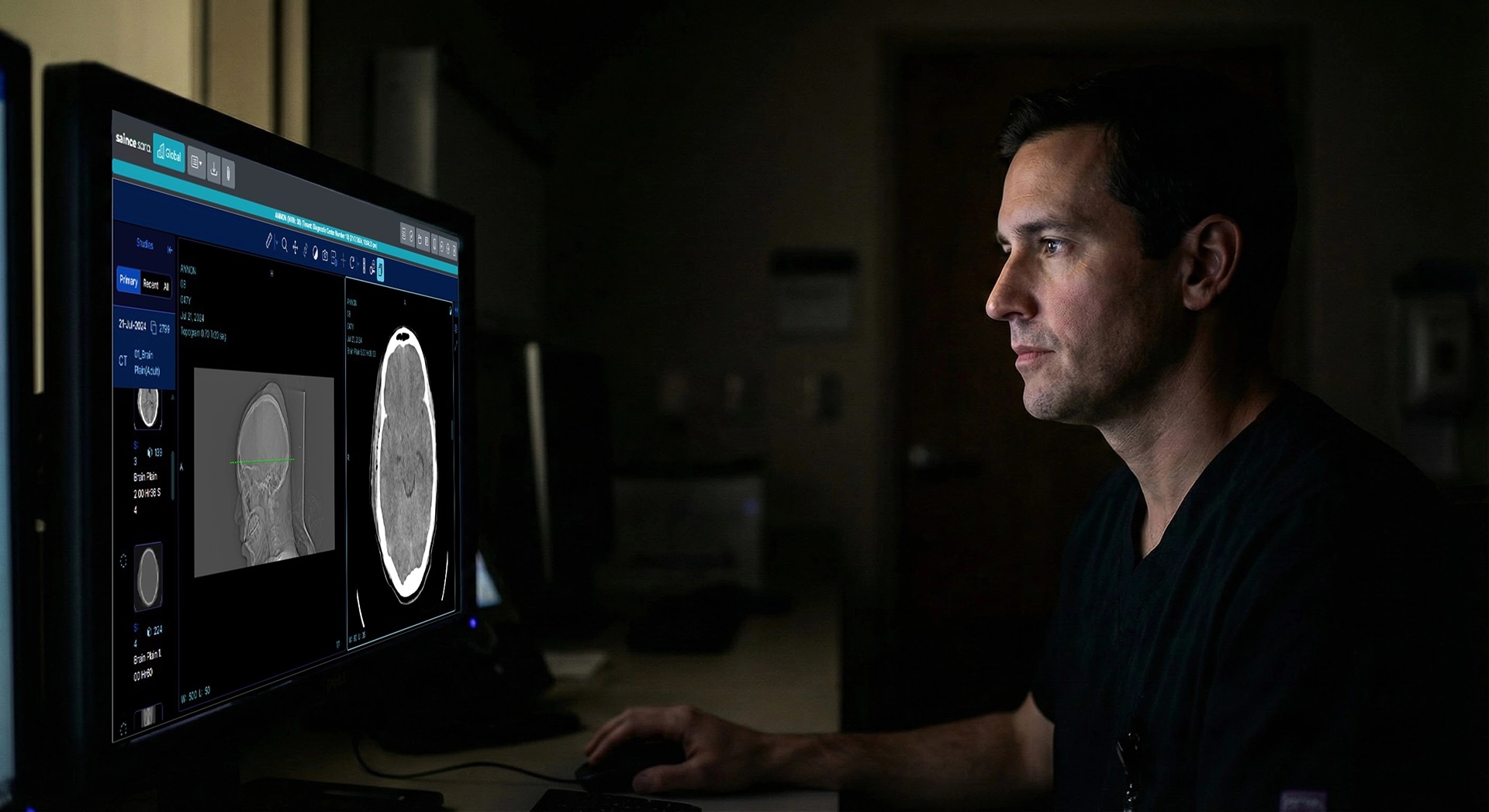
These products address different jobs. A viewer helps a radiologist examine an image. A radiology information system helps the department move a patient through the examination. Saince’s pitch joins those jobs while supporting connections to third-party systems. Its range is a positioning choice; whether it simplifies a particular hospital depends on how well those connections work there.
Keep the neighborhood connected
Ziva takes the coordination problem across an Indian hospital, linking registration, records, insurance billing, diagnostics, pharmacy and inventory. There is precedent for that ambition. In 2016, Saince Health Tech introduced the RapidR prescription app. In 2019, Qural launched as a free-to-subscribe platform connecting patients, physicians, pharmacies and laboratories.

Launch coverage described Qural as promoter-funded, with profits reinvested, and reported over ₹50 crore invested in the platform and drug-database technology. That historical investment illustrates the cost of building connections; it is not a price for today’s hospital products. Earlier, Saince had appeared on the Inc. 5000 in both 2015 and 2016.
The current company describes its move toward AI as a strategic shift built on clinical workflow experience. The recurring idea is easy to copy: follow information through the whole job, including the person who checks it. For a hospital evaluating Saince, the decisive test happens at those handoffs. Does the next person receive something they can actually use?