Raghav Narayan can make an industrial sensor sound like a question about time. A business takes a sample. The sample travels. Someone waits for a result. Meanwhile, the business keeps running. Aprisium, the Singapore company he co-founded, works on that awkward interval between something happening and someone knowing enough to act.
It is a fitting problem for an executive whose career has already included more than two decades inside a multinational. At Volvo Group, Narayan held general manager and managing director roles. Now his company develops autonomous, on-site contamination monitoring. The scale of the organisation has changed; the need to persuade an operator that a new approach is useful has followed him.
There is an appealing lack of romance in the proposition. An industrial customer has a process to run, costs to manage and decisions to make. The sensor has to earn its place among those obligations. For Narayan, the business begins where an interesting piece of technology meets someone with a reason to use it.
Twenty-four years, then a new problem
More than 24 years at Volvo Group gave Narayan experience in established operations with international reach. His background spans automotive, industrial, financial services and technology businesses. That is a different preparation for founding a company from the familiar story of someone arriving directly from a university laboratory.
He also led the rollout of a B2B enterprise software startup across 26 Asia-Pacific countries. A rollout across that many markets makes commercialisation an undertaking of its own. The product needs to travel through customer organisations as well as across borders. A useful feature must become a reason to buy, and a purchase must become something people actually use.
Seen in that light, the distance between enterprise software and environmental sensing looks more manageable. Both involve organisations adopting a new way of working. Scientific performance matters enormously at Aprisium, but the CEO’s experience also belongs to the less photogenic part of the job: moving an organisation toward a decision.
A company between the sample and the answer
Aprisium was established in Singapore in late 2021. Its founding story continued through the Singapore Deep-Tech Alliance’s 2022 venture-building cohort, where Narayan and physicist Dr. Lars-Henrik Skjolding built a company around technology originating at A*STAR, Singapore’s Agency for Science, Technology and Research.
The partnership joined commercial experience with specialised sensing expertise. Skjolding’s background includes chemical sensor development and research into electrochemical sensors. Narayan brought the operating and market-facing side. The pairing gives the venture a recognisable shape: research can provide a capability; a business has to find the people, applications and relationships that give that capability a working life.
The company’s devices analyse contamination at the site rather than making every answer depend on sending a sample away. Its wider approach connects sensing with cloud-based data and analytics. For a customer, the attraction is the possibility of acting on conditions closer to the moment they occur.
That timing matters to the story because the company is selling a change in an operating routine. A reading is useful when someone can connect it to a choice: investigate a change, adjust a process, or decide what requires attention. A dashboard full of numbers still needs a place in the working day.
The founder still has to sell
Narayan has called founding Aprisium the highlight of his career. Asked to describe the job, he included troubleshooting, generating revenue, negotiating partnerships and keeping the team moving together. The answer puts a useful amount of furniture back into the otherwise rather empty phrase “startup leadership”. There are actual tasks in the room.
“The true highlight of my journey has been starting Aprisium.”Raghav Narayan
His public advice to newcomers emphasises learning, connections and persistence. His lighter answers include an unresolved preference between sesame ice cream and rum, raisin and nuts. It is a modest glimpse of someone whose public working life is otherwise crowded with analyzers, funding rounds and partnership agreements. The dessert counter has escaped the efficiency programme.
The picture is of a founder comfortable discussing both the technical ambition and the ordinary demands of a business. That combination matters in a company staffed by people with very different kinds of expertise. The product has to work; colleagues also need a shared understanding of what they are trying to deliver.
Seven million dollars buys a next chapter
In August 2024, Aprisium announced an oversubscribed US$7 million Series A led by Deep-Tech Venture Partners and Cocoon Capital, with participation from Woh Hup and Solisa Peppercorn. The stated plans included expansion in Europe, the United States and Southeast Asia.
At the time, the company reported analyzer deployments in Singapore, the Philippines and Australia. Its commercial interests covered several different operating environments, including water treatment, cooling towers, data centres, mining and shipping. Those markets share an interest in understanding what is happening inside a material or a process, though the customer’s daily work differs considerably.
The funding therefore marked a transition with practical consequences. Reaching further afield means explaining a technical proposition in more settings. Each prospective customer brings a different installation, procurement process and reason for caring about the result. A larger map gives the commercial team more work to do.
For Narayan, international expansion also returns to familiar territory. His earlier career had already involved multinational operations and enterprise software across Asia-Pacific. Aprisium gives that experience a new object: an instrument whose value has to be understood at the point where an industrial decision gets made.
The cooling-system chapter
By October 2025, Aprisium was announcing agreements around cooling fluids. One memorandum with Castrol BP set out plans to explore analytics and digital monitoring for liquid-cooling and thermal-management systems. The proposed combination brought Castrol’s PG25 engineered coolant together with Aprisium’s sensing and analytics platform.
A separate memorandum with IX Technology, announced at Data Centre World Asia, concerned integrating monitoring into immersion and liquid-cooling systems. The intended work covered coolant quality, contamination and performance. These were agreements to develop and explore applications, with their eventual operating results still to be established.
This chapter gives Narayan’s business a particularly concrete setting. The digital world has a physical backstage: equipment, fluids and systems that require attention. A data centre customer may encounter Aprisium through the question of keeping a cooling process under observation. The commercial conversation can begin with the equipment already in the building.
In April 2026, Aprisium agreed a pilot with MREIT and FOPM at One Le Grand Tower in Manila’s McKinley West. The project was designed around cooling-tower operations, with intended measurements involving water use, energy efficiency and chemical dosing. Imagine H2O Asia’s Water Innovation Pilot Fund supported the initiative.
A pilot is a useful unit of ambition. It gives the proposition an address and a set of questions that can be tested in operation. Here, the promise of more timely information becomes a question about how one building’s cooling tower runs. That is a scale at which a customer can begin to judge the idea.
A signature, and the work that follows
At Singapore International Water Week in June 2026, Narayan signed a memorandum with Adrian Lo of TÜV AUSTRIA. The proposed collaboration covered real-time monitoring, laboratory services, validation and certification. It also envisaged opportunities across Asia-Pacific, Europe and the Middle East.
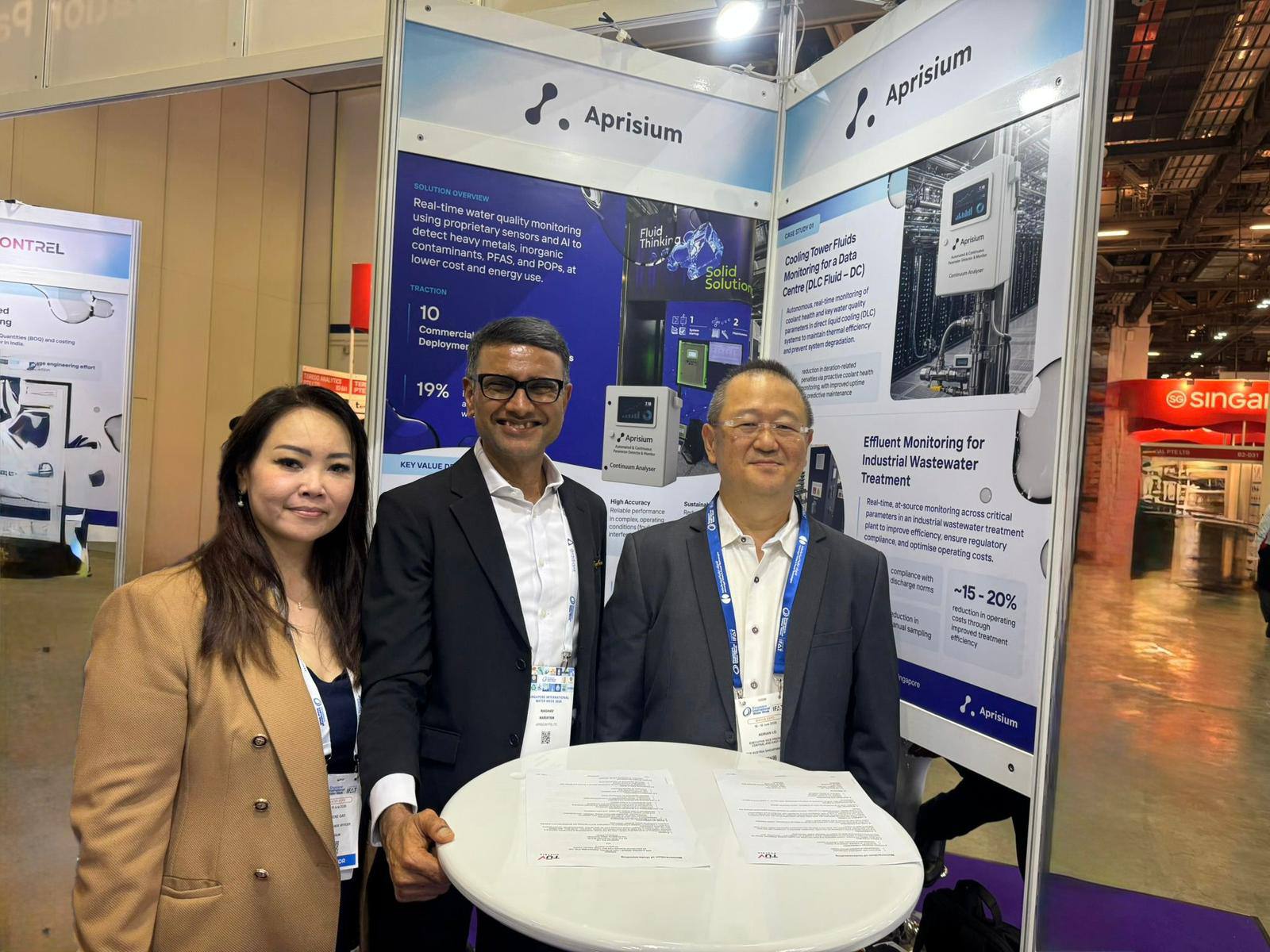
The agreement brings another consideration into view: customers need confidence in an answer as well as speed. Bringing monitoring together with validation acknowledges both parts of that decision. An instrument enters a workplace with existing expectations about reliability and responsibility. The relationship around it can matter alongside the reading it produces.
The event photograph captures a recognisable part of Narayan’s work. There is a stand, a table, paperwork and people gathered beside displays explaining the equipment. For all the science inside the product, business still involves making the case face to face. The exhibition badge remains a stubbornly analogue accessory.
The question he keeps returning to
In a June 2025 video interview, Narayan discussed autonomous water analysis and its role in reducing waste and shortening treatment cycles. Aprisium had also received the 2023 Emerging Enterprise Most Promising Sustainability Startup award. The recognition and interviews gave him platforms to explain a business whose usefulness depends on details far from a stage.
The award led to a conversation with radio host Michelle Martin, published in January 2024. The discussion centred on how Aprisium uses data management and analytics to help customers understand contamination. It put Narayan in the role of interpreter: explaining a technical business to listeners who might never need to purchase one of its devices.
That public-facing work sits naturally beside his commercial responsibilities. An interview, an exhibition stand and a customer discussion ask for different levels of detail. Each requires him to connect the instrument with a recognisable problem. The chemistry can be specialised; the explanation still needs somewhere clear to begin.
The through-line is a practical one. A customer needs an answer early enough to affect an operation. A scientific team needs a route into that operation. A founder has to bring those needs together, then repeat the work with another customer, another partner and another site.
Narayan’s second act places decades of commercial experience beside a technical problem with immediate consequences for how businesses run. The latest agreements give the company further places to test its proposition. His task continues at the meeting point between an analyzer and an operator: making the next reading arrive with a reason to care.