Rain is democratic. The bill for dealing with it rarely is. In Fairfax, Virginia, the old stormwater funding arrangement placed a disproportionate burden on residential properties. Commercial properties paid less than their share; untaxed properties paid nothing. Changing that arrangement meant handing some people a new expense. A better calculation was about to become a difficult conversation.
- Raftelis helps governments and utilities set rates, organize work, and explain consequential changes.
- Its work connects financial analysis with public outreach and practical implementation.
- Ellio adds subscription software for financial scenarios, performance, and peer comparisons.
That conversation is a useful place to meet Raftelis. The firm occupies an unglamorous, consequential corner of consulting: helping public organizations make essential services financially workable. Its assignments can end in a rate schedule, a leadership appointment, a strategic plan, or a functioning billing system. The common thread is a decision that somebody must explain to the public.
01 / The meeting changes the model
In its account of Fairfax, Raftelis describes stakeholder meetings and tailored communications about the proposed stormwater fee. Business and faith-based groups raised concerns. The city expanded credits and postponed implementation so affected organizations could prepare. After a hearing with more than two hours of comments, most supportive, the council approved the fee.
The interesting detail is the changed policy. Listening produced something more concrete than a nicer brochure: different terms and more time. For anyone managing a contentious change, that is the part to copy. Ask what people can reasonably absorb while there is still room to adjust the decision.

02 / A specialist with several toolboxes
George Raftelis started the business in 1993 after leaving Ernst & Young. The firm’s early purpose was financial consulting for essential public services. A group of employees acquired part of the company in 2004. That history helps explain its market position: a specialist in the economics and management of organizations whose customers depend on continuity.
Today its financial practice covers cost-of-service studies, rates, capital plans, valuations, and affordability. Other teams handle organizational assessments, executive recruitment, strategic planning, communications, and technology. A city can use those services to examine staffing, recruit a manager, or determine how a proposed investment would affect customers’ bills.
The technology practice adds systems work that buyers might otherwise procure separately: financial management, customer information, asset management, data, and cybersecurity. That combination matters when a recommendation depends on several departments sharing information. A finance team can approve an elegant rate structure and still need help making its billing software, records, and everyday procedures carry out the decision consistently.
Raftelis says it has supported more than 2,000 local governments and utilities. Nearly 20% of its staff have worked in public agencies. Those are company-reported figures, but they describe the pitch clearly: experience with the institutions buying the advice, alongside technical expertise.
“At Raftelis, my contributions are valued, and I learn from my colleagues daily.”
Beverly Foster, consultant
The firm describes hybrid work, mentoring, peer groups, and staff retreats. Its employee-led charitable fund also gives its community mission a practical outlet. In 2025, it reports contributing $111,552 to 26 organizations. Culture claims deserve scrutiny; specific activities offer something firmer to examine than a wall of adjectives.
03 / A billion dollars needs a rate model
Pittsburgh Water illustrates the stakes. Deferred maintenance left the utility facing extensive renewal. State utility regulation arrived in 2018, adding new reporting and rate-setting demands. Successive five-year capital plans exceeded $1 billion, while substantial rate increases made affordability a central concern.
Raftelis built a cost-of-service and rate model, supported five completed regulatory rate cases between 2018 and 2025, and used account and census-tract data to examine affordability. It also helped develop stormwater fees and integrate billing. Here, the assignment connected an infrastructure program with revenue collection and the households expected to fund it.
- 01CalculateCosts + investment needs
- 02TestAffordability + public input
- 03ImplementRates + billing operations
This breadth is Raftelis’s useful distinction. The same public-sector focus runs through financial advice, communications, staffing, and software. Alternatives include specialist rate consultants and financial practices within engineering firms. Procurement records put names such as Bartle Wells, Carollo, NewGen, and Willdan in the same market. Buyers still need to compare the actual scope and team.
04 / What the invoice buys
Dallas provides a concrete cost example. In December 2020, the city approved a five-year service price agreement with Raftelis for maintenance and support of its existing Stormwater Information Management System. The estimated amount was $1,197,000. The record specifies that actual spending depended on need and appropriations; the estimate was neither an upfront payment nor a spending cap.
Estimated over five years for existing stormwater software maintenance and support.
First deployed in fiscal 2017, that customized application connects billing datasets, produces export files, and records parcel-level changes. Nightly updates keep information current. Maintaining the system is continuing operational work. The example also explains why a support agreement should be read carefully before treating its headline value as revenue already earned.
05 / The model stays on the desk
Ellio gives Raftelis another business model: annual software subscriptions. Financial lets utilities compare scenarios involving rates, borrowing, growth, and capital projects. Its organization subscription includes unlimited users, with consulting support available. Performance assigns responsibility and tracks goals. Analytics compares utility rates and financial measures, using filters such as geography and utility size.
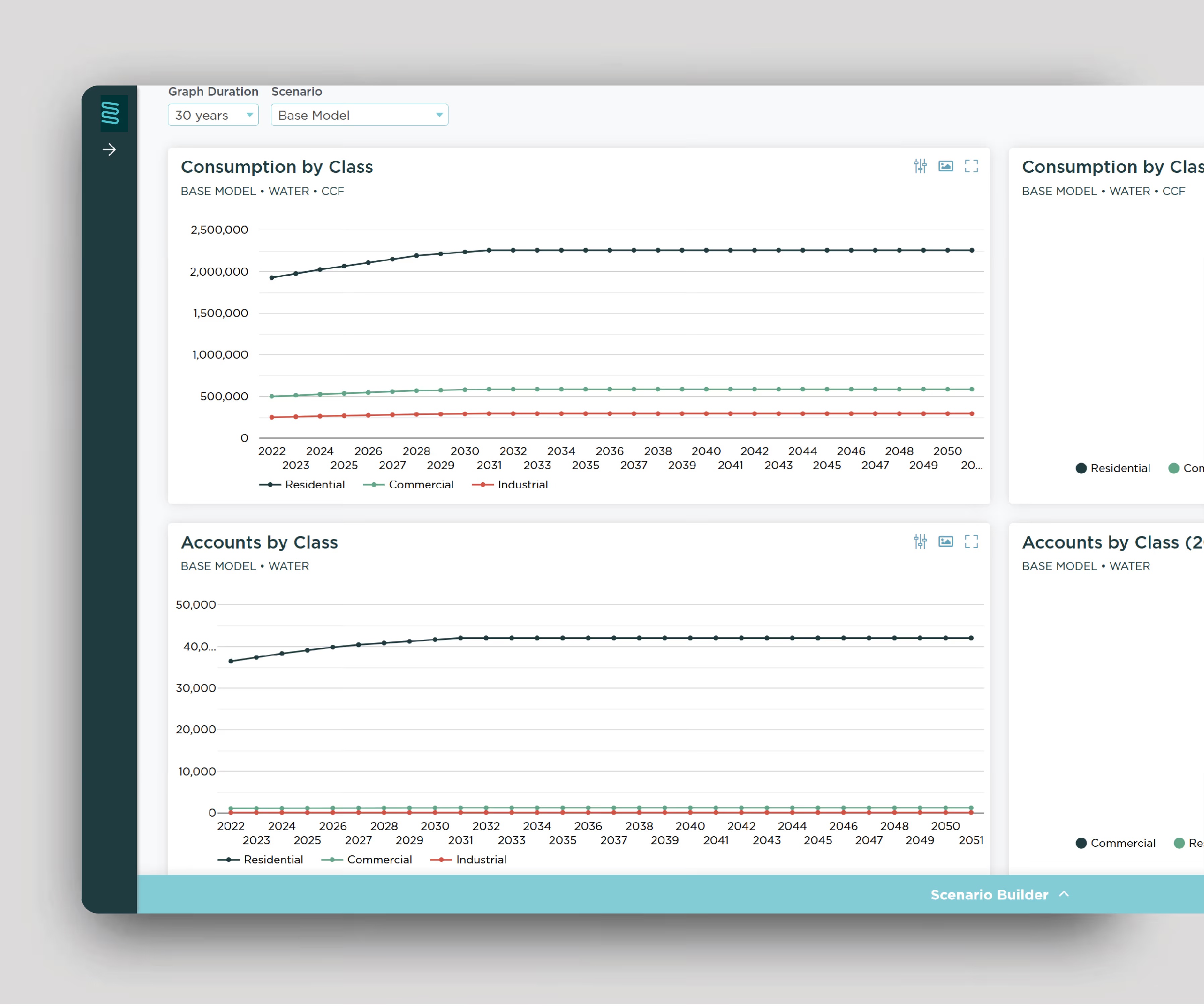
For a utility manager, the attraction is practical: revisit assumptions when circumstances change and keep colleagues working from a shared model. A dashboard still needs dependable inputs and someone responsible for acting on the results. Likewise, outreach needs an agency willing to reconsider details. Fairfax’s response suggests why flexibility matters as much as presentation.
A useful buying question follows: which parts of the job need outside expertise, and which will remain with staff? A rate study, a public engagement process, and software support address different needs. Put the expected deliverables, ongoing responsibilities, and assumptions beside the price. Dallas’s agreement shows why the duration and spending terms matter. Fairfax shows why a schedule may need room for public response. An organization that cannot supply reliable information or make decisions across departments should address those constraints before expecting a consultant’s model to settle the argument.
The question to borrow from Raftelis’s work is simple: who has to live with this decision after the consultants leave? Put that person into the analysis early. The public meeting, the capital plan, and the eventual invoice all become easier to understand when they are treated as parts of the same job.