The original Radix product solved a problem so ordinary it was easy to ignore: apartment managers were spending their week calling competitors, collecting rents and concessions, and rebuilding market surveys in spreadsheets. By the time the document reached an executive, the market had already moved. Blerim Zeqiri had watched this ritual from inside Alliance Residential, where he worked across revenue management, research, asset management and acquisitions. His conclusion was blunt. The industry did not need another prettier report. It needed a better way to collect the facts.
Radix, founded in Scottsdale in 2016 by Zeqiri, Alex Viderman and Eugene Kobrinsky, turned that complaint into Benchmark, a cloud product that standardized competitive properties down to floor plans and refreshed operating measures such as effective rent, occupancy, leasing traffic and concessions. One million apartment units entered the network in roughly its first year. Two million followed by 2019. The company says the network passed 5 million in 2020 and reached 9 million in 2023.
That sequence matters. Radix did not begin by asking customers to believe an elaborate prediction. It first replaced a repetitive workflow, then used the resulting data network to make the analysis more valuable. The dashboard came after the discipline.
Operators shouldn't have to spend more time gathering data than actually using it to make decisions.Blerim Zeqiri, CEO and co-founder
01 / The productThree doors into the same building
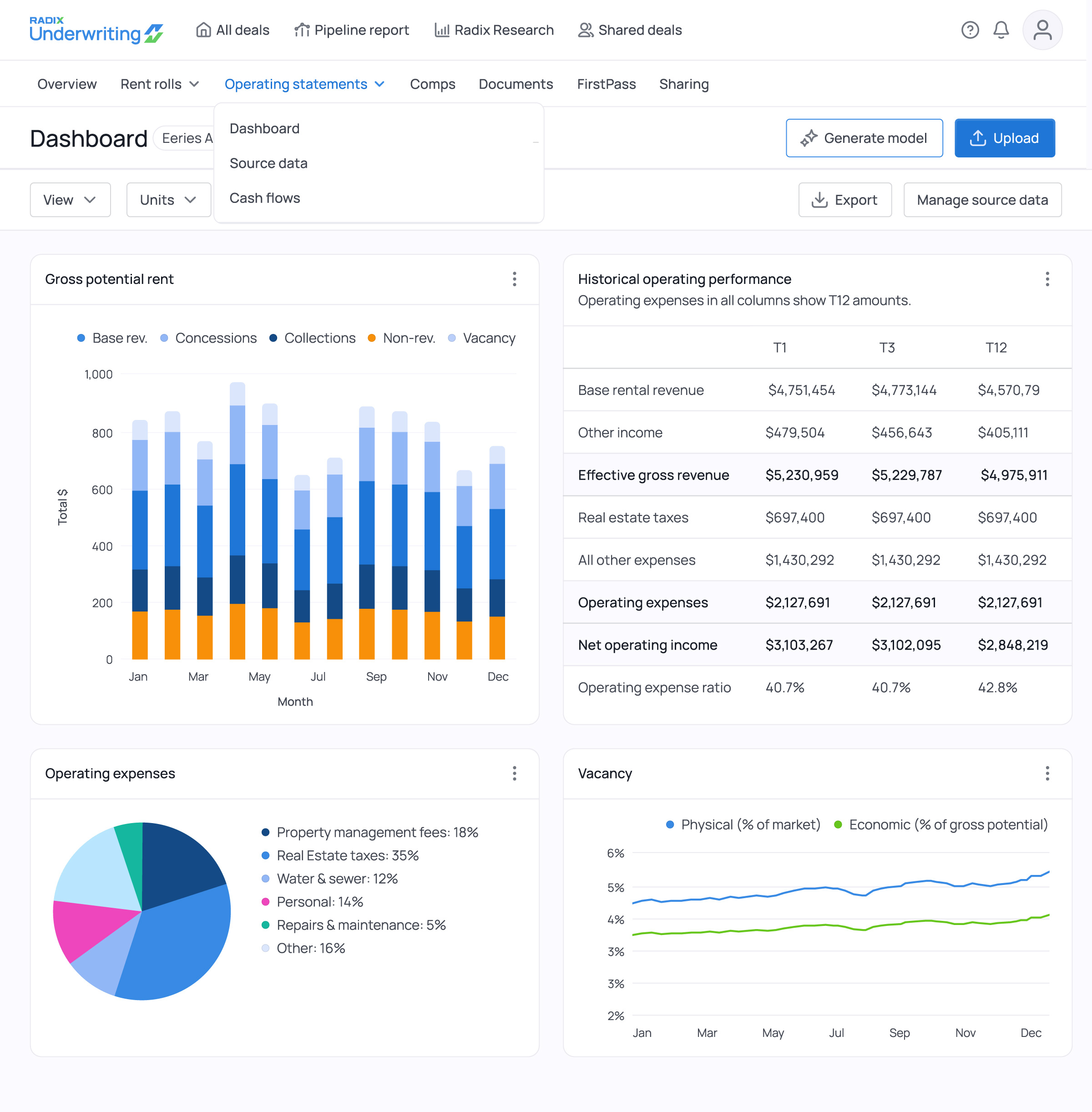
Today Radix presents three products. RealRents is the consumer door: an apartment marketplace that calculates an all-in price, including recurring fees, specials and concessions, then ranks listings by renter fit rather than advertising spend. Radix Analytics is the operator door: real-time competitive data, property and portfolio benchmarking, market research, forecasts and early signals around traffic, leasing and occupancy. Radix Underwriting, built around the redIQ platform Radix acquired in August 2024, is the capital-markets door: rent-roll extraction, operating-statement standardization, scenarios, valuations and Excel exports whose formulas remain intact.
The connective tissue is more interesting than any door. Property data can flow from a management system into a public RealRents listing and back into Analytics as market context. Underwriting can combine the asset's own rent roll with live information about employment, affordability, construction pipelines and nearby operating performance. In the ideal loop, the renter sees the true bill, the manager sees how the property compares and the investor sees whether an acquisition assumption survives contact with the market.
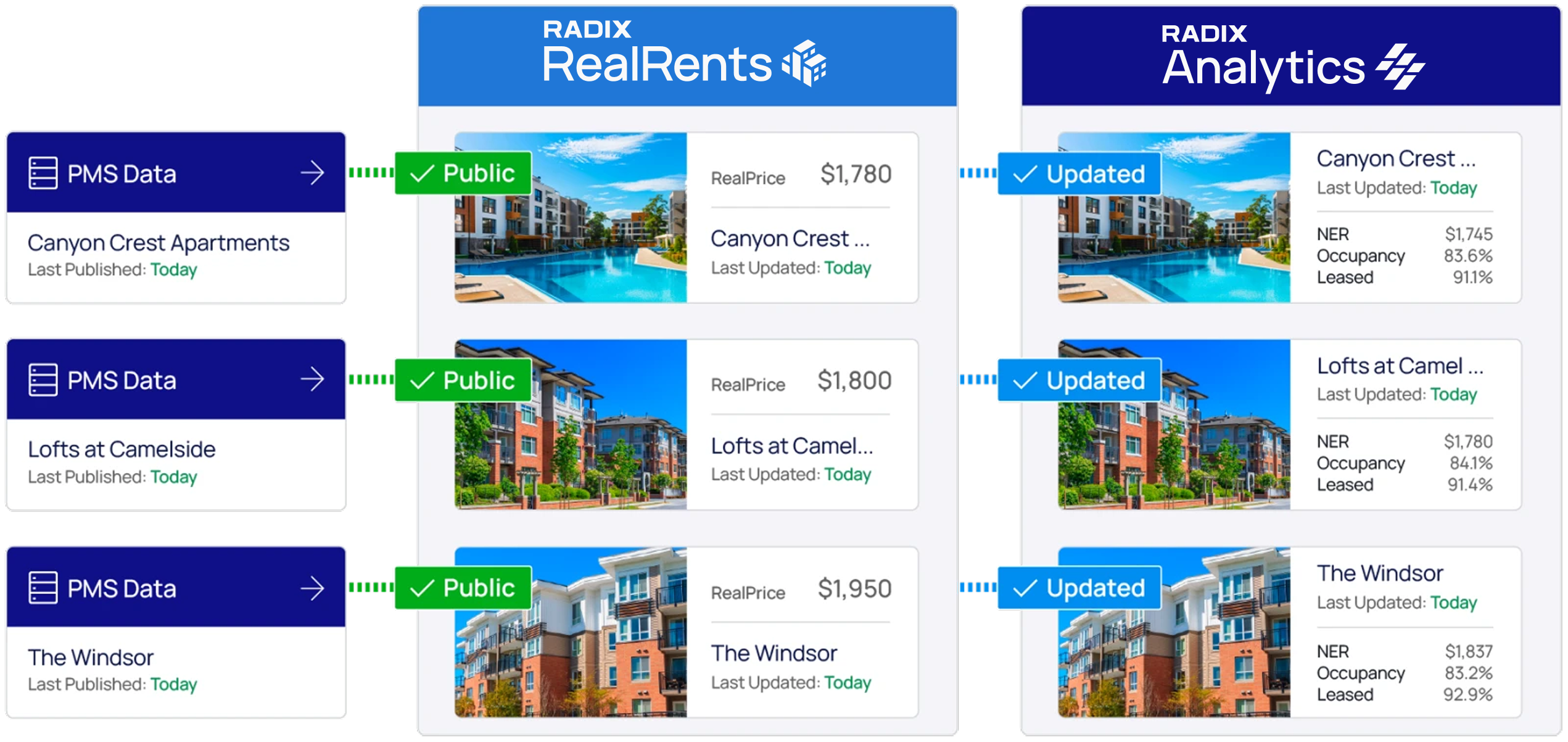
The Radix loop
02 / The turnFrom private comp set to public square
The early value proposition was private and club-like: participating properties exchanged current operating data and gained a clearer view of their competitive set. Customers included owners and managers such as Greystar, Fairfield, Bozzuto, Lincoln Property Company, RPM, Mill Creek Residential and Cushman & Wakefield. Radix said in 2022 that more than 200 major owners and operators used the platform. In 2023 it said 23 of the NMHC Top 50 were represented.
Then the politics of rental data changed. Algorithmic rent setting drew regulatory scrutiny, renters pushed harder against hidden fees, and a private-data advantage began to carry reputational baggage. Radix's answer was not to abandon data but to make more of it public. In 2024 it offered clients complimentary access to scraped information alongside its direct data and committed to a public-facing ecosystem. RealRents, launched in 2025, gave that position a product.
This is Radix's sharpest distinction from conventional listing sites. A typical internet listing service sells attention; a property can pay for greater visibility. RealRents says relevance and comparative value determine rank. It also distinguishes a base rent from the amount a person will actually pay. That makes the product as much a policy argument as a search engine: a rental market works better when the price is legible.
03 / The acquisitionThe spreadsheet still gets a vote
Radix's 2024 acquisition of redIQ filled a conspicuous gap. Analytics can tell an owner what is happening at a property. It does not, by itself, clean the rent roll or build the model that an acquisition committee will approve. redIQ had spent more than a decade on those chores. At the time of the deal, Radix said roughly 30 percent of multifamily transactions passed through redIQ and that the system processed more than 500,000 rent rolls in 2023.
The combined Underwriting product now promises to turn weeks of document wrangling into minutes, preserve Excel formulas, and let analysts test debt, rent, expense and exit scenarios without rebuilding the file. Radix says 700-plus acquisition teams use the product, including six of the ten largest NMHC owners, and that more than $1 trillion in assets have been underwritten through it. Those are company figures, best read as evidence of distribution rather than an audited measure of outcomes.
The business model is classic vertical SaaS: professional products are sold by demo to owners, operators, investors, brokers and lenders. There is no public rate card. The disclosed capital cost of expansion is clearer: Level Equity led an $11 million Series A in April 2022. The price Radix paid for redIQ was not announced. RealRents is the distribution counterweight - free to renters, and pitched to operators as a way to earn qualified attention without buying ads. Public listings feed the enterprise intelligence layer, which gives “free” a strategic job.
04 / The catchReal time has a human in it
Radix's first enemy was manual collection. Its newest product has not escaped humans entirely. RealRents can pull unit-level rent, lease term and availability from supported property-management systems each day. Concessions, however, must still be updated manually every week. A property gets a Verified badge when its key information has been refreshed within seven days; stale entries lose that signal and may fall in visibility.
That is not a footnote. A free month, waived fee or odd lease term can materially change an apartment's effective price. If the promotion is stale, the “true price” stops being true. The weakest part of a data network is often the one field an overworked on-site employee must remember on Friday afternoon.
The clever part is not collecting more data. It is making one clean input useful to three people who usually argue from different spreadsheets.YesPress analysis
The playbook worth stealing
- Start with the recurring task customers resent, not the dashboard they say they want.
- Standardize the inputs at the smallest useful level - for Radix, that meant floor plans and units.
- Let participation improve the product for every customer; a data network compounds better than a feature list.
- Expand into the adjacent decision, as Radix moved from market survey to research, underwriting and rental search.
- Give the free surface a job. RealRents is consumer utility, operator distribution and fresh market input at once.
05 / The limitsWhere the model bends
Radix fits best where there are many comparable apartment properties, supported management systems, repeat transactions and teams willing to maintain the feed. Its floor-plan comparisons and network effects are less compelling for one-off buildings, unusual asset types or thin markets. It is also a U.S. multifamily specialist, not a general real-estate operating system.
Properties share standardized, frequent data; operators connect supported systems; and teams act on traffic, leasing and occupancy signals before they become lagging reports.
Concessions go stale, integrations are unavailable, comparables are sparse, or a team buys analytics without changing the weekly decision process around them.
Competitors attack pieces of this stack: Yardi Matrix and CoStar sell market intelligence; RealPage and MRI cover property operations and revenue tools; Apartments.com and Zillow dominate renter attention; internal Excel models remain stubbornly flexible. Radix's defense is the join. It wants the same normalized evidence to follow an apartment from listing to lease, and an asset from first look to disposition.
That ambition also explains the company's culture. Radix has grown from Scottsdale into an international team of more than 100, with a Prishtina, Kosovo, office opened in 2018 for engineering, design and management talent. Its leadership mixes former operators, economists, product builders and data specialists. The best product clue may be the least glamorous one: this is a company staffed by people who know exactly how a rent roll arrives - late, inconsistent and attached to an email with “final_v7” in the filename.
Radix is not trying to remove judgment from multifamily. It is trying to make judgment less dependent on archaeological work. If it can keep the public promise as carefully as it built the private network, the payoff is larger than faster underwriting. Renters, operators and investors could finally disagree while looking at the same number.