The doctor is in the directory. That much is settled. Whether the doctor is at the listed address, accepts the plan, or takes new patients is another investigation altogether. A provider directory can look like an invitation and behave like a locked door.
Quest Analytics operates in that uncomfortable interval. It sells software and services to the organizations that build healthcare networks and the agencies that inspect them. Its subject is access: where providers are, whom they serve, and what happens to a network when a name is added, corrected or removed.
- For plans and regulators: measure network adequacy, identify gaps and prepare reports.
- For provider data teams: verify directory information through BetterDoctor and examine its effects on access.
- For network builders: compare providers, model changes and bring claims-derived performance into contracting decisions.
There is a wonderfully bureaucratic word for the central problem: adequacy. It asks whether a network provides sufficient access under the applicable criteria. The trouble begins when the inputs flatter the network. A beautiful map made from bad addresses remains a beautiful mistake.
01The doctor exists. The appointment may not.
In its second round of Medicare Advantage directory reviews, conducted between September 2016 and August 2017, CMS examined 14,869 provider locations. It found at least one inaccuracy in 52.20% of them. Errors included incorrect telephone numbers, providers absent from listed locations and misleading information about acceptance of new patients.
That distinction between a provider and a provider at a particular place is essential. CMS identified group-level records as one contributor to error: a practice could list a physician at an office where that physician rarely or never saw patients. The organization had an address. The patient needed an appointment.
Quest connects two questions often handled separately. Is the network geographically adequate? Is the information describing it accurate? Its argument is that the second answer can change the first. Counting a doctor at an unused location does more than spoil a directory entry; it can distort the apparent supply of care.
02Two founders, then a purchase of better facts
David H. Hill and John P. Weis founded Quest Analytics in 2003. The early business supplied healthcare network software and consulting, including access and disruption analysis. Disruption analysis has an unusually human purpose beneath its technical name: compare networks to understand the consequences of changing them.
Vestar Capital Partners acquired Quest in August 2017. Hill and Weis retained a substantial minority ownership stake at the time. In June 2018, Quest acquired BetterDoctor, with financing from Vestar and Health Catalyst Capital. The deal joined tools for analyzing a network with a business devoted to verifying the records underneath it.
“Network adequacy and accuracy are inextricably linked.”
Ari Tulla, then Quest Analytics CEO / June 2018
The purchase made strategic sense. Software can calculate the distance between two coordinates very efficiently. It cannot make an outdated practice address true by calculating harder. Verification belongs upstream of the map. Buying BetterDoctor put that work inside the same company.
Quest's history also contains a useful wrinkle: its QAS product page describes a network-analytics lineage, including GeoAccess, stretching back roughly 30 years. That is a claim about the tools' heritage. The company itself dates to 2003. Software, like houses, sometimes comes with older foundations.
03The ruler on both sides of the desk
Quest's market position is unusual because its customers include both health plans and their overseers. In December 2025, the company announced a five-year CMS contract renewal. It says its work supporting Medicare Advantage adequacy reviews began in 2007, and describes geocoding and proximity mapping against time and distance standards.
A Quest-published case study of an unnamed metropolitan plan makes the attraction concrete. The plan offered Medicare Advantage and Medicaid products but struggled to establish where it stood before regulators reviewed its network. Some apparent gaps came from reporting and coding errors. The first failure was the measurement process.
The plan adopted QES Adequacy. Its network operations manager valued being able to analyze adequacy internally using the same supplier used by CMS and the state's Department of Health. This is a vendor-selected account, but the operational lesson is sound: discover the problem while there is time to investigate it.
- 01VerifyProvider + location
- 02MeasureAccess + gaps
- 03ModelAdditions + removals
- 04ActRecruit + correct
Sharing a supplier does not remove the need for good inputs or regulatory judgment. It does offer a common measurement language. That helps explain Quest's appeal without pretending that buying its software buys an automatic pass.
04The fax had a better idea
BetterDoctor's own account of its early verification work provides a practical lesson about listening. It began large-scale validation with phone calls in 2015 and found that practices preferred different ways to communicate. During a 2016 pilot, it added email, fax, mail and voicemail alongside calls.
The company reported quarterly response rates rising from 40% to as much as 70% after that change. It also described problems collecting corrected records back by fax or mail and moved providers toward online attestation. Those are historical company-reported results, not a forecast for a new customer. The copyable idea is simpler: give people several routes into the task, then make the final record structured.
Today, BetterDoctor offers practitioner verification through its portal and roster submission for large groups and health systems through BetterDoctor Exchange. The latter is free to those groups. Asking a large practice to submit a roster recognizes that its administrative work differs from that of a single clinician.
05More than a compliance filing
Quest Enterprise Services, or QES, is the cloud SaaS platform for network management. Its tools cover adequacy, data accuracy, network performance, modeling and access reporting. Quest Analytics Suite, or QAS, is the desktop offering for access and disruption analysis, geocoding, maps and commercial RFP responses.
The work reaches beyond insurers. Health systems can examine specialty coverage, identify recruitment needs and assess the value of their networks in payer negotiations. Brokers and benefit consultants can compare access for an employer's population. Regulators can examine submitted networks. These users share data problems, but ask different questions.
Quest also integrates outside performance information. An April 2024 partnership brought Motive Practicing Wisely's physician appropriateness measures into QES. A June 2025 Arcadia integration added elements of CareJourney's Provider Performance Index, including cost, quality and episode information. The ambition is to move contracting discussions beyond a provider's name and address.
Provider Claims Insights supplies claims-derived activity and performance information; Competitive Insights compares networks using payer-supplied, regulator-validated data alongside claims and public information. These tools help teams build a shortlist with a reason for each name. The final negotiation still happens outside the analysis.
Michigan approved a three-year contract ceiling for Quest software supporting in-house network validation, analysis, data collection and reporting. A ceiling is an authorization limit, not proof of spending or a standard price for QES.
The business earns money from organizational software and services, including consulting and support. Buyers should assess the work they need done, the data they can supply and the scope of the implementation. A regulatory agency's purchase is a useful cost example; it is a poor substitute for a proposal tailored to a health plan.
The broader market includes provider-data suppliers and network-development firms. IDC's 2022 payer data-management assessment also covered companies such as symplr, Availity and LexisNexis Risk Solutions. Andros overlaps in network development. Quest's distinctive pitch is the connection between verification, adequacy measurement and network decisions, supported by longstanding regulator relationships.
06A conversation still needs a correct address
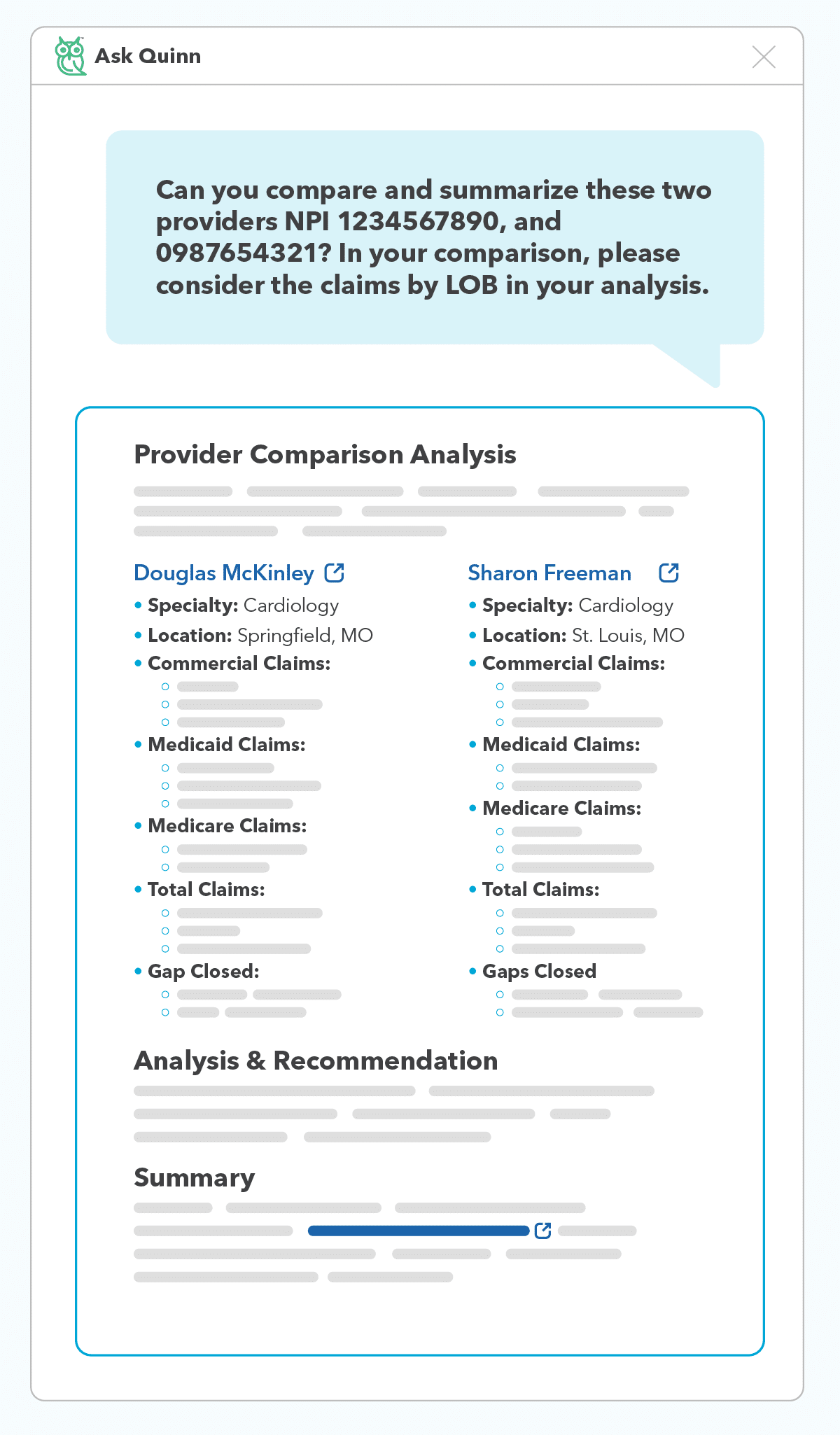
In May 2026, Quest introduced Quinn, a conversational AI assistant within QES. Users can ask about individual providers, access points, gap closure and provider-level effects on adequacy. It changes the route to an answer. The importance of a correct underlying record remains.
The company appointed Mike Cavan Chief Commercial Officer in April 2026 and Chris Lance Chief Product Officer in May. In June, it recognized its first QES and QAS Certified Professionals after hands-on learning labs at Vision Quest. Even a conversational interface benefits from users who understand the question they are asking.

Quest's recruiting materials describe flexible work, professional development and a culture of curiosity and collaboration. Those are employer claims. Its certification program offers a more tangible glimpse of the skills around the product: people practicing network decisions, rather than simply receiving another feature announcement.
The limits are practical. Verified records can still become stale. A gap analysis cannot persuade a specialist to move to an underserved county, create appointment capacity or sign a contract. Performance measures require interpretation. A network team must connect the findings to recruitment, correction and ongoing checking.
For anyone borrowing the approach, start with the provider-location pair. Separate a missing doctor from a missing field. Test proposed network changes before making them. Give practices a manageable way to respond, and keep checking afterward. The reward is a less flattering list and a more useful one. Patients have little use for a doctor who exists only where the spreadsheet says.
Follow the work
Explore the tools, product updates and conversations behind provider network management.