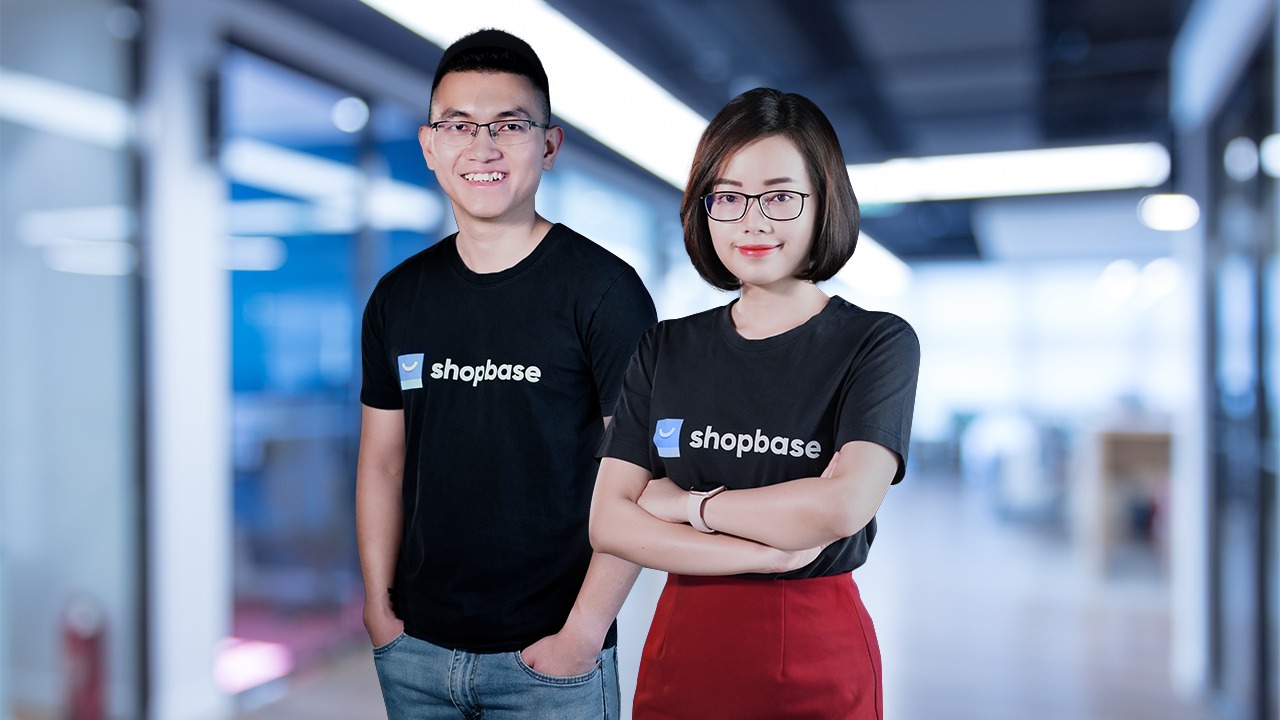
At an American e-commerce conference in late 2017, Quan Truong discovered what a change of shirt could do. On the first day, he wore ordinary clothes and attracted little conversation. On the second, he put on a Beeketing shirt. People came over to talk. Some wanted to invest. A company name on cotton had accomplished what the anonymous founder could not.
For Truong, the pleasure was recognition. People knew something his team had made. This was a particular sort of satisfaction for a programmer who had once delivered websites to clients and then watched his connection to the work end at handover. The shirt offered evidence that a product could acquire a life beyond its maker.
Today, Truong is co-founder and CEO of OpenCommerce Group, the business behind ShopBase, PrintBase and PlusBase. He also uses the name Quin Truong professionally. Across the changes in product and company identity, a question keeps returning: what happens to the customer after the software has done its apparently impressive part?
The customer already had a website
His first commercial skill was coding. As a student, he found freelance website work for overseas clients and built a small team. That work was practical, paid work, connecting programming ability in Vietnam with demand elsewhere. He was learning that software could travel a great deal farther than the person writing it.
A visit to San Francisco sharpened the possibility. He saw Vietnamese and Chinese engineers working at Facebook and Google, earning substantially more than engineers back home. In his telling, the encounter made selling Vietnamese software into the American market feel possible. Geography had started to look less like a career instruction.
His website-building venture, Sieuweb, exposed a less agreeable truth. A merchant could acquire a handsome site, buy traffic and still struggle to turn visitors into customers. The founding team had been close enough to those merchants to see the gap. More visitors did not automatically produce more sales. Neither did a nicer page.
In 2014, Truong and his colleagues started Beeketing to work on that gap. Its marketing applications followed shopper behaviour and helped sellers make recommendations, send reminders and bring customers back. The product addressed work a small shop owner might otherwise have to learn, organise and repeat by hand.
There is a small joke tucked inside the name. Beeketing combined co-founder Phuong Anh Ha’s interests in marketing and her Pomeranian. The business had an automation proposition, a market and a dog somewhere in its etymology. Corporate naming committees have laboured longer for less.
A pitch deck learns to count
An early Beeketing presentation described a commercial sequence: attract merchants with free applications, learn from their use, then offer paid tools suited to their needs. The slides reported $24,000 in monthly recurring revenue and monthly growth of 30 to 50 percent for nine consecutive months. Those were the company’s figures at that stage, rather than a promise about the years ahead.
The presentation also divided responsibilities among the founders. Truong handled business and product, Alice Ha handled marketing and sales, and Dzung Da handled systems and backend technology. Even in a short pitch, the work had more than one author. Software companies become easier to misunderstand when every achievement is squeezed into a single founder’s biography.
Beeketing joined 500 Startups’ Batch 15. In a later account, Son Le Thanh remembered meeting Truong during a Founder Institute Vietnam delegation to Singapore in 2014, when Beeketing was still unfamiliar in the local technology community. The international ambition preceded the familiar name.
The route abroad also involved listening. Two founders spent time in the United States talking with customers and investors on a budget below $2,000 a month. That detail gives the expansion a useful scale: before the funding announcements came the decidedly less ceremonial business of paying the bills.
- 2012SieuwebBuild the website
- 2014BeeketingHelp the visitor buy
- 2019ShopBaseBuild the commerce platform
The founder who let the team get on with it
By July 2019, an appearance on the Always Be Raising podcast framed Truong’s management problem as the move from five people to more than 130. The episode also addressed fundraising. A team that size asks different questions of its founder: who decides, who explains, and which decisions still need to reach the top?
In his discussions of hiring, Truong placed particular weight on the first employees. He wanted capable people who took responsibility and could manage themselves. He warned founders against copying large employers’ recruitment methods when they had neither the same money nor the same name recognition. A smaller company had to give a candidate a convincing reason to join.
His argument came with an obligation. The reason had to be personal, credible and supported by examples. A large ambition could open a conversation; the founder then had to behave as though he meant it. Otherwise, a recruitment pitch was merely a pleasant story with an employment contract attached.
At early Beeketing, that commitment had a price. Truong said the company was losing about $3,000 a month while employees’ pay was maintained and founders took reductions. He went without a salary for six months. The claim matters as a specific early decision, with an actual cost to the person making it.
He also described moving a new employee between functions so that the person could find work that suited them. In another account of the company, he spoke about monthly conversations with colleagues about what they wanted from their jobs, and giving team members responsibility and authority. He could spend a month travelling in China while the business continued to function. For a founder, being missed less can be a useful achievement.
“We used to spend thousands of hours getting our business in shape.”
Quan Truong, on building tools for online sellers
Build the ground beneath the shop
Beeketing depended on larger platforms. In his 2023 account, Truong said a platform policy change in 2019 hurt revenue and helped persuade the team to build a platform of its own. ShopBase began in the middle of that year. Selling tools inside someone else’s world had exposed the limits of control.
The decision widened the job. OpenCommerce Group’s ecosystem came to include ShopBase, PrintBase and PlusBase, covering storefronts, print-on-demand and dropshipping. The ambition was to help a merchant with more of the sequence between choosing something to sell and getting it to a buyer abroad.
For a seller, those stages are connected. A marketing campaign can succeed while the order behind it remains difficult to fulfil. A storefront can work while payment or shipping becomes the obstacle. Following the merchant’s work pulls a software business toward the less photogenic parts of commerce: orders, production arrangements, delivery and support.
In February 2022, OpenCommerce Group announced a $7 million Series A led by VNG, with Do Ventures participating. At the time, the business reported supporting 86,700 sellers across 195 economies and reaching $670 million in cumulative gross merchandise value. The last figure measures merchandise traded through the ecosystem; it is separate from the company’s own revenue.
Truong said the money would support product improvements and help reach new customer groups, with Europe, the United States, China and Southeast Asia in the expansion plan. Do Ventures’ Vy Le described the opportunity in terms of lowering the threshold for Vietnamese merchants to enter overseas markets. The investor and founder were discussing the same practical ambition from opposite sides of the cheque.
A reading list with work to do
Truong’s book recommendations have the air of a working shelf. He described Traction as an introduction to digital marketing for someone whose background was programming. He returned to Rework for ideas about meetings, product choices and how to work. Lean Analytics offered a way to choose where a company with limited resources should put its attention.
There was room for fiction. He credited The Little Prince with helping him think about purpose, family and his enthusiasm for work. He also recalled reading The Dip while struggling with Sieuweb and considering whether to continue. The reading crossed from how to operate a company into how to decide whether a particular company deserved more of his life.
He later singled out systematic problem-solving. He said he began studying the skill deeply in 2019 and that OpenCommerce Group required leaders and managers to understand the approaches in Ray Dalio’s Principles and Charles Conn and Robert McLean’s Bulletproof Problem Solving. His verdict was cheerfully numerical: “I think I’m at least 2x smarter.”
The line has the programmer’s fondness for an improvement that can be expressed as a multiplier. It also admits that the founder needed to learn something. A company can outgrow the habits that helped create it; a reading list is one way to keep that fact in view.
The next question is still about the user
In July 2025, Leanbase announced a webinar featuring Truong as CEO of both Leanbase and OpenCommerce Group, alongside ShopBase product manager Giang Le. The subject was product development with AI, understanding users and producing business results. He describes Leanbase as a product management platform for customer-first teams.
The setting had changed from merchants’ storefronts to the teams deciding what software to build. The underlying question was recognisable. What does the user need, and how does the product help them accomplish it? A feature can look finished from the developer’s chair long before its usefulness is settled.
OpenCommerce Group’s published ambition now includes reaching millions of merchants. Its company website lists more than 100,000 customers and 130,000 stores created across 195 countries. These are company-reported ecosystem totals, distinct from the dated figures attached to the 2022 financing. They describe the scale of the work around Truong, rather than a personal score.
The conference shirt remains a pleasing place to leave him. Software is invisible until somebody uses it; a name becomes familiar because a customer remembers what happened next. Truong had spent years building things for other people. For one afternoon, wearing the thing’s name was enough to bring those people over.
Keep the conversation going
Find Truong’s work, his public profiles and the longer conversations behind this story.