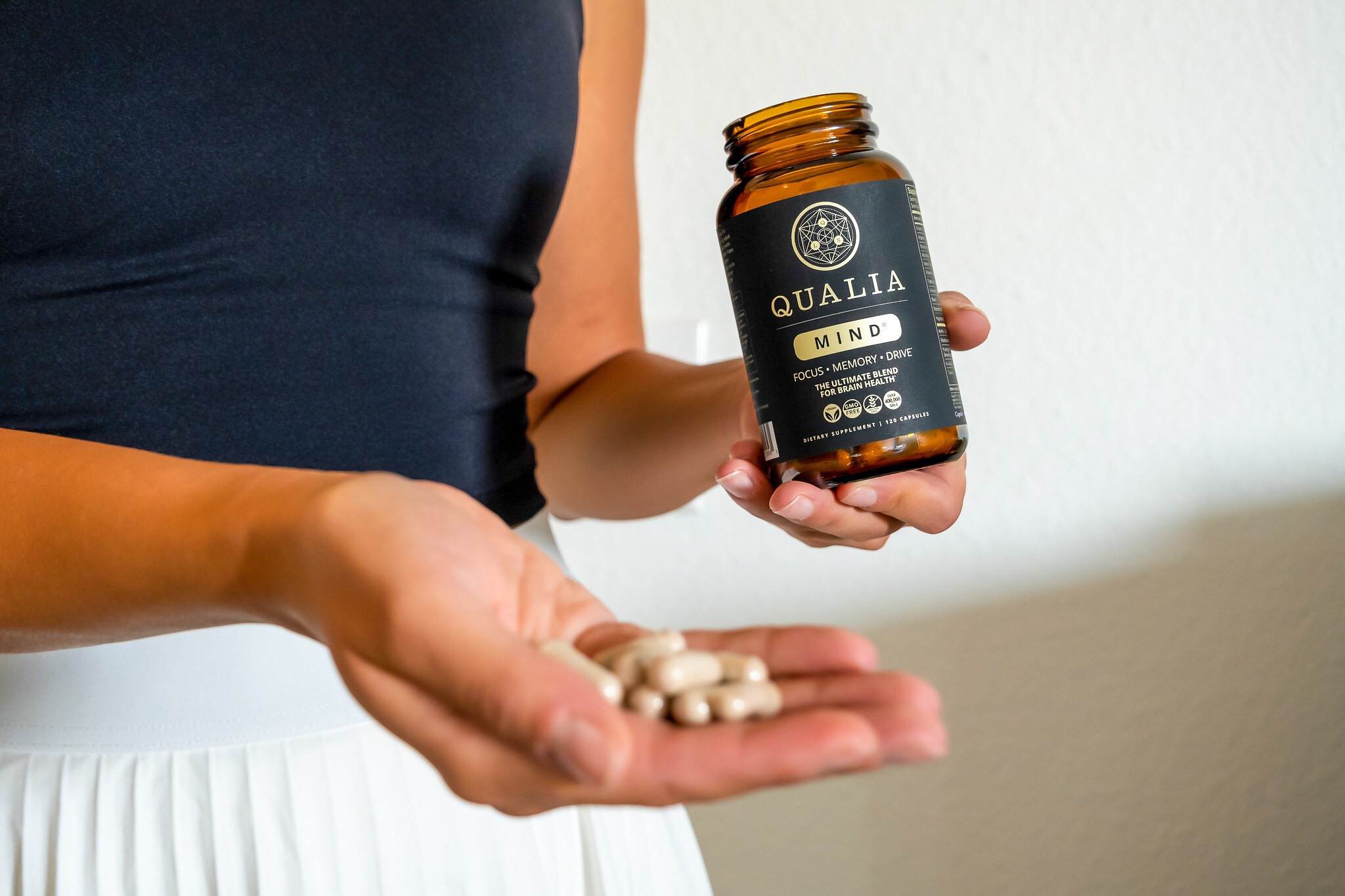
The most honest number in Qualia Life Sciences' story is not 32, the ingredients in its flagship brain formula. It is six, the capsules a customer must swallow for one serving. The earlier version required seven. Customers complained. The company listened, removed eight ingredients, added 13, changed several doses and squeezed the new arrangement into one fewer capsule. This is what innovation looks like in the supplement aisle: partly biochemistry, partly industrial design, partly the stubborn arithmetic of what a human being will do before breakfast.
Qualia sells premium dietary supplements for cognition, sleep, cellular energy, exercise support and healthy aging. Its catalog runs from the $159 Qualia Mind to Qualia Senolytic, a six-capsule course taken on two consecutive days each month, and Qualia NAD+, a two-capsule daily formula. The buyer is usually health-conscious, curious about performance and willing to pay someone else to assemble a complicated stack. Some arrive through podcasts and biohacking circles. Others now find the bottles at GNC, Sprouts, Amazon or through a health practitioner.
A brain brand discovers the rest of the body
The company did not begin with the tidy name on today's label. James Schmachtenberger, his brother Daniel and entrepreneur Jordan Greenhall formed Neurohacker Collective in 2015 after research that had begun the previous year. Their early ambition was gloriously oversized: increase human capacity so people could better handle civilization's problems. The first commercial answer, launched in 2016, was Qualia, a dense nootropic assembled around a claim that still defines the company - biology behaves as a system, so useful formulations should account for relationships between pathways and ingredients.
That was a sharp contrast with the familiar supplement play: isolate one fashionable compound, print its name in large type and imply a straight line from capsule to outcome. Qualia's formulas instead combine vitamins, amino acids, botanical extracts and branded compounds. Its product team maps mechanisms, studies possible synergies and conflicts, considers absorption, then tests candidate formulas. The result is not minimalist. Mitochondria+ lists 34 ingredients and an eight-capsule serving. Night lists 25. Qualia's wager is that comprehensiveness can justify inconvenience and price.
The name eventually became a cage. "Neurohacker Collective" made sense for brain performance; it sounded peculiar on magnesium, joint health and healthy-aging products. By September 2024, the company had renamed itself Qualia Life Sciences. The shift was more than fresh stationery. Two longevity products, Senolytic and NAD+, had become major sellers. Qualia was no longer trying to stretch a nootropics identity over the entire body. It let the product brand swallow the parent.
“We spent about two years in pure research before we felt like we had something solid enough to bring to market.”James Schmachtenberger, CEO and co-founder
What it cost, and what broke first
Patience did not make the early economics painless. Public crowdfunding reports show revenue of $6.62 million in 2018 and $8.19 million in 2019. Gross margin improved to 69.19 percent, but the company lost $909,846 in 2018 and another $334,079 in 2019. It financed operations with a mixture of debt, equity, SAFEs and convertible notes, including a $575,000 note carrying a $40 million valuation cap. Gross margin was healthy; the machine around it was still hungry.
Three things failed before the core idea did. The company was not profitable on a net basis. The original product imposed capsule fatigue. And the original name could not comfortably carry the expanding catalog. None required abandoning complex-systems formulation. Each required translating it into a more workable business: reduce friction, widen the category and build distribution that does not depend entirely on an expensive stream of online ads.
The company also learned that a large ingredient bibliography is not the same as evidence for the finished formula. Ingredient-level studies can suggest a mechanism, but customers buy a combination. Qualia increasingly put complete formulas into human studies before launch, then used open-label or placebo-controlled work to decide between versions and support claims. In 2025 it said two trials of Qualia NAD+ found increases in NAD+ levels. In 2026, an exploratory 53-person Senolytic pilot became its first paper in a peer-reviewed journal.
The Senolytic pilot had no placebo group, lasted one week and reported exploratory biomarker changes that did not remain significant after adjustment for multiple comparisons. The paper can guide better research; it does not show that the product treats disease or extends life.
The research became part of the product
For Qualia, evidence does three jobs. It helps choose a formula. It gives practitioners something more substantial than an influencer testimonial. And it supplies the language of premium positioning. The company can say it tested the complete bottle, not merely cite papers about ingredients inside it. That distinction helped earn a 2025 Nutrition Business Journal award for science and innovation. It also gives a salesperson at GNC a compact reason why this $79 bottle is not interchangeable with a generic jar.
The route to market now mirrors the formulation philosophy: no single channel does all the work. Direct ecommerce provides data, subscriptions and room for long explanations. A 100-day guarantee lowers the perceived risk of a high first purchase. Amazon captures existing demand. Fullscript and roughly 3,800 U.S. practitioners add professional recommendation. Sprouts and GNC provide discovery at scale; nationwide GNC distribution followed a 400-store pilot. The company's site says it sells directly in more than 50 countries.
This mix matters because the product is hard to explain in a thumbnail. Qualia Senolytic's cleverest feature may be behavioral, not molecular: a two-day monthly regimen turns an obscure conversation about cellular senescence into a calendar ritual. Stem Cell uses four days a month. Other products use five days on and two days off. The cadence makes the complexity memorable. It also creates natural renewal moments for a subscription business.
What an operator can steal
The transferable idea is alignment. Pick a point of view that can shape formulation, content, evidence and distribution at once. Qualia's point of view is that the body self-regulates through interacting systems. That explains why its formulas are large, why its education is detailed, why it tests combinations and why practitioners are a useful channel. The company does not bolt "science-backed" onto a conventional product after the fact; at its best, the scientific method is visible in the way the product is assembled and revised.
Turn recurring customer friction into a specific development brief. Qualia treated “seven capsules is tiring” as a design problem, then published the exact before-and-after changes.
More components do not automatically create a better outcome. Every added ingredient brings sourcing, interaction, dosage, compliance, testing and explanation costs.
Give each channel a job. DTC teaches, subscriptions retain, practitioners validate and retail creates discovery. One story should travel through all four.
Company-sponsored trials can improve a product, but they need transparent methods, meaningful endpoints, replication and caveats to earn durable trust.
There is also a useful lesson in the rename. Companies often defend an identity long after customers have chosen a better one. Qualia was already the recognizable product; Neurohacker described only the first category. Management changed its mind when the longevity catalog and its audience made the mismatch obvious. Founders can copy the move by asking a blunt question: does the company name make the next three products easier to understand, or does every launch require an apology?
Where the playbook stops working
Qualia is a poor template for a low-price commodity brand. Large formulas, branded inputs, third-party testing, clinical work, educational content and generous refunds consume margin and attention. The approach needs customers who value curation enough to pay for it, plus a team capable of reviewing interactions rather than decorating a label with fashionable doses. It also needs restraint. If a company turns preliminary biomarkers into promises about disease or lifespan, the research asset becomes a credibility liability.
The products themselves will not suit everyone. High capsule counts are still high. Effects can be subtle, individual and difficult to separate from sleep, diet, stress or expectation. Some ingredients may interact with medications or be inappropriate in pregnancy or for particular conditions. A buyer who wants one well-understood compound, a low monthly cost or a medically supervised intervention should look elsewhere and speak with a qualified clinician.
Still, the company's second act is instructive. Qualia did not become less opinionated as it grew; it became more legible. The civilization-sized rhetoric receded. In its place appeared a product-development loop, a smaller serving, a broader name, controlled retail pilots and research with visible limitations. That is less romantic than “upgrading humanity.” It is also how a strange idea survives contact with customers, cash flow and the supplement shelf.