A beautiful architectural rendering can be a surprisingly effective way to derail a meeting. Qi Su discovered this as a young designer: the team would assemble drawings and diagrams, then the clients would seize on one or two pictures. The rest of the building might as well have stayed at home. Animations helped change the discussion. Showing people the working CAD software introduced a fresh problem: the audience now had to make sense of the machinery behind the image.
Su carried that irritation from architectural practice into a software company. He co-founded Modelo with industrial designer Tian Deng in 2014, bringing 3D models into the browser so people could present, inspect and discuss them. Its origin was a familiar professional indignity: possessing a great deal of information and struggling to get another person to see what you meant.
There is a particular comedy to this predicament. An architect can describe a building that does not yet exist, but explaining a corner of it may require an attachment, an arrow and another email. Su had spent enough time inside that routine to start questioning the tools.
The browser gets another dimension
Architecture had been the expected direction. Su grew up with a family background in architecture and civil engineering, and becoming an architect was a childhood ambition. There was a teenage diversion toward professional soccer. Buildings eventually won. His training took him through the University of Southern California and then Harvard’s Graduate School of Design, where he studied from 2011 to 2013.
By then he had experience of architectural offices and teaching. His career included work with amphibianArc, MADA s.p.a.m. and Michael Sorkin Studio; he also taught at USC and Tongji University. These were useful vantage points for someone interested in how designs travel between people. A classroom, a practice and a client meeting each demand a different kind of explanation.
Harvard brought programming closer to the center of his work. In 2012, Panagiotis Michalatos showed him a 3D model rendered in a browser with WebGL. The significance was immediate: the model could become something another person encountered on the web. A digital object produced for design work could be explored beyond the specialist application that made it.
His thesis project was called SharingStudio. An early version explored a social and virtual environment for designers, using Harvard’s Gund Hall as its interface. The idea changed as it moved toward a business. Su’s academic work also earned the Peter Rice Prize in 2012 and the Digital Design Prize in 2013, connecting his interests in structural invention and digital tools.
A partnership you could rotate
The business emerged through experiment and revision. Betaspring, the startup accelerator, helped mark the transition into a more sustained undertaking. SharingStudio also acquired a new name. Su explained Modelo’s final letter as a circle: the model could be viewed through a full turn. A small naming exercise contained the larger product idea.
A mutual friend introduced Su to Tian Deng. Su remembered their early discussion about working together taking place on a Modelo model page. They chatted and rotated the object in front of them. The proposed collaboration had found a convenient venue inside the thing they were building.
Deng brought an industrial designer’s perspective. Su brought experience of buildings and a growing ability to make software. Their disciplines differed, but both understood the repetitive work surrounding design. Su’s early accounts of the partnership emphasized shared dedication and attention to the experience of using the product. The problem was close enough to both of them to keep the conversation going.
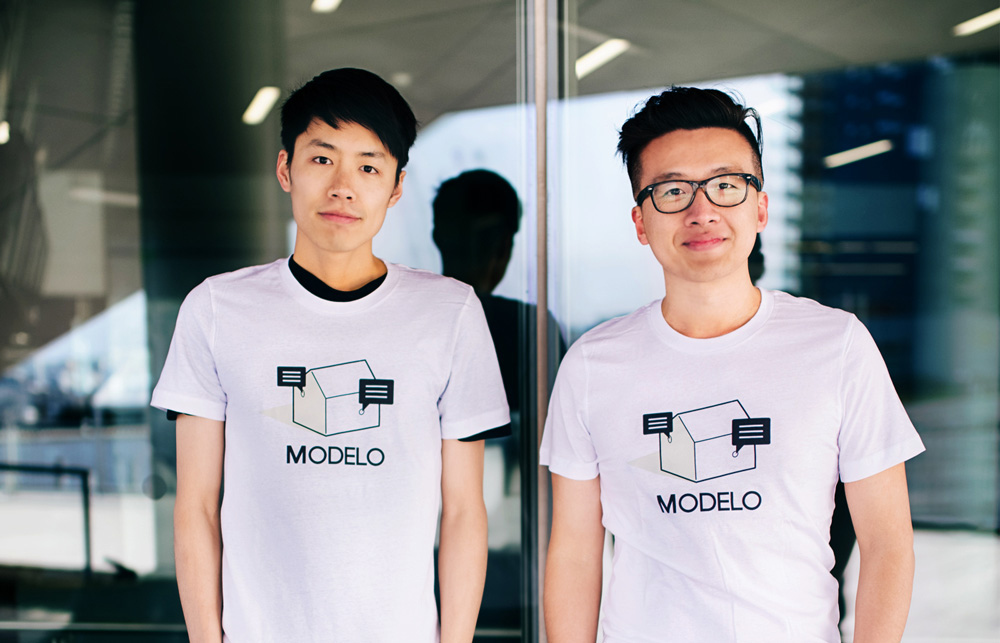
The early company still had the ordinary work of becoming a company. The first prototype appeared in September 2014. Funding followed in January 2015, allowing the team to hire. These are modest calendar entries with substantial consequences: a prototype must become something other people can use, and the people building it must learn to work as an organization.
Su’s responsibilities extended into product development, sales, marketing and recruiting. The architect’s project had acquired customers, colleagues and a payroll. An idea about how to share work was now demanding several new kinds of work from its founder.
An architect among software buttons
Su had opinions about the software his profession used. In a 2015 essay, he argued that CAD applications could contain the necessary capabilities while presenting them through interfaces poorly suited to visually oriented designers. He admired the attention newer graphic and web design tools paid to their users’ habits. Familiarity with an awkward interface, in his view, did not make the awkwardness desirable.
This was a designer’s criticism from inside the daily routine. The person producing a model and the person reviewing it have different tasks. A client should be able to understand the design without first learning which commands created it. That distinction gave Modelo a concrete place to work: the exchange between the author and the audience.
THE WORK HE WANTED TO SIMPLIFY
A schematic of Modelo’s presentation and feedback approach, rather than a measured performance comparison.
At a Boston Society of Architects gathering in 2016, Su described the old review process: print views, sketch changes, scan the marked pages, turn them into PDFs and explain them by email. The audience responded with recognition. Here was a product demonstration with a head start: the people in the room already knew the problem.
His proposed alternative put the conversation closer to the model. He also described keeping the early platform flexible and watching how people used it. That approach left room for customers to reveal which parts of the workflow mattered most. A designer’s experience could suggest the starting point; other designers still had something to teach the company.
His presentation advice showed a similar concern for the recipient. In 2017, he warned architects against overwhelming clients with modeling interfaces, relying too heavily on a rendering or assuming that theoretical diagrams would explain themselves. The point was practical: understand what the client needs before investing more time in material the client cannot use.
The office, with a side of ramen
Su’s product writing also supplied an appealingly ordinary test site: the office. For a panorama demonstration in 2017, he took a Ricoh Theta S camera around the Modelo workspace and its neighborhood in Davis Square, Somerville. The excursion included a favorite ramen place. Even a tutorial benefits from having somewhere to go for lunch.
He then used a map screenshot and the floor plan from the lease to construct the office in Rhino. Downloadable Herman Miller chairs and tables furnished the model. Photographs could be attached to comment cards corresponding to places in the space. The resulting demonstration joined a recognizable room to the views taken inside and around it.
Another tutorial drew on the diagram style associated with Bjarke Ingels Group. Su recalled spending hours moving between Rhino, V-Ray and Illustrator to produce presentation drawings. His walkthrough showed how Modelo’s ArchitectEffect and layer settings could help create an interactive diagram. The founder was still doing a designer’s work, with a different set of controls.
These examples give his software ambitions a useful scale. The task can be as small as explaining a room or showing how parts of a building fit together. Each example asks whether the tool helps another person follow the thought. An office floor plan is a fairly unforgiving place to hide behind a slogan.
Buildings take their time
For someone trying to change design workflows, Su could be patient about the profession’s pace. Asked why the building industry adopted technology slowly, he pointed to its complexity and its many participants. His answer had the economy of a good correction:
“We are dealing with buildings, not toothpaste.”
Qi Su, 2016
He was less forgiving about architectural education’s preparation for running a practice. His comments returned to an obligation beyond making an interesting object: a business must take care of its customers. Software entrepreneurship offered a faster learning cycle, he said, while sharing architecture’s basic satisfaction of creating things for people to use.
Modelo announced its stable release for the AIA Conference on Architecture in April 2017, following more than two years of development shaped by client feedback. The company said its beta had reached thousands of users across hundreds of firms. Those were the company’s reported adoption figures at the time, as the experiment entered a more public commercial phase.
Kujiale acquired Modelo in 2020. The announced plan kept the brand operating independently while connecting it to the buyer’s technology and business resources. In June that year, Su was still explaining product details in a post about adding recorded voice to 3D comments. The audience could explore a space and hear the explanation alongside it.
His public professional profile now places him in Shanghai and lists ByteDance. Modelo remains a clear chapter in his career: an architect encountered a repeated difficulty, learned enough of another discipline to build an answer, and found a partner to develop it. The lovely image on the meeting table had acquired something useful. Someone else could turn it around.
Follow the conversation
Read Su’s writing, hear him discuss the early company, or explore the tools that grew from it.
- Qi Su on LinkedIn ↗ · X / Twitter ↗ · Medium ↗
- Su’s account of Modelo’s beginnings ↗
- The co-founders’ 2016 conversation ↗
- Listen: From Architect to Tech Startup ↗
- Listen in Chinese: IT 公论, episode 190 ↗
- Explore Modelo ↗ · Modelo on YouTube ↗
- Watch: Modelo’s Ennead customer interview ↗
- The 2014 founder interview ↗ · The Boston design tools demonstration ↗
- The office panorama tutorial ↗ · The diagram tutorial ↗
- The 2017 release announcement ↗ · The acquisition announcement ↗