A dentist’s attention belongs inside the patient’s mouth. The equipment, however, lives on the dentist’s face. Between those two places sits an awkward design problem: the clinician must see a small working area while holding a posture that can survive a working day. Q-Optics has built a business around that interval. Its loupes enlarge the view; its fitting process decides where that view should meet the person wearing them.
- Custom dental and surgical magnification, made in the United States.
- Three optical families: Galilean, Prismatic, and posture-focused ErgoAngle.
- Individual fitting, prescription options, and a 45-day trial.
Here is the interesting part. A pair of loupes can look perfectly sensible in a catalog and still be wrong for its owner. A working distance that suits one person may oblige another to move closer. A handsome frame cannot rescue misplaced optics. The question becomes less glamorous, and more useful: where are your eyes when you are actually doing your job?
The geometry of a working day
Q-Optics is a division of Quality Aspirators, whose history begins in 1976. The brand identifies 1997 as its founding year on its homepage and LinkedIn profile. Today its customers include dentists, hygienists, medical professionals, and students. The shared requirement is detailed vision during close work. The fitting requirements are personal.
The company calls its process TrueFit. It individualizes angles, working distance, pupillary distance, and drill height rather than forcing those dimensions into a standard arrangement. Swallow Dental, its UK seller, describes digital capture of facial features and frame position. That makes fitting part of manufacturing, rather than a quick adjustment after a finished product arrives.
Consider the business implication. A conventional catalog presents a product and asks the buyer to choose. This approach needs a conversation about the buyer’s working habits before the specification is complete. The representative has a consequential role: a measurement is useful only when it describes the posture the clinician intends to use.
Three ways to see the same tooth
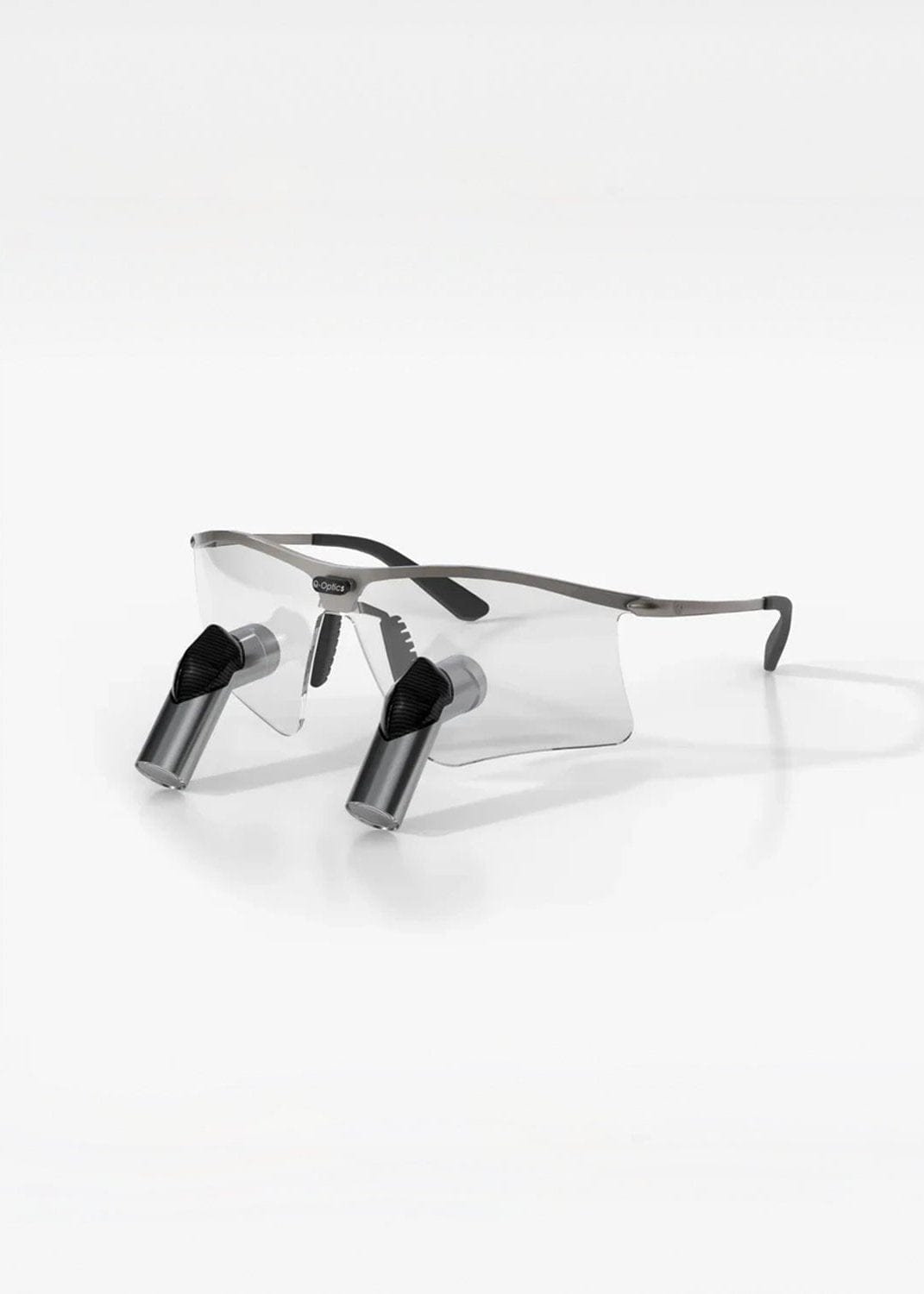
Q-Optics offers three main optical families. Galilean models cover 2.5x, 3.0x, and 3.5x magnification. Prismatic models offer 3.5x, 4.0x, and 4.5x. Their construction includes machined titanium housings and carbon fiber shrouds. The materials serve an unromantic purpose: reduce the burden of wearing an optical instrument on your face.
ErgoAngle adds deflection optics, directing the view downward while allowing a more upright head position. Its listed magnifications run from 3.0x to 4.5x. Q-Optics markets the design around neutral neck positioning. That is a design intention, not a promise that buying glasses will resolve every source of discomfort.
The published specifications reveal a choice that deserves more attention than frame color. In the Galilean range, moving from 2.5x to 3.5x takes the stated field of view from 7-10 centimeters to 3-4 centimeters. More enlargement comes with less surrounding scene. Depending on the task, the smaller window can be either welcome detail or an inconvenience.
Prescription choices make the distinction between models even more practical. The Eclipse frame accepts a removable prescription insert, useful when alternating with contact lenses or changing a prescription. Classic and Panto frames can carry built-in single-vision or bifocal prescriptions. The right choice depends on the wearer’s routine, not simply the appearance of the frame.
Light has a price tag, too
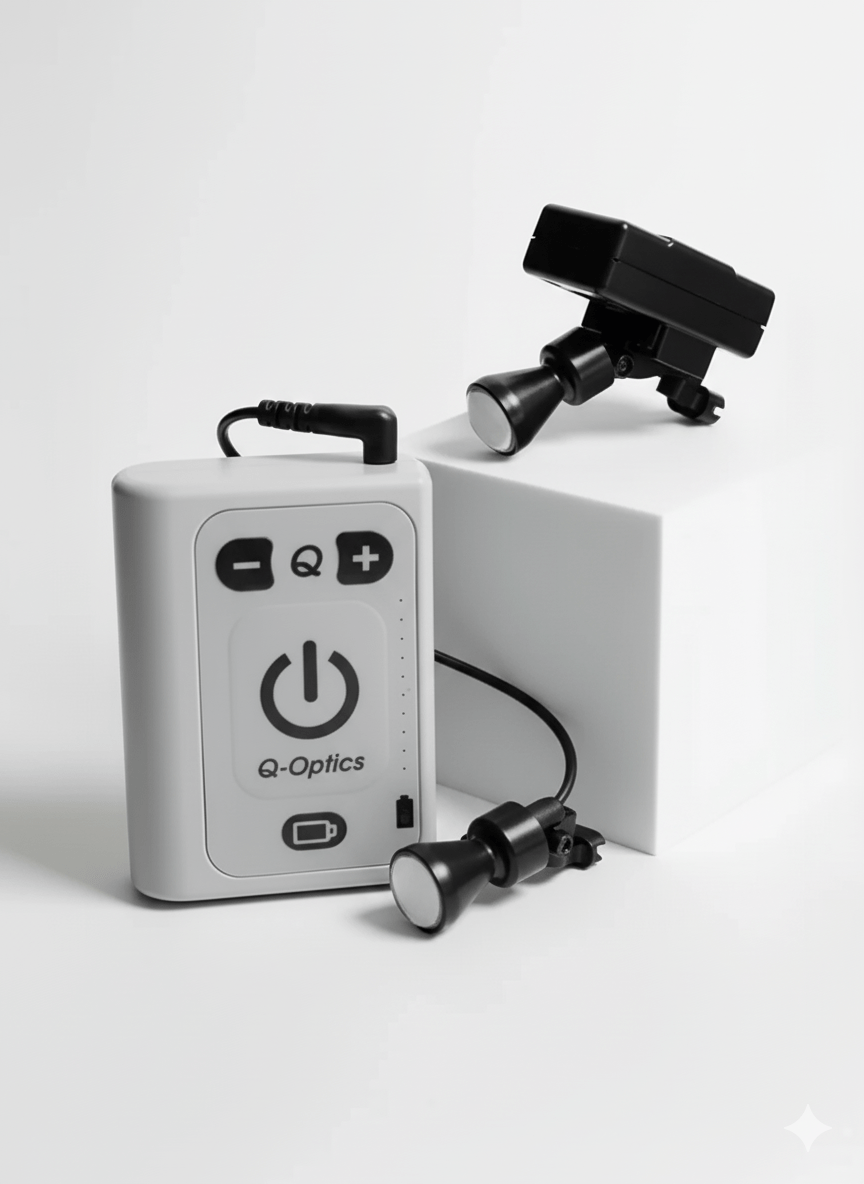
Magnification does little for a patch of shadow. Q-Optics also sells Radiant wired and cordless LED headlight systems. Both product pages list a color rendering index of 90. Color rendering concerns how colors appear under illumination; it is a separate consideration from how large an object looks through the lenses.
At the time of this profile, the wired system and its cordless counterpart each carried a public list price of $945 USD. Custom loupe buyers obtain pricing through a representative. That makes the sensible purchasing exercise a configuration-specific quote: optics, frame, prescription, lighting, and any applicable student benefits considered together.
The sales model mixes personal service with online commerce. Representatives handle demonstrations and custom purchases; international distributors provide another route to local fitting. Lighting and accessories also appear in the web store. Q-Optics competes in a specialist equipment market alongside brands such as Orascoptic, Designs for Vision, SurgiTel, and LumaDent. A useful comparison begins with the actual wearer and a written quote.
The fitting continues after delivery
Delivery is not the end of the experiment. Q-Optics offers a 45-day trial, with a refund or adjustments if fit, magnification, or optical alignment needs attention. Students receive additional provisions, including no-interest payment plans and free prescription and working-distance changes while enrolled. That acknowledges something sensible about training: a student’s setup can change.
There is also a learning period. In Dental Advisor’s ErgoAngle evaluation, ten evaluators reported 375 uses and a 96% clinical rating, with Editors’ Choice recognition. One evaluator put the transition plainly:
“The learning curve is not steep, but it takes some getting used to.”ErgoAngle evaluator / Dental Advisor
Its practical advice includes practicing on a model, beginning with simpler procedures, and arranging a representative follow-up. The rating describes that evaluation; it cannot establish how every clinician will feel years later. Familiar habits, inaccurate fitting, or an unsuitable field of view can all complicate adoption.
Ownership deserves equally careful reading. The limited lifetime loupe warranty covers specified defects for the original purchaser. Normal wear and accidental damage receive four years of coverage, subject to exclusions. Lights have shorter terms: 24 months for wired headlights and their accompanying battery, while cordless batteries have 12 months. A battery and a titanium frame have different futures.
The lesson travels beyond dentistry. Measure the person at work. Compare tools in the conditions where they will be used. Leave time for adjustment. Q-Optics’ proposition is persuasive when those steps happen together: a small instrument, individually positioned, with service available after the box is opened. The face in the catalog is never quite your face.