A lead can have an owner and still be alone. There is a name beside it, a phone number beneath it, perhaps a property attached. The database looks orderly. The prospective buyer is waiting. Somewhere between assigning the enquiry and actually answering it, the system has mistaken possession for progress.
PropSpace has a feature for this rather human problem: a shared Lead Pool. An idle enquiry can return to circulation under rules set by the brokerage, giving another agent a chance to work it. It is a modest idea with an interesting implication. Sometimes the useful thing to buy after paying for leads is a better way to handle the ones already purchased.
That is a good entry point to this Dubai software business. PropSpace sells a cloud-based customer relationship management system for property professionals, with a companion property management platform. The work includes enquiries, listings, viewings, commissions, leases and maintenance. The glamour belongs to the buildings. PropSpace gets the follow-up.
A new enquiry
A named agent
A next step
A workflow, not a conversion forecast. The brokerage sets the rules.
Four months to something useful
The origin was close to the work. Alex Nicholas and Siddharth Singh, the co-founders of JRD Group, had worked together at Accenture. Their property portals put them in contact with the agents who would become their software customers. They could see where managing the day’s work became awkward.
In a 2016 interview with Wamda, Nicholas described building the first version with Singh and one engineer in about four months. In June 2012, he recalled, “we scored our first client”. It is a useful founding detail because it has dimensions: three people, a few months, somebody willing to use the result.
By 2015, PropSpace had entered the UK and US, and JRD had received a Series A investment from iMENA. The company’s starting point in the Gulf did not prevent it from trying markets with established software suppliers. Today its pitch is again particularly legible to UAE agencies: software organized around the transactions and connections they handle.
The portal and the filing cabinet part company
Property Finder’s purchase of JRD Group was announced in 2019. That brought a property portal and the software behind agency work under the same owner. The logic was understandable: one business helped people find property; the other helped professionals organize what happened around that search.
In 2024, Property Finder divested PropSpace, explaining that it wanted to concentrate on its core offerings. There is the documented change of direction. A portal could focus on the consumer property search while the CRM became an independent business.
Patrick Caulfield became CEO. He had previously led Arthur Online, a UK property management software business acquired by Aareon, and subsequently worked on acquisitions for Aareon. PropSpace’s own history identifies Caulfield and COO Tom Dickson as the buyers. Dickson’s background spans brokerage and software in the Middle East. Together, their experience sits on both sides of the problem: operating property businesses and building tools for them.

CEO · Property software operator

COO · Brokerage and SaaS experience
Independence did not remove the practical need to work with the former owner. Property Finder remains a supported integration. Ownership and connection are different questions, and a brokerage using the product needs the second to keep working regardless of the first.
The deal ends. The work carries on.
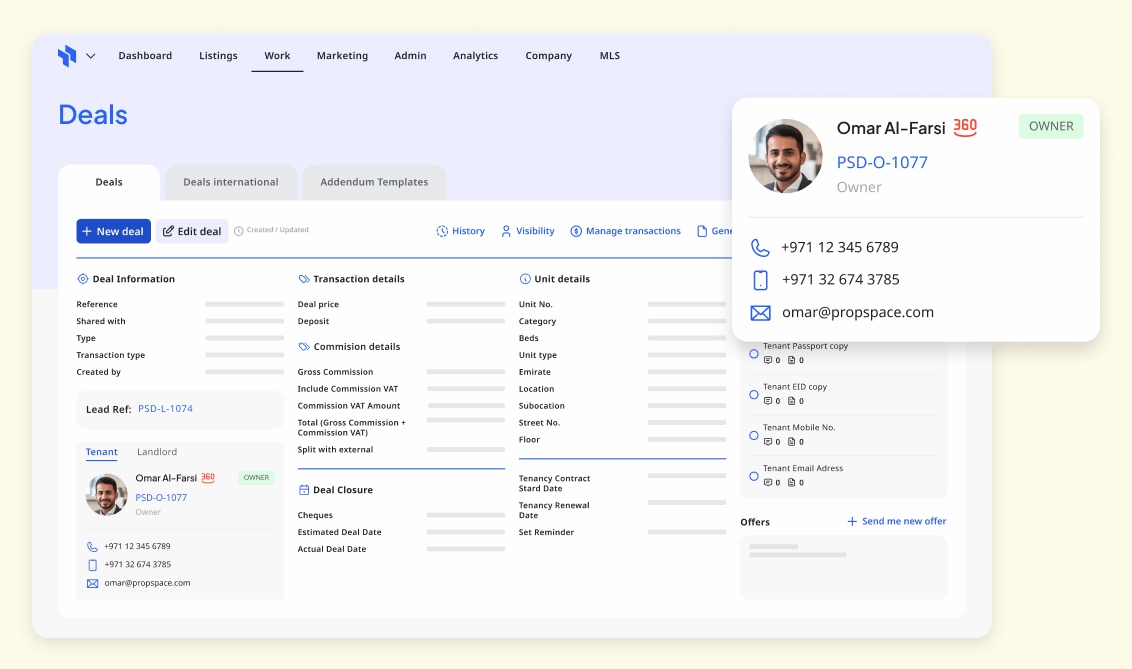
On the brokerage side, PropSpace connects property records with people and activity. Agents can create listings, match them to enquiries, arrange viewings and track transactions. Marketing tools produce brochures and campaigns; the company advertises publishing to more than 80 portals, including Property Finder, Bayut and dubizzle. Deal tools record payments and commission splits.
The local detail is the point. A generic contact record is useful almost anywhere. An agency also has to get a listing onto the portals it uses, keep its transaction documents together and establish who earns what when a deal closes. PropSpace puts those tasks inside a product built around property work.
The manager’s version follows a different clock. It records tenancy contracts, renewal reminders, maintenance work orders and expenses. It can generate statements for landlords, while dedicated portals serve managers, tenants and owners. A sale might be a milestone; a managed apartment is a continuing series of obligations.
The glamour belongs to the buildings.
PropSpace gets the follow-up.THE EDITOR’S TAKE
The pairing makes particular sense for a business that both lets properties and manages them. Customer details, property records and later operational work belong to a connected process. PropSpace offers migration assistance and training, recognizing that a new system has to receive the existing business before it can organize the next one.
The company says hundreds of agencies use its software and displays customers including CBRE, Savills, Hamptons and Edwards & Towers. That places it in the everyday business software market, selling subscriptions to professionals. An agency is buying a working environment for its team, rather than paying PropSpace a commission for finding a house.
There are alternatives. Zoho markets CRM tools and configurable solutions to real estate businesses too. The useful comparison is how much of an agency’s actual process each setup covers. For PropSpace, the case rests on familiar UAE portal workflows and the combination of brokerage and management. A demo should follow a real enquiry through a real transaction.
The small print is a number
PropSpace publishes its brokerage price at AED 220 per user per month. There is an AED 500 monthly minimum. That means a solo subscriber does not simply pay the headline seat price. Five users, at the published rate, come to AED 1,100 a month.
Calculated from AED 220/user and the AED 500 minimum. Before prepayment discounts; published terms checked September 11, 2026.
Property management is priced separately at AED 11 per unit per month. Paid contracts have a 12-month minimum, even when payments are monthly. The published discounts are 10 percent for a year paid ahead and 25 percent for two years. There is no implementation fee, and a one-week demo gives a team time to try the workflow.
For a small operator, the minimum spend matters. For an established agency, the practical test is whether people will use the system consistently. A neglected record does not become accurate because its subscription is paid annually.
A phone, an export, a second chance
The revealing part of PropSpace’s 2026 update is its candour about ordinary software trouble. The company says its older mobile foundation constrained development. It rebuilt the Broker app in March, added assignment push notifications in April and reported full mobile browser support in June. Large exports had also run into timeouts; the release notes say those were fixed.
These repairs matter to the proposition. A viewing takes an agent away from a desk. A report is only useful if it finishes downloading. Long experience in a market earns familiarity, but every working day still tests the software.
A September API explainer adds another practical detail: agencies can connect lead and contact workflows, and populate their own websites through documented interfaces. Both public APIs are available on every plan, with keys managed inside the account. The product can sit within an agency’s existing tools as well as hold its records.
There is a practice here that a reader can copy without switching software: give an enquiry an owner, a next action and a clear rule for returning it to the team. Decide those rules openly. If activity records are incomplete or reassignment windows ignore the way clients actually decide, automation can shuffle responsibility without improving service. The phone still needs a person at the other end.
Open the working parts
Explore PropSpace, check plans, or browse the product blog and help centre. Read the 2024 divestment announcement.