Dubai has a fund for people who run funds. That may sound like finance disappearing into its own reflection. At Dubai Future District Fund, it is the central idea: a city that wants more technology companies also needs more investors able to finance them. The fund writes checks to startups, but it writes checks to venture capital managers, too. It is trying to improve the supply of both businesses and backers.
The starting commitment was AED1 billion, approximately $272 million. The sum attracts attention; the structure deserves more. Anchored by Dubai International Financial Centre and Dubai Future Foundation, DFDF combines a fund-of-funds strategy with direct startup investment. Its remit connects financial returns to Dubai’s ambition to develop new industries. In practical terms, it wants promising companies to find capital, expertise and a reason to do business in the emirate.
In an August 2022 interview, founding chief executive Sharif El-Badawi identified a shortage one level above the founder’s pitch: the region needed deeper pools of limited-partner capital, the money that finances venture funds. A startup investor cannot keep saying yes if its own fundraising stalls. DFDF’s response was to work on that upstream constraint while continuing to invest in companies itself.
A billion dirhams, with a longer clock
The origin has two dates. Dubai announced the district and its proposed billion-dirham fund in January 2020. The formal launch of Dubai Future District Fund followed on November 15, 2021, when Sheikh Maktoum bin Mohammed also approved El-Badawi’s appointment as CEO. The institutional founders were DIFC and Dubai Future Foundation. This was a public investment initiative, rather than the familiar story of two founders and a borrowed office.
The billion dirhams represents committed investment capital, not a price paid to build a software product. DFDF takes investment exposure through funds and directly through companies, seeking returns as those assets grow in value and eventually produce proceeds. Its founding mandate also includes economic diversification and job creation. The business model therefore has two scorecards: investment performance and a more productive local technology economy.
DFDF describes its structure as evergreen. Unlike a conventional venture fund working toward a fixed life of roughly ten years, it can consider investments with different return horizons. That flexibility matters when a company needs time to establish a market. It does not make the underlying risk disappear. A longer calendar gives a good business more room; it cannot manufacture demand for a bad one.
The fund’s published fellows material describes an intended half-and-half allocation between venture funds and direct startup investments. Treat that as a strategy, rather than a claim that cash moves in perfectly equal amounts each quarter. One channel delegates selection to managers; the other puts DFDF closer to individual companies. Together, they let it support a market at more than one level.
Thirty investments, two very different jobs
DFDF’s review of 2025, published in July 2026, counted 30 investments: 11 venture funds and 19 startups. Eight commitments were new during the year, comprising five funds and three direct company investments. Those figures describe the reported year-end portfolio, not every company indirectly reached through the underlying funds. Keeping the units straight is essential in a business where one fund commitment can touch many founders.
The counterparties are consequently varied. Venture managers seek an institutional backer. Technology founders seek capital and commercial support. Established companies seek useful new products. Job seekers can browse openings across the portfolio through DFDF’s jobs site. Calling all of them customers would flatten the relationship: an investee company sells an ownership interest, while a corporate partner may eventually buy that company’s technology.
The fund’s position is also more complicated than a conventional competitors list suggests. A venture manager can be another bidder for a deal, a co-investor or a recipient of DFDF capital. Its institutional backing and evergreen structure distinguish its offer. For founders, the relevant comparison is whether another investor brings better sector knowledge, a more suitable check or more useful access to customers.
Payments plumbing meets property paperwork
The portfolio thesis becomes easier to understand through the work being financed. In its February 2023 discussion of financial technology, DFDF highlighted NymCard, which provides infrastructure for issuing and processing payment cards. The attraction is the machinery behind financial products: banks, fintechs and other businesses can build services without assembling every component themselves. DFDF’s interest extends beyond consumer banking apps into the systems those apps need.
The same discussion covered FinFlx, an employee financial-wellbeing business, and set out interests spanning payments, insurance, lending, wealth management and regulatory technology. These are distinct operating problems. A company improving employee benefits is selling something different from a card-processing platform, even if both sit under a fintech heading. That breadth explains why DFDF needs specialist managers alongside its own investment team.
Property technology became a more explicit priority during 2025. The annual review reported investments in two property-technology companies and two sector-focused funds. In July 2026, DFDF announced a commitment to MetaProp Fund IV. The New York investor’s model combines early-stage investing with an accelerator and a network of property owners, operators and specialists. For a startup selling into real estate, that network can matter as much as another pitch meeting.
A July 2026 investment note on Isometric shows how DFDF evaluates another kind of infrastructure. It participated in a $40 million Series A alongside AVP, Plural and Lowercarbon Capital. That is the entire round, not DFDF’s individual check. Isometric develops technology for industrial certification, including carbon-removal verification. DFDF’s account emphasized the founder’s previous company-building experience, established customers and potential demand in the UAE.
The revealing detail is the sequence. DFDF says it consulted regional stakeholders while exploring the Isometric investment. Their response helped validate local demand. This is evidence of how conviction formed, rather than a dramatic change of heart: identify a technical capability, test its relevance with potential users, then consider what a regional investor can help accomplish. Founders can copy that order before they copy the fundraising deck.
The introduction has to reach a buyer
A corporate logo on a partnership announcement is easy to collect. A paying customer is harder. DFDF’s work with Nestlé MENA offers a more concrete picture of its intended contribution. At its 2025 annual meeting, the discussion centered on a curated engagement program, including targeted pitch days that would connect startups with the relevant senior decision-makers inside Nestlé.
Rachid Maalouli, Nestlé MENA’s head of innovation, offered the compact instruction: “Don’t try to impress. Try to engage.” The practical advice was to explain the business problem, show traction and adapt to what the corporate actually needs. For a founder, the useful introduction is to someone with a problem to solve and influence over the decision. A room full of executives is only the beginning.
In August 2026, Emirates NBD announced a partnership with DFDF to identify technology, run pilots and consider commercial adoption. Its stated interests included AI banking capabilities, embedded finance, SME tools and compliance technology. The arrangement gives the bank a curated startup pipeline and gives founders a route toward a large financial-services buyer. A pilot remains a test; the announcement should not be read as a booked sale.
The logic is practical, and conditional. It works best when a startup has a product ready for a serious buyer and the buyer has a defined need. It becomes less useful when procurement drags on, the product cannot meet enterprise requirements or the introduction never acquires an internal owner. Capital can pay for development; it cannot substitute for the customer’s decision to adopt.
“Don’t try to impress.
Rachid Maalouli · Nestlé MENA
Try to engage.”
DFDF’s 2025 annual meeting
Fifteen years of venture capital in three days
DFDF also spends effort on the people who will make investment decisions. Its inaugural Venture Fellows program was announced in December 2022 for Emiratis interested in venture investing and technology entrepreneurship. The original intake targeted ages 25 to 40, with four modules over twelve months beginning in February 2023. The learning design included online and in-person work, shadowing, deal scouting and a final investment thesis.
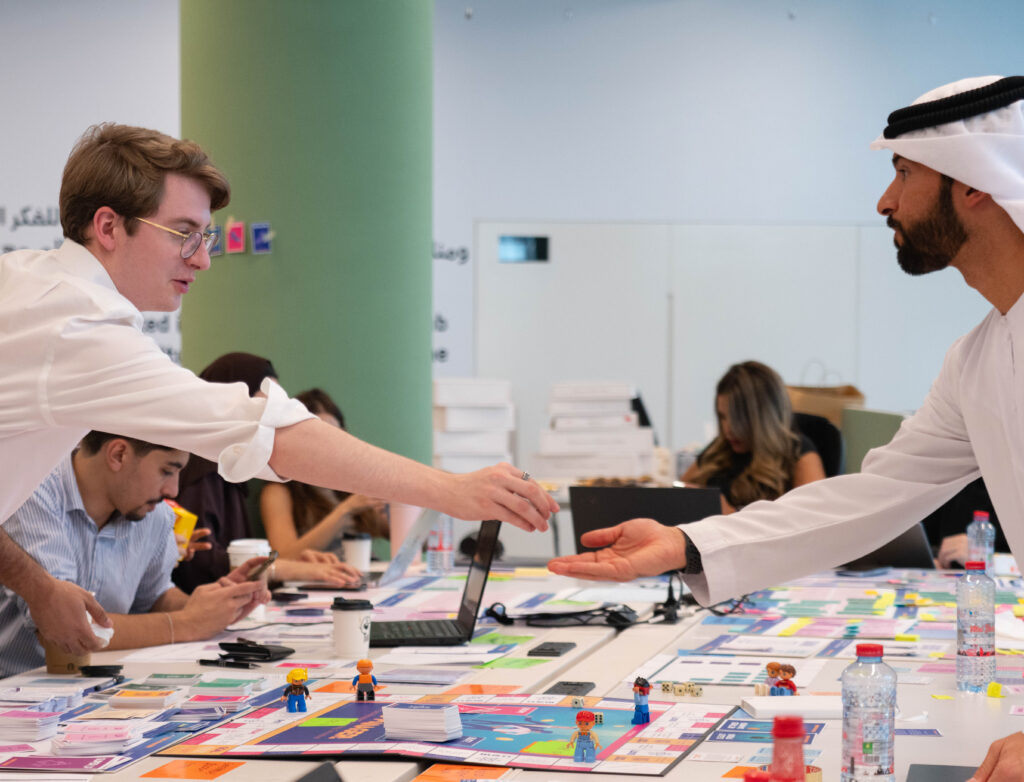
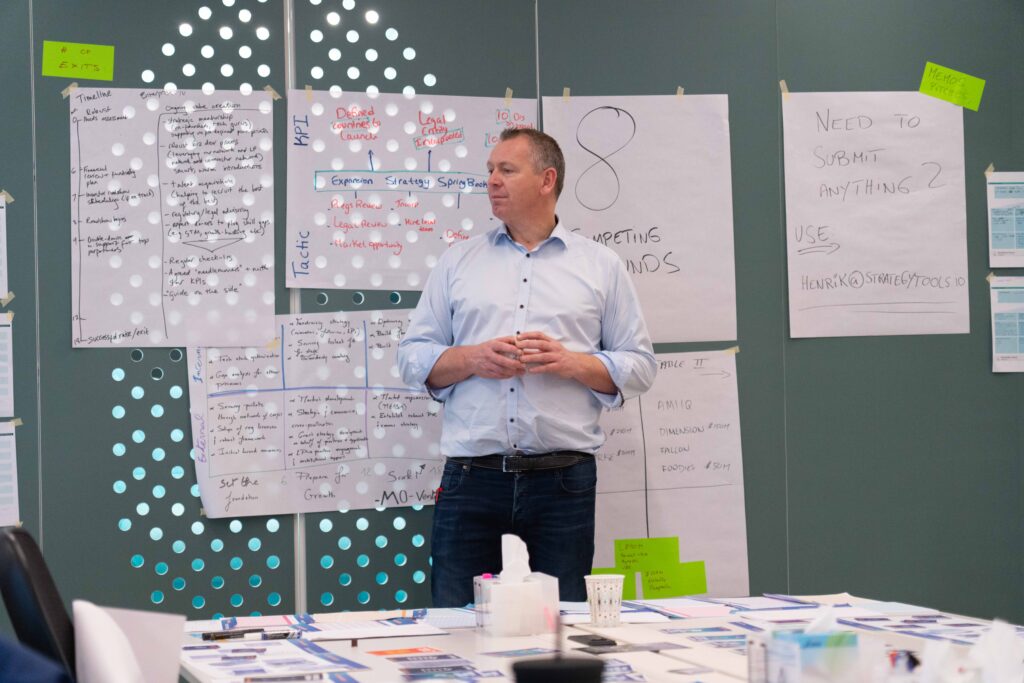
A separate fund-manager workshop made the learning more tactile. In November 2023, DFDF and Strategy Tools brought participants together for a three-day simulation covering fifteen years of venture scenarios. Photographs show tables crowded with game boards, cards, laptops and miniature figures. For once, venture capital’s fondness for calling everything a game had literal props.
The point was to practice decisions across a fund’s life without waiting fifteen actual years. Strategy Tools described a mixed group of experienced professionals and newcomers, with support from AWS and Knowledge Fund Establishment. It is a replicable idea for an investment community: teach allocation, collaboration and long-term consequences together, instead of treating access to a term sheet as an education.
The current team page reflects a similarly broad operating model. Nader Albastaki is managing director; Mahmoud Ward covers investments and ecosystem development; Tiffany Bain works on value creation. Legal, operations, technology and investment roles sit alongside them. The observable culture is one of teaching and commercial matchmaking as well as selecting investments. Those activities are visible commitments, rather than a claim about everyone’s experience at work.
A useful pitch starts with a useful fit
For a founder approaching DFDF, the public record suggests three questions worth answering first. Does the business fit its technology priorities? Is there a credible connection to Dubai or the wider region? And what would this particular investor help the company do after funding? Its mandate spans areas including health technology, logistics, deep technology, the circular economy and Web3, alongside the financial and property examples.
For a fund manager, the equivalent task is to explain the investment thesis, team and regional contribution. DFDF’s 2026 priorities include backing first- and second-time managers through a dedicated allocation. That creates a reason for emerging investors to follow the fund’s announcements, while leaving room for the selection process. An announced priority is an invitation to demonstrate fit, not an entitlement to capital.
The approach also requires institutional patience and access to people who can make commercial decisions. An investor without those relationships cannot reproduce it by adding a partnerships page. A founder whose business needs modest, steady growth may be better served by capital with different return expectations. Dubai’s experiment is most interesting where those expectations meet: invest in the company, strengthen its backers, and help the product find a buyer.
Follow the money, meet the people
Explore the DFDF website, browse its portfolio and portfolio jobs, or read its investment notes and news.
Follow DFDF on LinkedIn, X, Instagram and Facebook.
Watch: Nader Albastaki on DFDF’s investment approachEncrypted podcast · Episode 96 · YouTube