The trouble began with a perfectly sensible purchase. In 2002, Michael Monteiro and Dimitris Georgakopoulos bought a rental property together in Providence, Rhode Island. The next year, they bought two more. Now there were more things to track, and more time spent tracking them in spreadsheets. The investment had acquired a clerical department. Its employees were the investors.
- Buildium connects property accounting, leasing, payments and maintenance in a cloud platform.
- Its growth story includes a correction: Sumeru says better onboarding and customer success helped cut churn in half.
- Subscriptions start at $62 a month. Your portfolio and transaction volume determine what the bargain becomes.
Three properties, one clerical trap
They started Buildium in 2004. There is something wonderfully unromantic about this origin. A rent payment is not a philosophical question. It has arrived or it has not. A repair has been arranged or it has not. Yet keeping those answers straight becomes a job of its own. The founders had discovered a software opportunity by encountering the job personally.
The spreadsheet was the first tool to become burdensome. That does not make spreadsheets foolish. They are cheap, flexible and unusually obliging. They will accept almost any system a landlord invents. Their weakness is that somebody has to keep that system coherent. The person entering the payment must also remember what to tell the owner and where the supporting record belongs. Add properties and the remembering grows.
Buildium’s answer is a shared place for the work. Its expertise sits in the administrative routines of property management: the accounting behind a payment, the paperwork around a tenancy, the record of a repair. These are recurring obligations. A landlord can finish a renovation. Nobody finishes rent collection.
The apartment has several audiences
Consider a hypothetical leaking sink. The resident wants somebody to fix it. The manager wants a work order and a reliable record. The vendor needs instructions. The owner wants to understand the expense. One physical problem produces several informational problems, each addressed to a different person. Much of the manager’s day is spent keeping those accounts consistent.
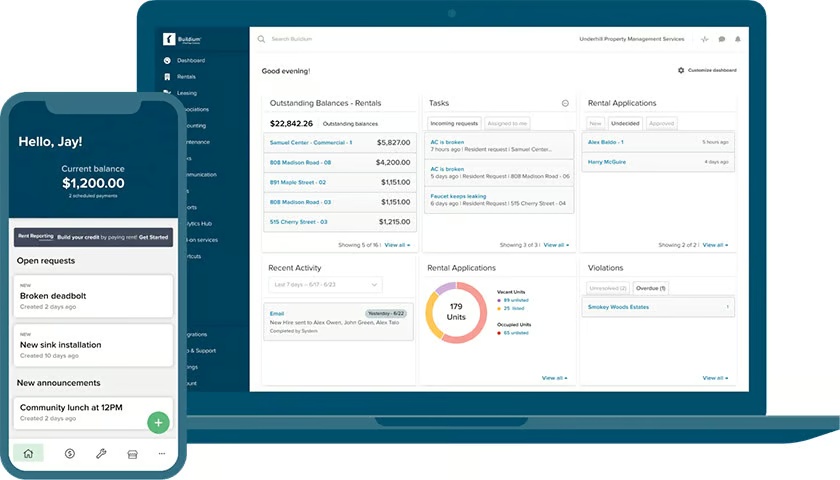
Buildium organizes maintenance requests and work orders alongside its other operating tools. Its accounting software handles financial records and reporting. Resident Center gives residents a place for payments, requests and communications; owners have their own portal. The attraction is easy to understand. A manager can spend less of the day acting as a search engine for other people.
- 01Apply
- 02Sign
- 03Pay
- 04Repair
- 05Report
The same logic extends to leasing: market a vacancy, collect an application, screen the applicant, prepare the lease and obtain signatures. Buildium sells these connected functions to landlords, management companies and community associations. It also supports mixed portfolios. Its natural audience is the operator for whom coordinating the work has become a material part of the work.
That places it among property management systems such as AppFolio, Yardi Breeze and DoorLoop. A fair comparison starts with a portfolio’s obligations. How many owners need statements? Who handles repairs? Which records must move between people? Buildium’s connected accounting and operations make a more persuasive case when those questions have complicated answers. A landlord with a handful of straightforward transactions may have less to gain from the breadth.
Good software, awkward economics
Buildium’s later history contains a second administrative problem, this time inside the software company. Sumeru Equity Partners says the business had a strong product but slowing growth, poor operating indicators and rising cash burn. Product knowledge had taken the founders a long way. Running a larger operation required additional skills.
A $65 million strategic investment was announced in June 2016. In its retrospective, Sumeru credits customer analysis, product improvements, onboarding and customer success with halving churn over 18 months. It also describes hiring operational leadership and a dedicated sales team. These are the investor’s reported results, rather than an independently audited experiment.
Reported over 18 months during its investment period. The operational work included onboarding and customer success.
The lesson is worth borrowing. A useful product can lose customers if getting started is awkward or getting help is difficult. Retention belongs in the design discussion. A software business needs to study where customers become stuck, then organize people and processes around removing those obstacles. The welcome email is a poor substitute for a working customer.
In November 2019, RealPage agreed to acquire Buildium for an initial $580 million cash purchase price, subject to adjustments. The deal closed that December. At announcement, Buildium had more than 17,000 customers across over 50 countries and approximately two million residential units under management. Those numbers describe the acquisition period. RealPage subsequently became privately owned by Thoma Bravo in 2021.
The price is a starting line
As checked in October 2026, Buildium advertises Essential from $62 a month, Growth from $192 and Premium from $400. These are starting prices. Unit count and services affect the bill. Growth and Premium require onboarding for new customers. API access sits in Premium, while live phone support begins with Growth.
What do 100 rent payments add?
One hundred incoming EFT payments add $235 at the published Essential rate or $135 at Growth’s rate, before subscriptions. This calculation illustrates why a manager should examine transaction volume alongside the plan price. It is not a complete quote. An inexpensive introduction can acquire a substantial supporting cast.
The business model follows the workflow: recurring software subscriptions, payment charges and optional services. Marketplace adds partner tools, including accounts payable specialist AvidXchange. Individual integrations can carry their own costs. A buyer should map what is included, what requires a higher tier and what belongs to a separate vendor before congratulating the budget.
Artificial intelligence, meet the invoice
Buildium now puts Lumina AI into this familiar administrative setting. AI Bill Scan extracts information from uploaded invoices and drafts bills for review. Write with AI assists with messages. Its AI Workforce capabilities extend to accounting and business operations, with availability depending on the plan. An invoice is an excellent place to examine the pitch: specific information goes in, a draft comes out, and somebody can check it.
The benefit depends on that checking burden. If a manager spends as long correcting an automated draft as entering the original, the promised saving evaporates. If the output is dependable enough to review quickly, the reclaimed minutes can accumulate. An operator should measure completed, checked work. Counting generated drafts is much easier and considerably less revealing.
Buildium’s customer story about Presidio Property Management supplies a concrete example of how to judge ordinary software value. Leuri Zibetti estimates that its efficiencies saved her team 20 hours a week. The account discusses maintenance follow-up, leasing and renewals. That is a customer estimate published by the vendor, not a guarantee for the next purchaser.
“Because if I’m too busy putting in checks, I can’t even return owner phone calls”
Leuri Zibetti / Presidio Property Management
Borrow the rehearsal, not the promise
For a prospective customer, the useful next step is a rehearsal. Buildium advertises a 14-day trial with sample data and no credit card requirement. Take a representative tenancy through an application, a lease, a payment, a repair and an owner report. Ask the people who will actually do those jobs to participate. Record where they pause and what they still have to do elsewhere.
Repeat the exercise with an awkward example: a partial payment, a changed lease or an invoice needing clarification. Check migration and training requirements. If custom connections matter, inspect the Premium API and confirm the necessary development work. A small portfolio needing only basic tracking, or a business with specialized requirements the platform cannot satisfy, may find the subscription and transition effort difficult to justify.
The transferable idea is to buy against a recurring task you can measure. Buildium began when two property owners noticed what their spreadsheets were costing them in attention. Its later correction concerned helping customers use the product successfully. Both problems reward the same habit: follow the work closely enough to see where time disappears. Then change something specific.