The apartment does not move. The application does. It passes from a website to a leasing agent, from a screening service to a lease packet, and finally to somebody waiting for a signature. At each stop, an ordinary piece of information can become an extraordinary nuisance. A name must be retyped. A document must be found. A perfectly interested renter must wait.
On-Site.com built its business around that journey. Its proposition was pleasingly unromantic: connect the work required to rent a home. Marketing, applications, background checks, payments, contracts and signatures could belong to the same digital process. In 2017, RealPage agreed to pay approximately $250 million for substantially all of the business. Paperwork had acquired a rather handsome price tag.
- The job: move a prospective renter from inquiry to signed lease.
- The customer: housing operators and property managers; the renter does the clicking.
- The distinction: connected leasing that can fit alongside existing property software.
- The deal: RealPage’s acquisition closed in September 2017.
A family business with a form problem
The Harrington family owned a small apartment portfolio in the late 1990s. Managing leasing functions remotely was difficult. On-Site’s early work addressed the forms inside that family business, a considerably more useful starting point than a grand theory about disrupting housing. The software had an immediate audience: people who already had apartments to manage.
Jake Harrington became chief executive in January 2012. His father, Tom, remained chairman; fellow founder Scott Jones served as chief technology officer. The public company profile puts its founding in 1999, and its historical financial statements confirm California incorporation that year.
The family origin helps explain the product’s attention to mundane details. For an operator, leasing crosses several departments. For a renter, it is one attempt to get a home. A marketing team may celebrate an inquiry while an operations team is still trying to assemble the documents. The renter experiences the interval between those achievements.

“The manager does not need to type information more than once.”Jake Harrington, speaking in 2012
That sentence is a useful product test. Follow a renter’s details through the process and count where someone must enter them again. Each repetition deserves an explanation. The point is especially relevant to anyone building business software: the person buying your system and the person doing much of the work inside it may have very different needs.
Five stops, one renter
On-Site’s 2012 Online Application 2.0 announcement put lead management, apartment availability, reservations, screening and payment processing in one package. It also recognized that renters wanted to complete the process on smartphones. The apartment office could have opening hours; the application did not have to share them.
- 01Inquiry
- 02Application
- 03Screening
- 04Lease
- 05Signature
One renter’s journey across several office responsibilities. Schematic, not a measured performance chart.
The public e-sign user guide shows what this promise requires underneath. Staff can add an applicant or guarantor, change the apartment, edit lease terms and return to screening results. Before anyone signs, the right people must be attached to the right agreement. A digital signature is the final flourish on a fairly demanding piece of administration.
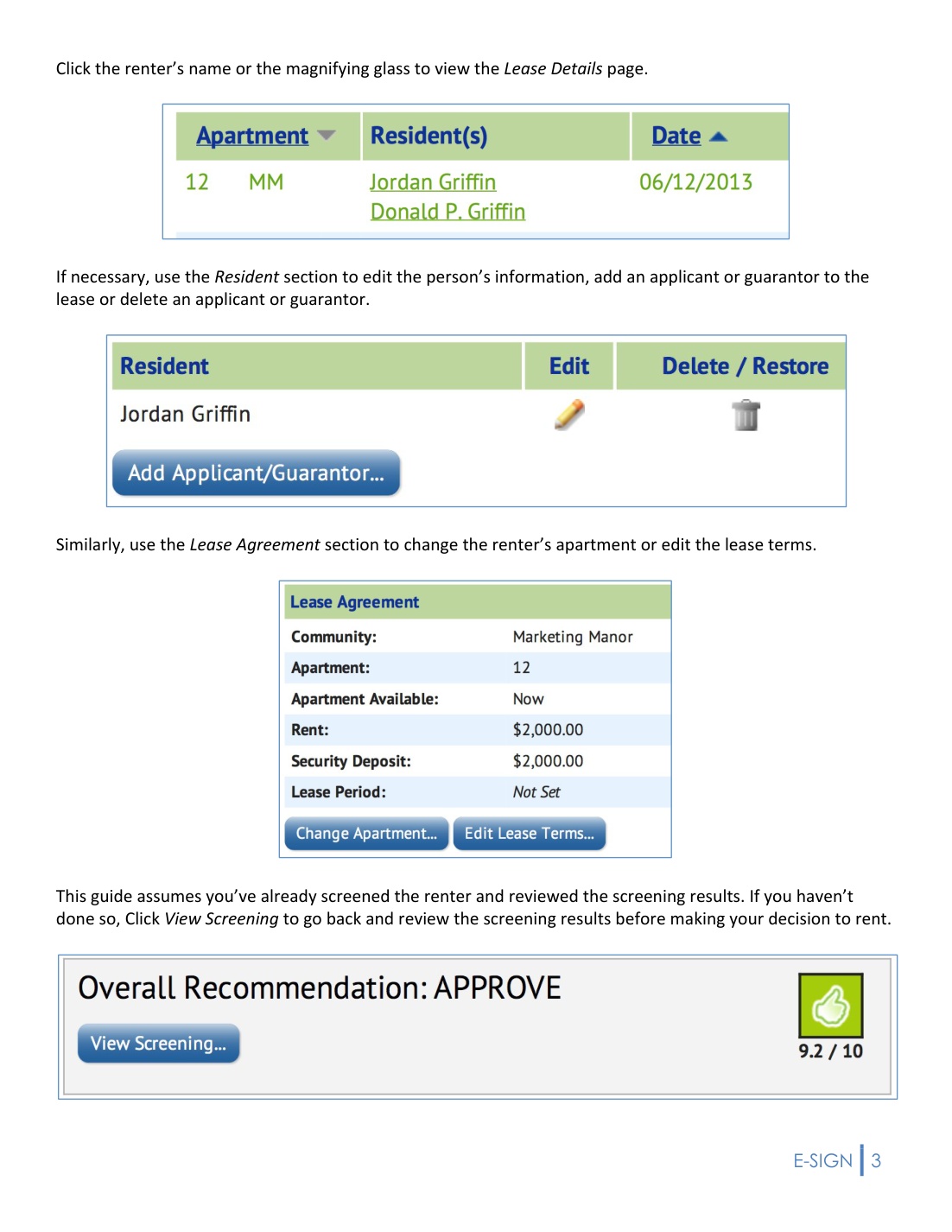
The guide also distinguishes reviewing a recommendation from making a decision. That is a detail worth preserving when a software demonstration makes everything look effortless. Records, terms and people still need checking. Moving them onto a screen changes the mechanics of the task, not the seriousness of the agreement.
A pretty website must eventually produce a lease
In 2015, On-Site acquired assets of Dallas-based Ellipse Communications. Customers had been asking for more personalized online brands than its template websites supplied. The resulting Ellipse Design offering added custom websites, advertising campaigns, three-dimensional floor plans, interactive site maps, video tours and analytics.
This was a practical extension upstream. A property website attracts a prospect; the application asks that prospect to commit time, information and money. Treating the two as unrelated projects invites an awkward transition. On-Site’s growing front-office offering tried to make attraction and execution neighbors.
Its announcement said nearly 15,000 U.S. communities used the software at that time. That is a historical snapshot, rather than a count of today’s customers. Still, it shows how far the form-filling problem had traveled beyond the family portfolio.
The price of keeping things moving
The business earned money in several ways. Historical audited accounts identify transaction fees, license and subscription fees, and commissions from risk-mitigation products. Screening and payment processing generated transaction revenue. Web-based services and subscriptions added a different kind of income. Calling the whole operation “software” is accurate, but it does not tell you what triggered the bill.
Approximate announced cash purchase price, subject to adjustments. An acquisition price, not a customer subscription.
In a retrospective published by its sale advisor, Harrington describes collecting a fee when an application was processed. High-turnover cities suited that model. As the business grew, internally financed expansion became harder; slower renter turnover also challenged the revenue story. An earlier sale attempt did not close because the owners were not ready to sell. The lesson for another founder is to examine transaction frequency and sale readiness before polishing a valuation pitch.
For a property manager evaluating the service, the sensible comparison is the entire cost of getting an applicant through the process. Ask what is billed per screening, what is billed as a subscription, and how payment charges work. A cheaper-looking component can become expensive if employees must spend their day transferring information between tools. That is an evaluation method, not a claim that On-Site always wins the comparison.
The buyer cared about the connections
RealPage’s acquisition announcement emphasized integration with Yardi, MRI and AMSI. This matters because an operator may want better leasing without replacing the software used to run the rest of the property. Compatibility gives a leasing product a place in an existing operation.
RealPage said it intended to keep supporting On-Site and combine features over time. Its September 2017 filing records the completed purchase. The strategic appeal was broader than an electronic contract: an established leasing business could extend RealPage’s reach into operators using other property-management systems.
Today, RealPage’s Front Office page still lists “Online Leasing (On-Site).” The original website leads with a login and applicant help. Parent company RealPage became privately held when Thoma Bravo completed its acquisition in April 2021. On-Site’s story now sits inside that larger software portfolio.
There is a small naming trap here. On-Site and RealPage’s OneSite are different names with different histories. OneSite is a broader property-management platform covering operations and accounting as well as leasing. AppFolio also sells connected marketing and leasing tools. A buyer should compare the required workflow and the existing system connections, rather than assume that similar names mean equivalent products.
The renter still needs an answer
A connected application can still contain a disputed record. On-Site’s Renter Relations service offers copies of reports and a route to investigate information an applicant believes is inaccurate or incomplete. Its guidance also draws a firm boundary: the property sets its rental policies and makes the approval decision.
The company says applications cannot simply transfer between different housing providers. Each has its own criteria and report requirements. That limits an attractive interpretation of “enter once”: continuity within a leasing workflow does not create a universally portable rental application.
For an operator, the approach works best when staff maintain accurate availability, review the information and have a workable connection to their existing systems. For a renter, its value is fewer administrative interruptions. Neither party benefits if an online form merely feeds another manual queue. The detail to copy from On-Site is the question it kept asking: where does the information need to go next?
On-Site website · Applicant help · RealPage Front Office · The 2012 company profile · Harrington on the sale · LinkedIn · X · Facebook