At the University of Rochester, about 2,000 first-year housing contracts used to arrive on paper each year. Someone had to track them, file them, notice cancellations and keep the lists straight. A student saw a room assignment. The housing office saw the machinery required to produce it. That gap between the apparent simplicity of a service and the work underneath is where StarRez makes its living.
- Cloud software connects housing applications, room selection, billing and resident support.
- Universities and accommodation operators buy it; residents use the self-service tools.
- Recent company and investor disclosures put its reach at more than four million beds annually.
- The useful lesson: redesign the process before celebrating the automation.
Two thousand contracts, one quiet office
Rochester implemented StarRez in 2024. Its old housing system was being phased out, and the university had already accumulated a small archipelago of PDFs, spreadsheets, shared drives and forms. Housing operations staff member Lindsay Karback put the mood plainly: “We all knew change needed to happen.”
The university brought applications, room changes, waitlists and seasonal housing into a shared platform. Contracts became digital; statuses updated automatically. Karback estimates a 95% reduction in the time spent processing first-year contracts. That is a customer’s estimate about a particular task, rather than a promise that every housing office will become 95% more efficient. Still, the distinction hardly diminishes the attraction of retiring an annual paper chase.
The more telling detail may be the quiet. Rochester’s account describes housing-lottery questions falling from more than 20 a day to nearly zero. Better information and more flexible room selection reduced the need to visit the office. An unanswered question costs a student time; a repeatedly answered question consumes the institution’s time too. A portal can remove both costs when it makes the next step clear.
The room is the easy part
StarRez operates in the specialist corner of business software where property management meets higher education. Its customers include universities, colleges and purpose-built student accommodation providers, alongside boarding schools, staff-housing operators and co-living businesses. They need to administer buildings, but also the people, rules and relationships inside them.
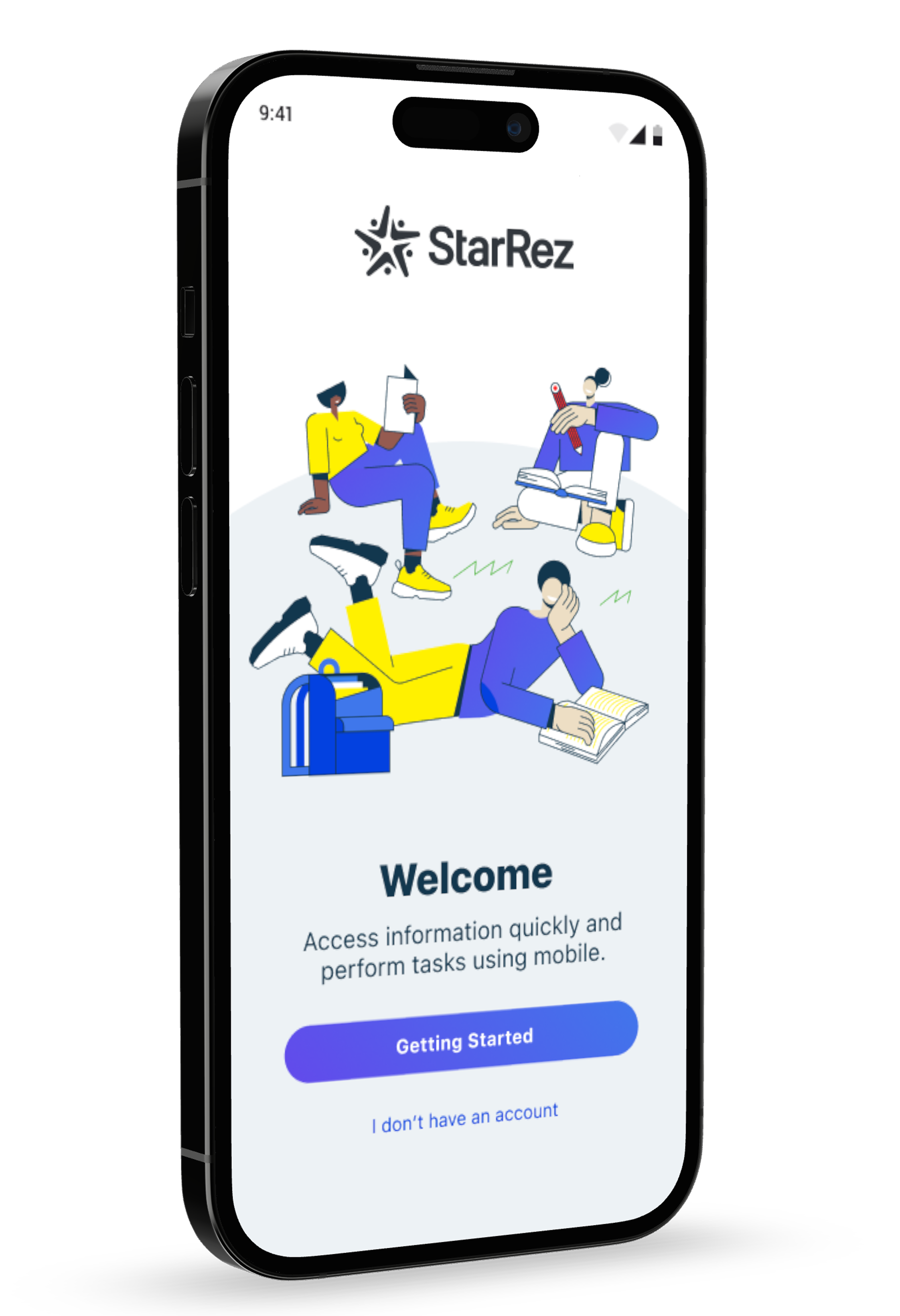
Housing Management covers applications, assignments, room and roommate selection, meal plans and billing. PortalX gives residents a configurable self-service interface. Rez360 gathers resident activity and engagement for residence-life work, including concerns, conduct and programs. Operational tools deal with inspections, maintenance and packages. Conference & Events manages temporary guests and group bookings. The breadth reflects an awkward truth: a housing office can become a finance desk, a logistics desk and a student-support desk before lunch.
Its position is distinctive without being exclusive. Independent competitor eRezLife also offers housing assignments, roommate tools and residence-life workflows. StarRez’s case rests on its combination of products, integrations and accumulated sector experience. Buyers should compare the actual tasks they need to run. A long feature list is wonderfully reassuring until someone must configure it.
A better queue has no queue
Gonzaga’s students with approved housing accommodations once selected rooms through an in-person process. Each met a staff member to review suitable spaces. As demand grew, the process took more time, and some students missed class to preserve their place in line. The difficulty began with the arrangement of the work.
The university configured room profiles around accommodation options and coded students so the portal showed eligible spaces. Students could then choose online, including roommates. Gonzaga reports that 97% of those students participated in online selection and that the change saved more than 28 staff hours per selection cycle. Staff still assigned an appropriate space to students who declined self-selection.

The portable idea is precise: encode eligibility, show the valid choices and retain a supported path for exceptions. This works when the institution can accurately describe its rooms and requirements. Bad records would merely give the mistake a pleasant interface. Software cannot create an accessible room that does not exist, and a student’s complicated needs may still require a conversation.
The price of giving time back
StarRez is subscription software purchased by institutions and operators, with modules and related services. A useful glimpse of the economics appears in Sam Houston State’s public FY2026 contract report: a September 2025 entry lists $111,658 for a StarRez residence-life software subscription. This is a specific university purchase, not a general rate card or the cost of Rochester’s or Gonzaga’s projects.
“StarRez initially felt a bit intimidating.”
Shari Hellman, University of Findlay · excerpt
The University of Findlay offers a helpful account of the less visible investment. Director Shari Hellman had valued her previous system’s reliability and support; StarRez’s breadth initially felt daunting. Talking to other users at Connect events helped her see how the flexibility could serve a smaller institution. Findlay redesigned room selection to offer specific rooms and introduced more detailed waitlists, rather than simply transferring old forms into new screens.
The team concentrated on its first implementation year before adding further improvements. Training, office hours and documentation supported that pace. The practical budget therefore includes staff attention as well as the subscription. A sensible buyer can copy the sequence: inventory repeated tasks, improve one workflow, measure its effect, then expand. If nobody owns configuration or maintains the records, the promised time savings become much harder to collect.
Beyond the campus gate, beyond the semester
StarRez acquired College Pads in 2025, adding university-branded off-campus listings and rental resources. It advertises the university service as free to institutions. Its Canadian expansion names McMaster University and Loyalist College among early adopters. The company is following students into a part of their housing journey that universities influence without owning all the buildings.
It also follows the calendar. Summer conferences, sports camps and short stays create another use for campus rooms. Seattle Technology Group brought its Iris conference and events platform into StarRez’s portfolio, including tools for dining, registration and guest logistics. The acquisition announcement put the combined conference-and-events customer base above 500 institutions. A bedroom can remain the same physical asset while the administrative business around it changes completely.
Connections to other systems matter throughout. StarRez lists integrations with student-information providers such as Ellucian and Workday, payment partners including Flywire, and electronic-signature services such as DocuSign. Its security materials describe Azure hosting, regional data storage, encryption and customer data ownership. Institutions are entrusting it with resident information, so the buying decision reaches well beyond the housing department.
A family business with a larger guest list
Alan Knipe founded StarRez in 1992. His son Travis became CEO in 2005. The company’s January 2022 Vista investment announcement described a 30-year family-business journey and a plan to expand internationally. Later, Travis moved to executive chairman and Jason Day became CEO. Five Arrows now lists May 2026 as its StarRez investment date, alongside Vista’s continuing involvement.
The company’s stated values include empathy, expertise and the cheerfully named “Z-Factor.” There is a more tangible expression of its culture in customer training, an advisory board and Connect gatherings where housing professionals exchange techniques. Findlay’s experience suggests that those conversations can influence adoption. The product comes with a network of people trying to solve similar operational puzzles.
Its 2026 industry report, drawing on surveys of 363 institutions, describes the pressure behind that appetite for better tools: 46% of housing operations have ten or fewer professional staff. This is company-sponsored research, but the question it raises is practical. How much administrative complexity can a small team absorb before service starts to suffer?
StarRez Intelligence extends the platform into AI-assisted writing, summaries and conversational data exploration. Its product page describes multi-step agentic assistants as a future direction. That distinction matters: buyers can evaluate the available tools on a real task today, while treating the roadmap as a proposal. Housing decisions still need sound records and human judgment.
The compelling part of StarRez is the smallness of its useful interventions. A contract status updates itself. A student sees only rooms that meet an approved requirement. A staff member answers a difficult question because twenty routine ones no longer arrive. Multiply those moments across a large housing operation and the software’s economics become easier to understand. The queue was giving the institution information all along. It was showing where the work needed to change.
Open the doors
Explore StarRez, its insights blog and company news. Read the customer accounts from Rochester, Gonzaga and Findlay.
Watch eight housing leaders discuss StarRez, the package-tracking walkthrough, or visit the YouTube channel. Follow LinkedIn, X and Facebook.