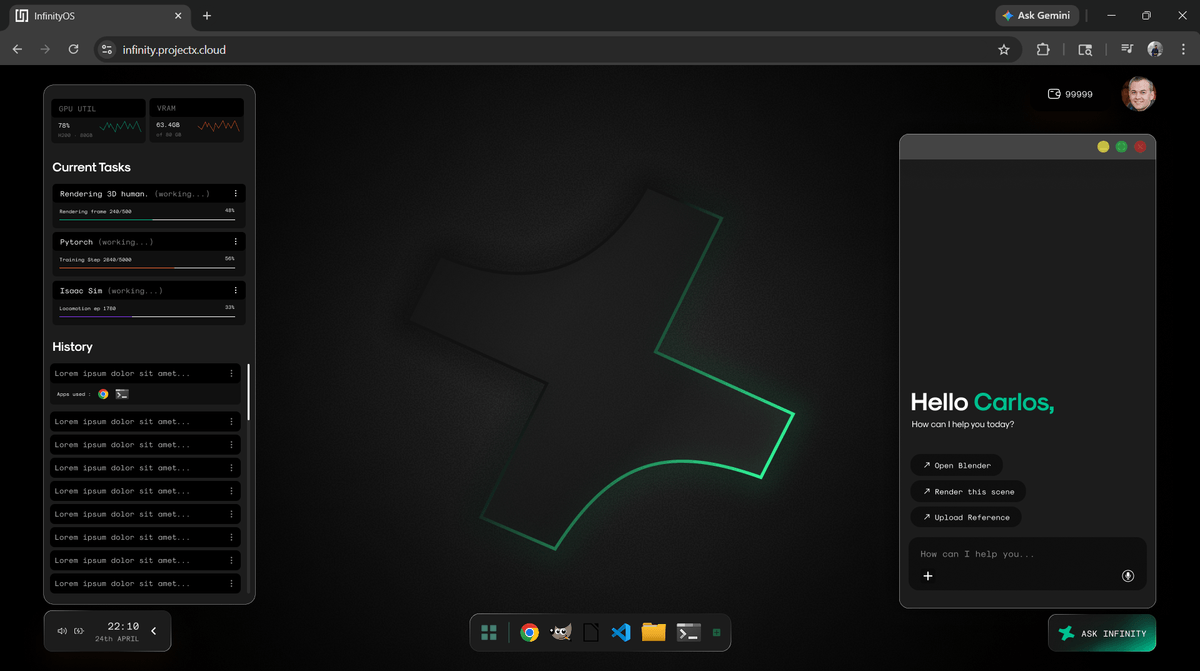
The Scene
A tab, opened slowly.
Somewhere in a SoMa walk-up, a junior animator clicks a bookmark. The page loads. Blender comes up. Then DaVinci. Then Unreal. Then Isaac Sim, then VS Code. Five icons, five logos, five entire industries, all stacked into the corner of a Chrome tab. Her laptop fan does not move. Her battery does not flinch. None of these applications are running on her machine.
This is ProjectX's pitch made literal. The company calls the product Infinity. Internally and to their YC partners they call it InfinityOS - the first cloud-native, distributed operating system designed for a world where humans and AI agents share the same desk.
It is, on paper, an absurd idea. Operating systems are not exactly an open category. They are graveyards of ambition. NeXT failed. Be died. ChromeOS survived by becoming a thin film over Linux. And yet here is a six-person team out of Y Combinator's X26 (now called P26) batch arguing that the desktop, like the floppy disk, has overstayed its welcome - and that AI agents need a workspace that was never built for the mouse.
"Infinity is a new computation layer - a web-based OS where every app you open runs on its own independent compute and GPU."
- ProjectX, official manifesto
The bet is contrarian and very specific. Most "AI agents" today are LLMs holding APIs at arm's length. They cannot really render a frame in Unreal. They cannot drop a robot into Isaac Sim and watch it fall over. They cannot scrub a timeline in DaVinci. Give an agent a real workspace, ProjectX argues, and you give it a real job.
Who It's For
Anyone whose laptop is too small for their job.
Robotics teams use Infinity to spin up Isaac Sim without renting a workstation. Game studios run Unreal builds from a Chromebook on a train. Schools in regions where a GPU costs more than a year of rent now get one for the duration of a class. The bridge from a phone-class device to an H100 is exactly one tab.
That last group is not incidental. ProjectX was originally pitched, in a 2024 press release, as a way to "eliminate the digital divide." The line is corny enough that you suspect it. Then you remember the founders are 23-ish and shipped it.
The first cloud-native OS built for a multi-agent, GPU-native future.
- ProjectX, YC profile
The Twist
Built before the hype was a hype.
Here is the part that amuses: ProjectX was started in 2022. The phrase "AI agent" had not yet conquered the dinner party. ChatGPT had barely shipped. The founders were sketching out a multi-agent operating system before there were many agents to operate.
It is the kind of timing you usually only get to claim in retrospect. The cynic in you wants to say it was luck. Then you read the manifesto. They were not betting on the LLM. They were betting on what computers would have to look like once LLMs needed somewhere to work.
There is something Oscar-Wilde-shaped about an operating system that exists mostly so software can stop pretending it lives on your desk. The desktop is a metaphor that has run out of things to be a metaphor for. ProjectX is offering a different one: not a folder, not a file, but a workspace that is itself negotiable.
Back to the Scene
The tab, still open.
The animator in SoMa has not closed anything. Blender is still rendering. DaVinci is grading. Unreal is compiling a shader. Isaac Sim is doing whatever it does when nobody is looking - falling robots, mostly. She has not bought a new laptop. She has not begged IT for a workstation. She has not had to choose which application to keep open.
That, more than the seed round, more than the YC batch, more than the founder's age, is what ProjectX is selling: the quiet boring miracle of nothing crashing because your computer ran out of computer. Five tools, five GPUs, one tab. A workspace that scales the way the work does.
The desktop metaphor is forty years old. It was designed for a person clicking icons with a mouse. It does not know what to do with an agent that wants to render a frame, grade a clip and run a unit test at the same time. ProjectX, plausibly, does.