The expensive click has already happened. Somebody searched, saw your ad, believed it for half a second, and arrived. Sending that person to a busy homepage is like inviting a dinner guest into the lobby and pointing vaguely toward the kitchen. Unbounce exists to build the room for that one visitor and that one promise. It is for marketers who need a campaign page today, an alternate headline tomorrow, and a result they can defend on Friday.
That focus explains the product better than its long menu of features. Unbounce is a hosted workshop for standalone landing pages, forms, popups, and sticky bars. You can drag elements around, publish on your own domain, connect the leads to the rest of your marketing stack, and test variants without filing a developer ticket. The platform is most useful when paid traffic is meaningful, campaigns change often, and learning is part of the job.
A founder with one waitlist page can use it, but probably should not rush to. Carrd, a website builder, or a page inside an existing marketing suite may be cheaper and simpler. Unbounce earns its chair when a team runs several offers, needs clean campaign-to-page matching, or wants marketers to own experiments end to end. Agencies are an especially natural fit because pages, domains, clients, permissions, and repeated production can otherwise become a small administrative circus.
Born from a ticket-queue grudge
Rick Perreault was a creative director who kept running into the same dull obstacle: marketing wanted a new landing page, while the people capable of shipping one had other priorities. In August 2009, he and five co-founders started Unbounce in a roughly 500-square-foot room in Vancouver’s Gastown. Several had worked together before. Perreault even knew the future CTO from a company where they had argued about getting landing pages made.
The founding team split the early engineering across the hosting platform, application and testing engine, and a visual editor. A rough beta arrived in early 2010. It could add an image, edit text, and place a button. The company also began publishing its blog before the product launched, an unusually patient bit of marketing that helped teach the category while the software caught up. Perreault later joked that having six co-founders was both the best and worst thing about the company. Anyone who has tried to choose lunch with five colleagues will understand.
The company has since moved beyond its bootstrapped room. Crest Rock Partners made a controlling investment in 2020. In July 2024, Unbounce merged with Insightly, bringing a CRM, marketing automation, and customer-service products into the same corporate family. The landing-page product remains the sharp end of the story: capture the response to a campaign, then hand that lead somewhere useful.
What you can actually do
The Classic Builder is still the center of gravity. Start with one of more than 100 templates or a blank canvas, then arrange sections, copy, images, buttons, videos, lightboxes, and forms. Build and higher plans permit custom scripts, pixels, styling, and HTML, so the no-code promise does not become a cage when a campaign needs a tracking snippet or bespoke widget.
Campaign pages
Publish on custom domains with free hosting, mobile layouts, reusable ideas, and lead forms.
Popups and bars
Target offers by timing, referral source, location, cookies, scroll behavior, and return visits.
A/B experiments
Create unlimited variants, set traffic splits, and read confidence intervals in real time.
Smart Traffic
Match visitors to variants using signals such as device, browser, location, operating system, and time zone.
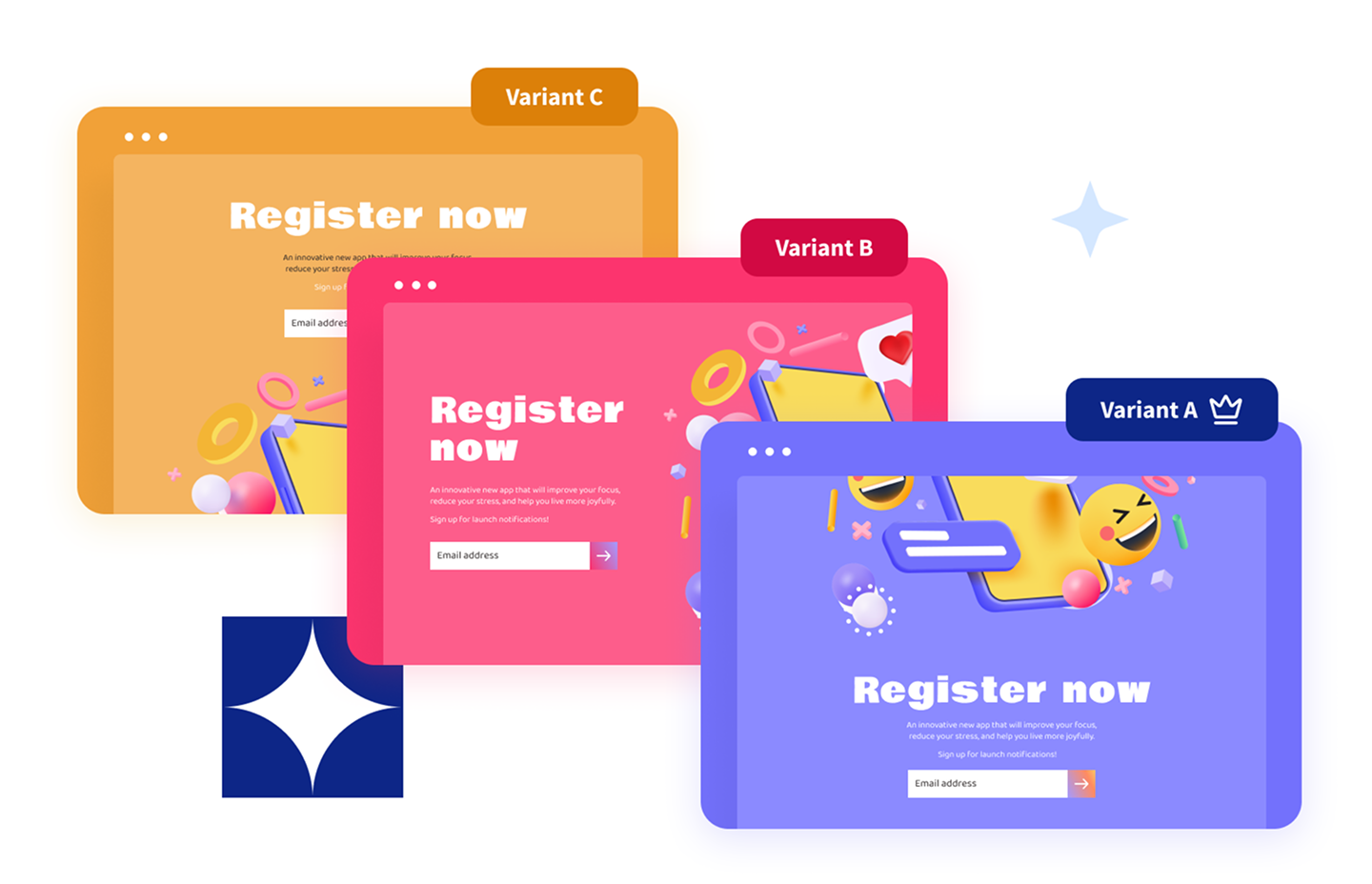
Experiment is the pivotal plan. It adds unlimited A/B tests, unlimited variants, manual allocation, reporting, and dynamic text replacement. That last feature swaps copy to match an ad keyword or campaign parameter. A searcher who clicked an ad for “Toronto payroll software” can see that same phrase on arrival instead of a generic headline. The trick is small, but message continuity is often where paid campaigns stop leaking.
Optimize adds Smart Traffic. Rather than declare one universal winner, the machine-learning system looks for patterns among visitor attributes and sends different people toward the variant most likely to work for them. Unbounce says it can begin optimizing in as few as 50 visits and reports an average 30 percent lift for customers who turn it on. That is a vendor-reported average, not a coupon guaranteeing your result. Thin traffic, muddy conversion goals, or weak variants remain thin traffic, muddy goals, and weak variants.

The new trick: pages by conversation
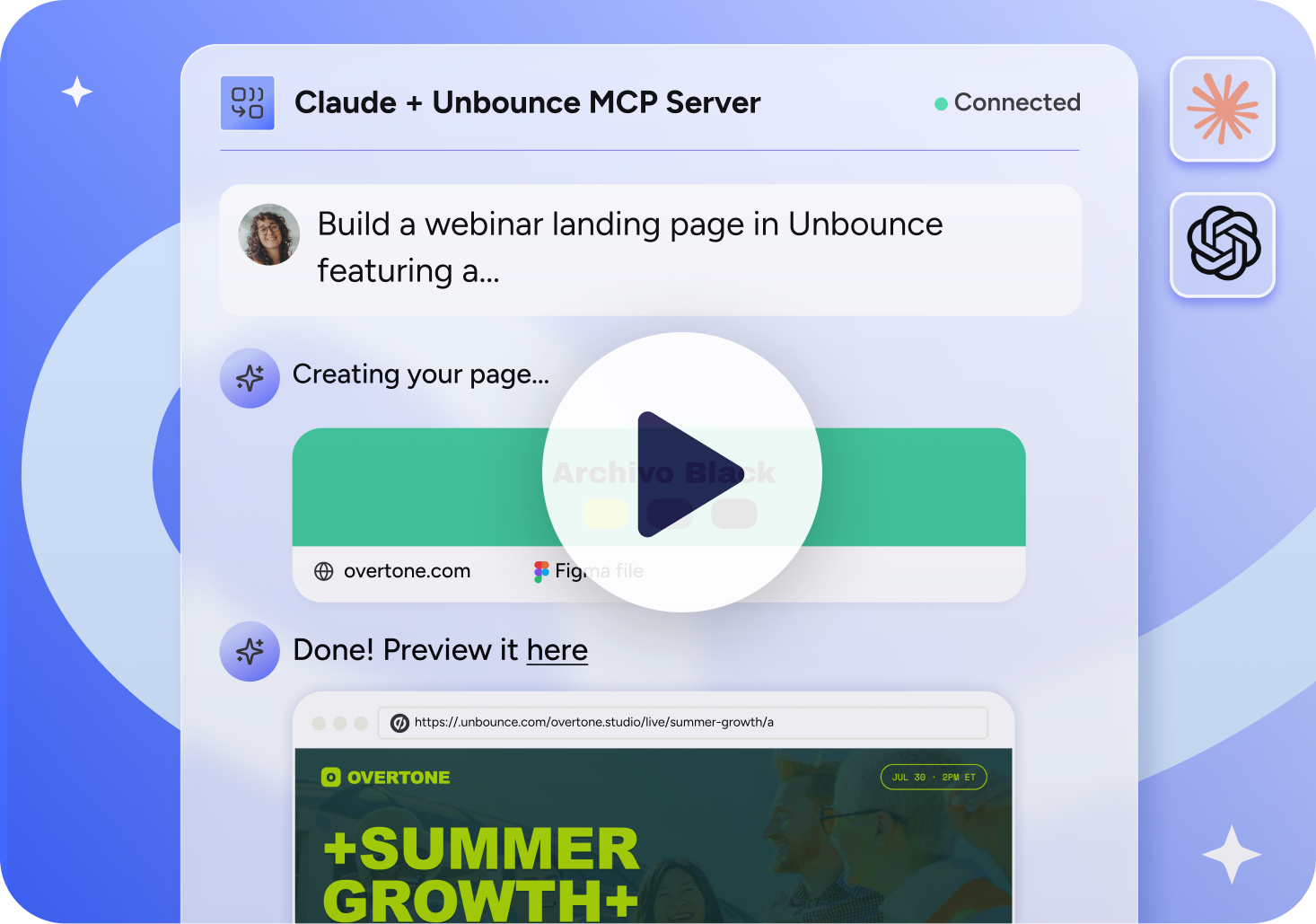
The newest feature is an MCP server, included across the current plan range. Connect Unbounce to ChatGPT or Claude and ask the assistant to build a responsive page from a brief, approved copy, brand guidelines, an existing page, or a Figma reference. It can publish, create a second variant, split traffic, start a test, turn on Smart Traffic where the plan permits it, organize pages, and pull aggregate performance reports.
There is an important seam. MCP creates custom HTML pages, and those pages cannot be opened in the visual Unbounce builder. Future edits must go back through the assistant. The MCP connection also does not expose individual lead data, according to Unbounce’s current privacy documentation. This is a workflow for production and campaign operations, not a chat window into a prospect list.
The price ladder, decoded
The $29 monthly Starter plan is a sampler: five pages, 500 monthly unique visitors, one user, and one root domain. It includes the builder, forms, hosting, templates, support, and MCP. Build costs $99 monthly and removes the page limit, raises traffic to 20,000, and adds popups, sticky bars, multi-step forms, AI copy, custom code, and the advertised library of more than 1,000 integrations.
| Plan | Monthly | Traffic | The reason to move up |
|---|---|---|---|
| Starter | $29 | 500 | Five simple pages and a low-risk trial run |
| Build | $99 | 20,000 | Unlimited pages, integrations, custom code, popups |
| Experiment | $149 | 30,000 | A/B testing, variants, DTR, confidence reporting |
| Optimize | $249 | 50,000 | Smart Traffic, targeting, scheduling, benchmarks |
Experiment is $149 monthly and supports three users, two root domains, and 30,000 visitors. Optimize is $249 with five users, three domains, 50,000 visitors, and the AI routing tools. Annual billing reduces the advertised monthly equivalents to $22, $74, $112, and $187. Concierge and Agency are quote-based.
Watch the odometer. Traffic allowances are pooled across an account, not granted per page or client. Pages stay live after an overage, but Unbounce may charge additional fees. A viral campaign is a lovely problem until finance discovers it by invoice.
What users praise, and what bites
Public review patterns are remarkably consistent. Capterra showed a 4.5 out of 5 rating from 257 reviews in August 2026, including a creative director who called it “a complete landing page builder” that works well for testing campaigns. G2 showed 4.3 from 386 reviews. Its review summary highlights the intuitive drag-and-drop workflow, flexibility, and integrations. Those are exactly the qualities a paid-media team notices when a campaign brief arrives late on Tuesday.
The recurring complaints deserve equal billing. Reviewers mention cost, billing friction, customer support, and extra work in mobile layouts. Reddit threads are rougher. Agency users have described steep account-specific price increases, while a 2026 PPC discussion complained about fixed sections becoming awkward around custom HTML and dynamic content. These are anecdotes, and the current public plans are clearer than the older bills being discussed. They still point to sensible trial tasks: rebuild a real page, check it on several phone widths, connect the actual CRM, and ask sales how overages and future domain growth will be handled.
One advantage is the data exhaust. For its 2024 Conversion Benchmark Report, Unbounce analyzed more than 41,000 landing pages, 464 million unique visitors, and 57 million conversions. The company put the cross-industry median landing-page conversion rate at 6.6 percent. Benchmarks never diagnose a specific campaign, but they are more useful than the folklore of whichever marketer spoke last in a meeting.
Who should buy it?
Choose Unbounce when your team buys meaningful traffic, launches distinct offers, and will regularly test copy, structure, or audience fit. It also makes sense for agencies that can turn templates and integrations into a repeatable service. Pick Experiment when controlled A/B testing is the reason for the purchase. Pick Optimize only when traffic volume and variant discipline give Smart Traffic something worth learning.
Look elsewhere when you need a complete content site and CMS, a single handsome page, deep funnel checkout, or the cheapest possible lead form. Webflow and Framer favor design-led sites; Carrd handles tiny one-page jobs; Leadpages competes on approachable lead generation; Instapage leans into paid-ad personalization; HubSpot makes sense when the CRM is already the center of the operation; ClickFunnels is oriented around sequenced sales funnels.
The verdict
Unbounce remains a focused campaign instrument. The editor gets a marketer from brief to published page quickly, the testing layer makes iteration legible, and Smart Traffic offers a practical alternative to waiting for one universal winner. The new MCP workflow is the fresh idea: page operations can now happen where a team is already drafting and discussing the campaign.
The catches are plain. Mobile polish can demand care, traffic caps need watching, and the plan that unlocks true experimentation costs five times the entry tier. Buy it for a testing habit, not merely for a page. A tool built to learn is wasted on a campaign nobody plans to revisit.