A landing-page demo can make every marketing team feel briefly underbuilt. The canvas is clean. The templates multiply. A presenter connects an ad to a personalized page, turns on an experiment, and watches the dashboard settle an argument that has occupied three people since Tuesday. Then the trial ends and the ordinary question returns: which part of that machinery solves a problem you have often enough to pay for it?
For buyers comparing Unbounce with Instapage, the useful answer is hidden beneath the familiar feature grid. Both platforms build pages. Both support experimentation and personalization. But their signature tools address different shapes of work. Instapage's AdMap is a control surface for a paid-media portfolio. Unbounce's Smart Traffic is a routing system for visitors arriving at a particular page. One becomes more valuable as the number of simultaneous ad-to-page relationships rises. The other can matter while a team is still concentrating its budget on one campaign.
First, draw the mess
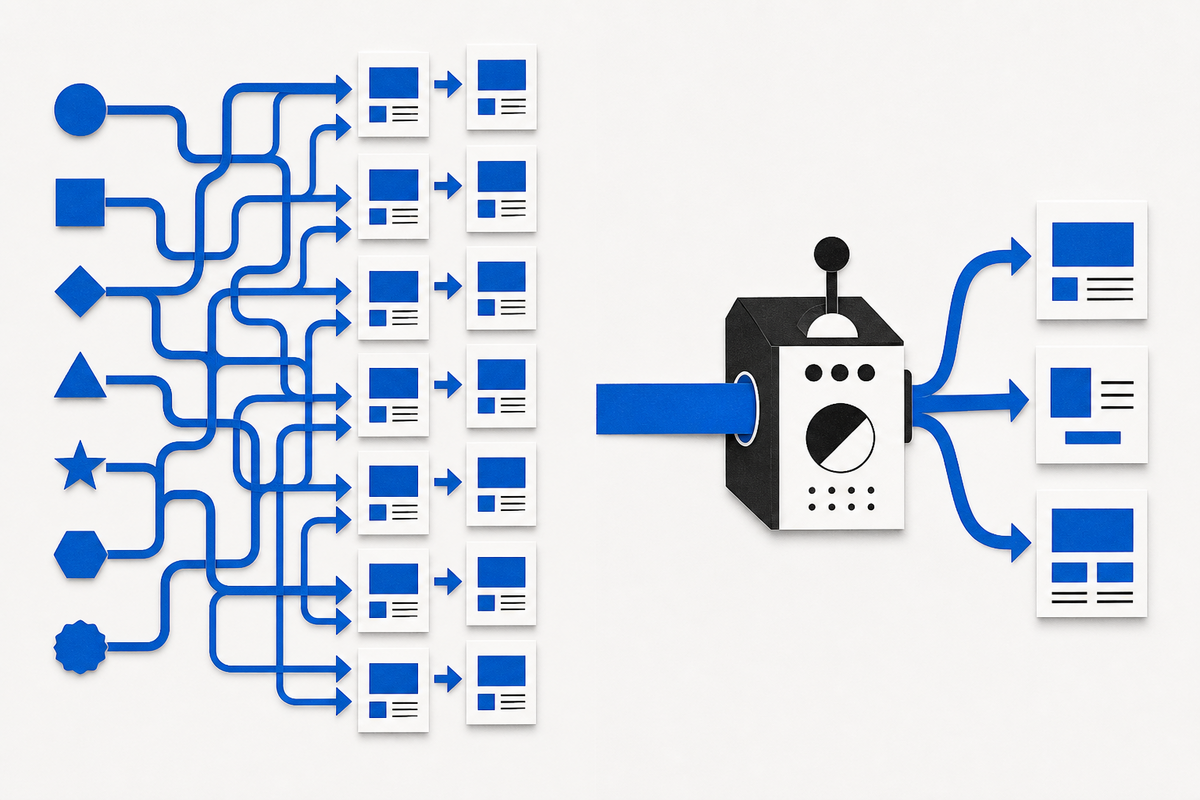
Imagine the operating diagram before considering the software. A company running search ads across regions, products, audience segments and offers can accumulate a thicket of campaigns, ad groups, creatives and destinations. Every new variation creates another promise that the post-click page ought to keep. If an ad says “inventory software for restaurants” and its destination speaks generally about retail, the machinery worked while the message failed.
AdMap is made for that thicket. Instapage says the product can visualize campaigns, connect ads to relevant landing pages, use UTM parameters to pair audiences with experiences, and synchronize mapping changes. Its earlier product explanation described importing a Google Ads account structure so marketers could see campaigns, ad groups, ads and attached pages in one place. The practical benefit is less romantic than “personalization at scale,” and more useful: the team can spot an orphaned ad, a stale connection or a page whose message no longer matches the traffic being purchased.
Many ads need a map. One busy campaign may need a router.
A map has network effects of its own. With five ad-to-page connections, a tidy naming convention and a spreadsheet may be perfectly legible. With five hundred, the spreadsheet becomes a minor piece of infrastructure, complete with ownership questions and quiet errors. AdMap's payoff rises with the number of relationships that must remain visible and correct. This is why the feature is easier to justify for agencies, distributed teams and companies with a large paid-search program than for a founder running one offer against a few audiences.
Unbounce
Value can appear within one campaign when several credible page variants receive enough visits to learn.
Instapage
AdMap's value compounds as ads, audiences, owners and destination pages multiply.
Unbounce optimizes the junction
Smart Traffic starts from a different diagram. A visitor reaches one Unbounce page URL. Several variants sit behind it. Instead of dividing traffic randomly until a conventional A/B test crowns one winner for everyone, the system uses attributes such as device, location, browser and operating system to predict which variant is most likely to convert that visitor. The page is the junction; the algorithm directs the arrival.
Unbounce says Smart Traffic can start optimizing after as few as 50 visits. Its FAQ adds an important piece of fine print: adding a new variant requires additional learning traffic, and republishing or changing variants returns the page to a learning phase. The company also says the system works URL by URL. It does not study a visitor's movement across an entire multi-page funnel as one continuous experience.
That modest starting threshold does not mean 50 visits will produce a stable, universal truth. Sparse conversions, weak variant differences and changing traffic sources can all limit what the system learns. It does mean the tool's logic is not reserved for a company running scores of campaigns at once. A small team can create meaningfully different variants for one campaign, define a conversion goal and let Smart Traffic begin adapting. The prerequisite is variation and traffic, not an elaborate account map.
This difference changes the buying conversation. Instapage asks whether the organization can maintain relevance across a portfolio. Unbounce asks whether different types of visitors respond to different variants inside a campaign. A team can have high traffic and low campaign complexity. It can also have many low-volume campaigns and a severe coordination problem. “We are growing” is not enough information. The axes are separate.
Price the avoided work
Current plan pages sharpen the distinction. Unbounce lists AI traffic optimization in its Optimize tier, alongside unlimited pages, up to 50,000 visits, five users and three root domains. Instapage lists ad-to-page personalization in its custom-priced Convert plan, together with global elements, heatmaps, root-domain publishing and professional services. Prices and packaging change, but the placement is revealing: one is sold as an optimization layer; the other sits inside an enterprise-ready operating layer.
The subscription price is only the visible cost. For AdMap, the return should be measured against hours spent tracing campaign connections, auditing message match, publishing coordinated changes and recovering from errors. If those jobs barely exist, the feature has little expensive work to replace. For Smart Traffic, compare the price with the delay and labor of conventional testing, plus the opportunity cost of showing a single “winner” to visitor groups that might prefer different experiences.
Neither product removes the need for judgment. Smart Traffic cannot rescue three cosmetic variants built around a weak offer. AdMap cannot decide whether every ad deserves a bespoke page or whether the segmentation itself is sensible. Automation is a multiplier for a coherent system. Feed it trivial variations or a chaotic campaign taxonomy and it will help operate those choices more efficiently.
A buyer's test that fits on a napkin
Start with last month's work. Count active campaigns, distinct ad messages, target audiences, landing experiences and people allowed to change them. Then note where mistakes or delays accumulated. If the pain appears in handoffs and mismatched destinations, put Instapage near the top of the trial list. Test AdMap with a real account segment and ask whether it exposes relationships the team currently struggles to see.
If the pain appears inside a focused campaign, test Unbounce. Build variants that embody actual hypotheses: a different benefit hierarchy, proof strategy or audience framing, not a button color chosen because the meeting was ending. Confirm the conversion goal, give the learning phase room, and avoid constant republishing. Examine whether routing produces useful lift over random allocation, while remembering that the displayed estimate is still an estimate.
Teams between those poles should resist turning the choice into identity. A sophisticated marketer is not the person with the busiest dashboard. It is the person who knows which complexity is worth managing. Instapage can be the better system even at moderate traffic when campaign governance is the costly problem. Unbounce can be the better system at substantial traffic when a compact team wants continuous variant routing without building a sprawling personalization operation.
Buy for the bottleneck on your calendar, not the ambition in the sales deck.
There is a final asymmetry. AdMap's value is easy to see in a screenshot: the unruly account becomes a diagram. Smart Traffic's value appears over time, in routing decisions that no marketer watches one by one. The first makes complexity legible; the second makes a stream adaptive. Both are credible forms of leverage. Only one may match the work waiting on Monday morning.
The choice, then, is not “which landing-page platform is best?” It is which recurring failure costs more. If ads and pages drift apart as the portfolio expands, map them. If one campaign attracts varied visitors and no single version serves them equally well, route them. Start with the traffic you have. The feature list will become much shorter.
Read the source material
Questions buyers ask
What is the main difference?
Smart Traffic routes visitors among variants on an Unbounce page. AdMap visualizes and manages connections between ads, audiences and relevant Instapage experiences.
Is Unbounce better for a single campaign?
It can be the more direct fit when the need is variant optimization within one campaign. Smart Traffic operates URL by URL and does not require a large portfolio of simultaneous campaigns.
When does AdMap become useful?
Its value grows when a team manages enough ads, audiences and landing pages that message matching and update coordination become recurring work.
How much traffic does Smart Traffic need?
Unbounce says it can start optimizing after as few as 50 visits. New variants extend the learning requirement, and page changes can restart the learning phase.
Does either platform guarantee conversions?
No. Results depend on the offer, page variants, targeting, measurement and traffic. Vendor-reported lifts are directional, not guarantees.