Recruitee is for the moment when hiring stops belonging to one heroic person with a color-coded spreadsheet. A department lead needs to review a CV. Finance wants the requisition approved. Three interviewers owe feedback. A promising applicant is quietly aging in a column called “Maybe.” The software puts all of that motion on one board and gives it rules. The result is less detective work for the recruiter and fewer excuses for everyone else.
Now called Tellent Recruitee, it is a cloud applicant tracking system built around collaborative hiring. Jobs flow to career pages and boards; applicants land in customizable pipelines; colleagues leave notes and structured evaluations; automations send messages or assign tasks. Recruitee says more than 180,000 people use it daily across 7,000-plus companies. Those numbers place it well beyond scrappy startup territory, yet the product still sells itself on being approachable to the manager who logs in twice a month.
Buy the demo if your hiring has become multiplayer.
- Several managers interview or approve candidates.
- You want a branded career site without a web project.
- Recruiters are copying notes between inboxes and spreadsheets.
- You hire often enough to automate reminders, emails, and scheduling.
A founder hiring four people this year can probably survive with a lighter tool. So can an agency that needs a sales CRM, dialer, and client-submittal machinery more than an in-house ATS. Recruitee’s sweet spot starts when consistency matters: a growing company, recurring vacancies, multiple locations, or enough hiring managers that “please send feedback” has become a daily refrain.
The clever part is social, not technical
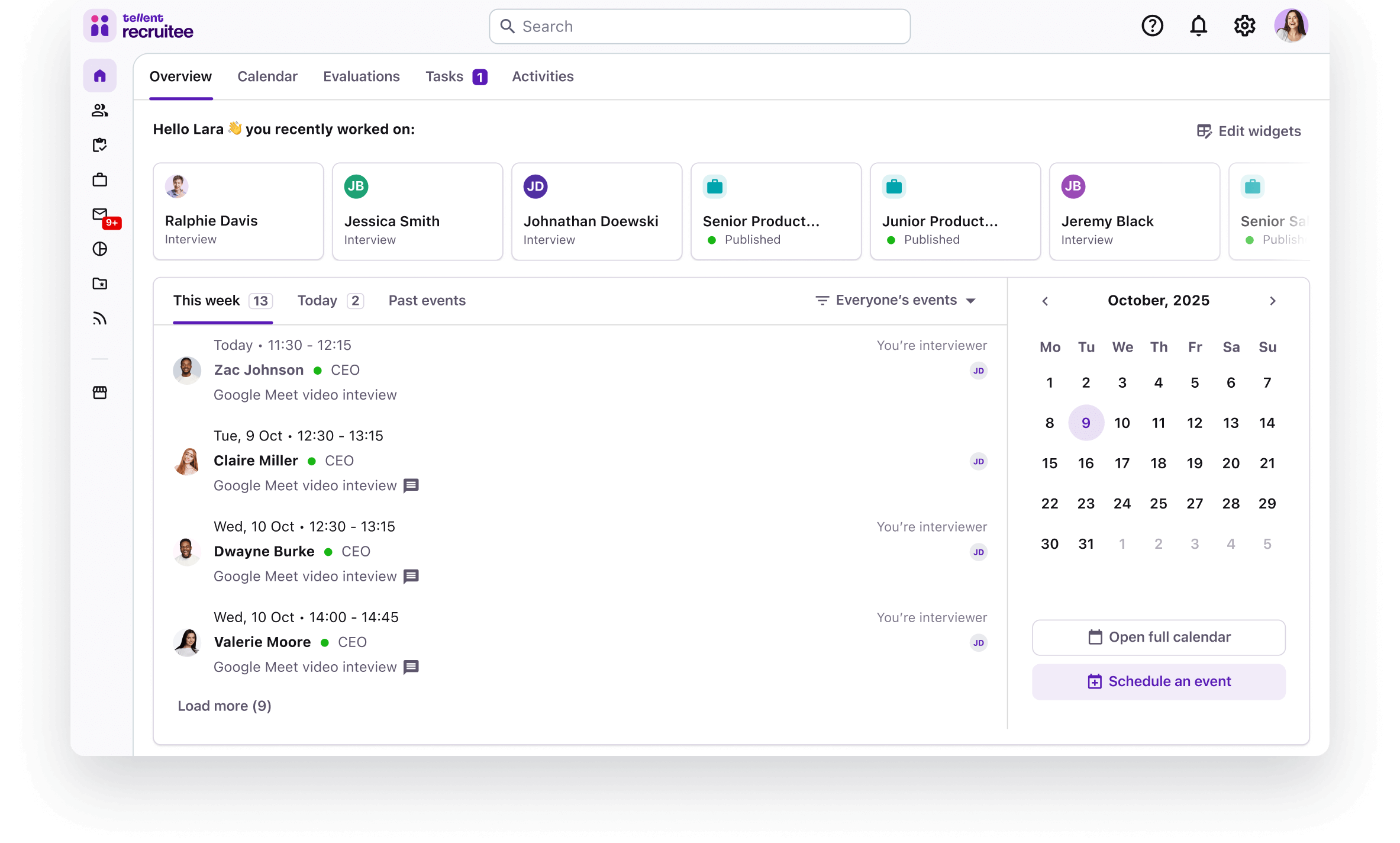
Most applicant trackers can store a CV and draw a Kanban board. Recruitee’s sharper decision is unlimited users on every plan. Per-seat pricing quietly discourages collaboration: the recruiter gets a license, the hiring manager gets a forwarded PDF, and the audit trail evaporates. Here, the whole hiring team can participate while permissions restrict what each person sees and does.
That design shows up in small, useful controls. Reviewers can be prevented from seeing earlier evaluations until they submit their own. Candidate details such as names or nationality can be hidden at selected stages. Reusable scorecards make answers comparable. Stage time limits flag an applicant who has been waiting too long. None of these guarantees a fair decision, but each removes a familiar way for a process to become careless.
“I can see everyone’s comments in one place.”Femke van der Meer, Head of E-commerce at YAYS
Build the front door
CareersHub creates branded, multilingual job pages, while the jobs widget fits openings into an existing site.
Fill the pipeline
Multi-posting reaches more than 2,900 free and paid boards; referrals, agencies, and talent pools add other routes.
Run the process
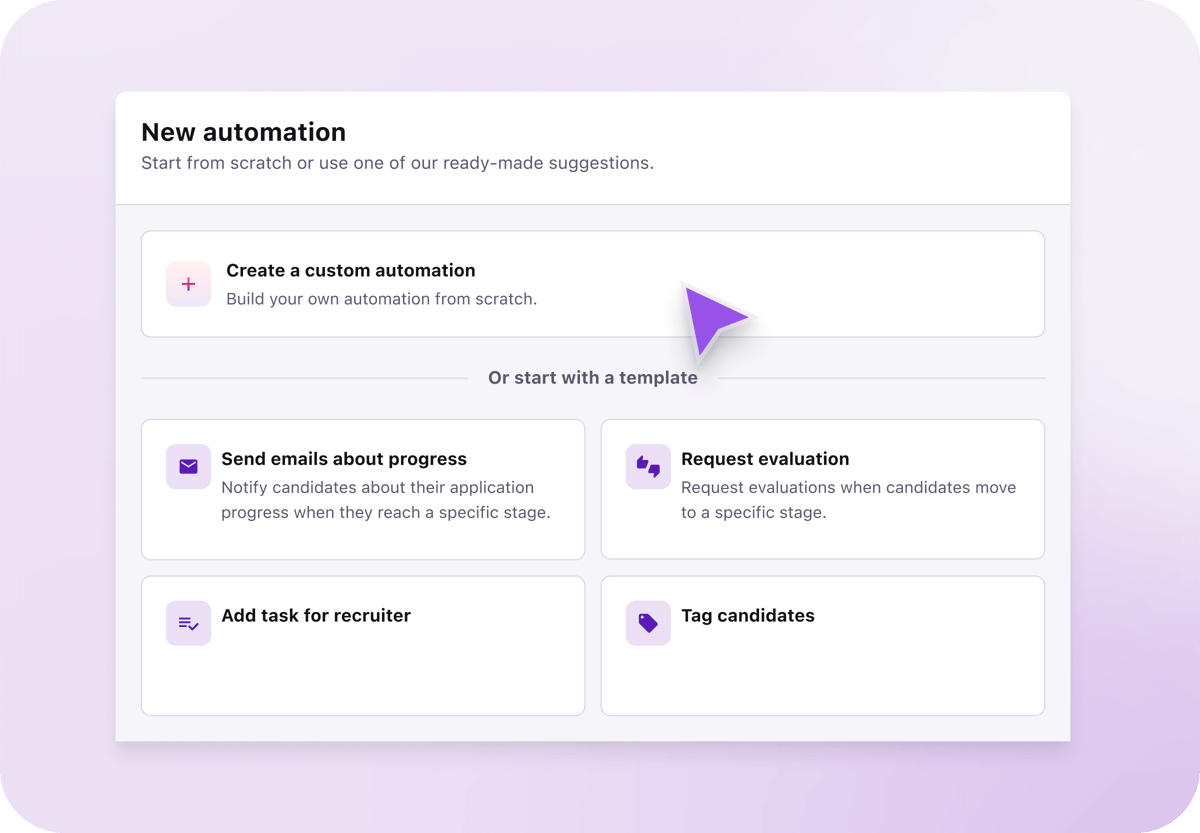
Custom stages, templates, bulk actions, knockout questions, approvals, tasks, and reminders keep candidates moving.
Close the loop
Calendar sync, self-scheduling, video integrations, offer letters, dashboards, and reports cover the later miles.
Scale figures are reported by Recruitee. “Integrations” refers to the Tellent Marketplace; job-board reach is a separate, larger network.
AI that leaves fingerprints
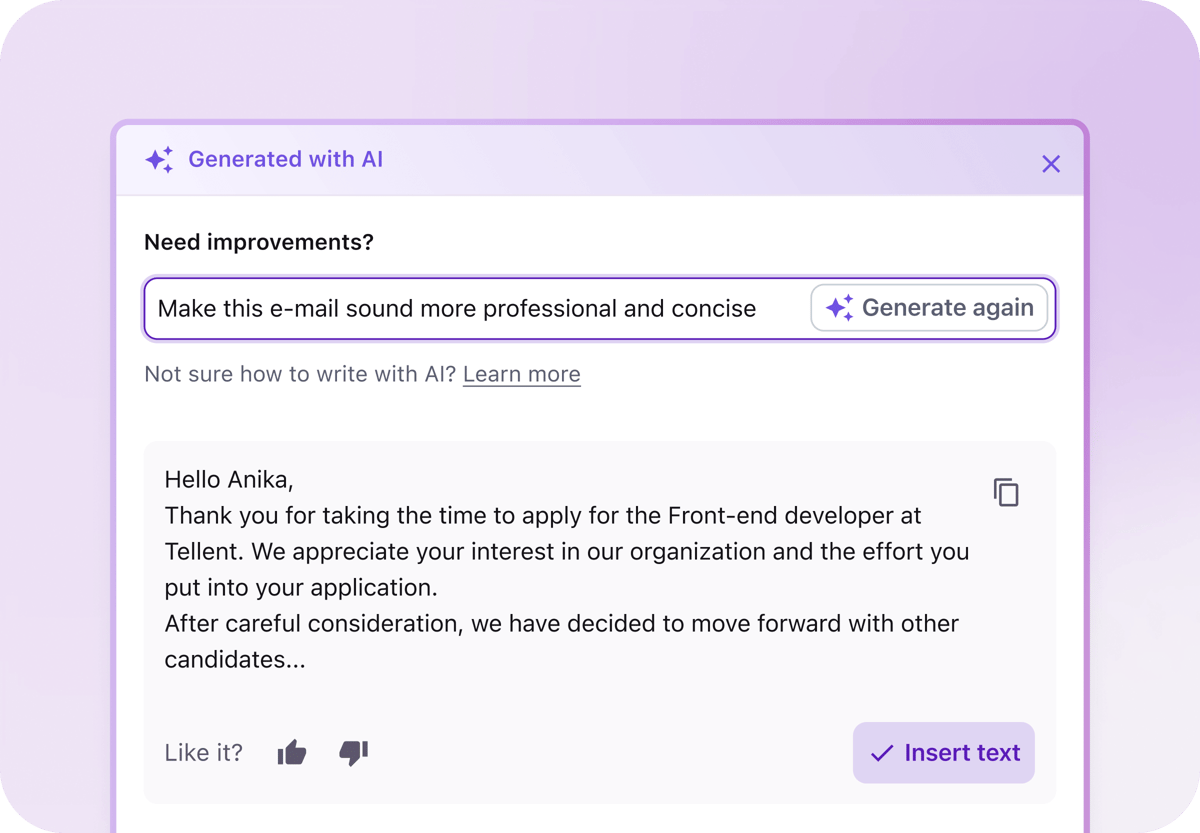
Recruitee’s AI has become a small cast. The Writer drafts candidate emails, job descriptions, translations, and summaries. Evaluation Insights condenses the interview panel’s notes. Screening Assistant checks CVs against job criteria. Matching Assistant searches talent pools and other active jobs for people worth revisiting.
The restraint is notable. Matching Assistant does not produce an 85 percent suitability badge, a top-ten ranking, or an automatic rejection. It surfaces candidates and explains why they match; a person decides what happens. Advance currently includes three matching searches a month, while Optimize lists 65. That allowance is a purchasing detail worth testing with real vacancy volume, not a footnote to discover after signing.
What users love, and what makes them mutter
Across G2’s 449 reviews, Recruitee held a 4.5 out of 5 rating when we checked. The recurring compliments are ease of use, a modern interface, automation, and collaboration. TrustRadius reviewers similarly praise the visual pipeline, job-board posting, notes, email templates, scheduling, and support. One Reddit recruiter who claimed to have tried a large field of systems called it the best in-house ATS they tested and “actually modern.”
The grumbles are equally consistent. Some G2 users want deeper, more customizable reporting. Third-party recruiters note that paid job-board subscriptions remain additional costs. Older TrustRadius feedback asks for agency-style company fields and more job capacity without a higher bill. On Reddit, a small-business customer liked the interface and easy training but said rising prices pushed the product beyond their budget. These are anecdotes, not a census, but they point to the right demo questions.
Our judgment based on current capabilities, packaging, and recurring review themes. Run your own workflow through a trial before treating any score as gospel.
The price is a conversation
Recruitee no longer publishes a simple monthly sticker price. Start, Advance, and Optimize are quoted according to plan, company size, and billing period. Every plan requires at least a one-year commitment, though invoices may be monthly. Annual payment receives a stated 20 percent discount. A no-card trial is available.
Start allows five active jobs and includes the single-page CareersHub, posting, collaboration, a candidate database, scheduling, basic AI credits, marketplace access, and API access. Advance removes the active-job ceiling and adds the multi-page careers site, referrals, automations, offer letters, custom reports, and broader AI tools. Optimize adds SSO, onboarding help, a dedicated customer success manager, conditional automation, fairness controls, approval workflows, BI links, a sandbox, and fuller screening and matching capacity. Texting, WhatsApp Hiring, Journeys, AgencyHub, and Tellent HR can cost extra.
| Alternative | Pick it when… | Recruitee’s counterpunch |
|---|---|---|
| Greenhouse | You need rigorous enterprise interview operations and a mature ecosystem. | Friendlier setup and unlimited-user collaboration across all plans. |
| Teamtailor | Employer brand and career-site storytelling lead the purchase. | Strong career pages plus configurable operations and European compliance posture. |
| Workable | You want broad sourcing and a familiar all-round SMB package. | More emphasis on tailoring pipelines around your process. |
| Personio | You want ATS and broad HR administration from one vendor. | A focused recruiting experience, with Tellent HR available separately. |
| Ashby | Analytics-heavy recruiting operations are the center of gravity. | Lower intimidation factor for occasional hiring managers. |
A seven-day trial plan
Do not spend the trial admiring the sample dashboard. Use one real or safely anonymized vacancy and recruit the people who usually avoid recruiting software.
- Build one true pipeline. Include the awkward approval, the technical screen, and the handoff your team actually uses.
- Invite two reluctant managers. Ask them to review, score, comment, and schedule without a tutorial. Watch where they hesitate.
- Test candidate communications. Check the application on a phone, email tone, scheduling, rejection delay, and sender identity.
- Automate one nuisance. Try a stage-triggered task or email and confirm the exceptions are easy to handle.
- Rebuild the report leadership asks for. If it needs a spreadsheet massage, price that labor into the decision.
- Interrogate the quote. Confirm employee-count bands, add-ons, AI allowances, renewal terms, onboarding, storage, and support.
- Export something. A relationship with an ATS can last years. Know how your candidate data leaves before it moves in.
From mobile games to people decisions
Perry Oostdam and Pawel Smoczyk founded Recruitee after working on a mobile gaming startup, then launched the product in Amsterdam in August 2015. A 2021 merger with Finnish HR software company Sympa, backed by Providence Strategic Growth, expanded the group. Javelo and kiwiHR followed in 2022. The umbrella later became Tellent, and in 2025 Recruitee emerged as Tellent Recruitee beside the company’s HRIS and performance products.
That history explains the current shape. Recruitee remains a distinct recruiting product, but the sales story now extends from vacancy to employee record and performance conversation. In 2026, LinkedIn Recruiter System Connect arrived, syncing candidate data and application history between systems. AgencyHub brought external agencies into one workspace. Matching Assistant began mining old applications for new openings. The mobile apps cover the essential approving, moving, messaging, and note-taking work away from a desk.
The verdict
Recruitee is an easy recommendation for a growing in-house team whose biggest problem is participation. Its best work is mundane in the healthiest way: making feedback visible, scheduling less tedious, process rules reusable, and forgotten candidates findable. The interface gives occasional users a fighting chance, while recruiters retain enough control to stop every department improvising its own miniature hiring religion.
The caution is commercial. Quote-only pricing and a one-year minimum make this a considered purchase. Small businesses with occasional vacancies may pay for sophistication they rarely use; analytics-heavy teams should prove the reporting fits; agencies should verify their CRM and client workflow needs. Bring those questions to the demo. If the answers hold up, Recruitee can replace a surprising amount of inbox archaeology with a shared, legible habit.
Keep digging
- Official website and current plans
- Complete feature directory and product updates
- Help center and LinkedIn Recruiter integration announcement
- LinkedIn, Instagram, Facebook, and YouTube
- Independent perspectives: G2, Capterra, and TrustRadius