Reclaim is for the person who opens Friday's calendar and discovers that the week happened to them. The important project is still waiting. Lunch became a cursor hovering over delivery apps. Three half-hours of concentration survived, each marooned between calls. Reclaim's pitch is simple: stop treating the empty squares as neutral territory. Tell the software what deserves time, then let it defend and rearrange those blocks as reality barges in.
That makes Reclaim less like a new calendar and more like a stage manager behind Google Calendar or Microsoft Outlook. You still look at the familiar grid. Behind it, the app negotiates among meetings, deep work, routines, tasks, travel and breaks. A flexible block can slide. A high-priority event can hold. When a customer call lands on Tuesday afternoon, Thursday's writing session need not vanish into the same mist as every abandoned New Year's resolution.
This is most useful for meeting-heavy knowledge workers, managers, product and engineering teams, salespeople, consultants and executive assistants. It is also useful for anyone with several calendars and a recurring habit of double-booking their private life. People who want a project manager with dependencies, documents and elaborate task hierarchies should look elsewhere. So should the person who feels a small electrical shock whenever software moves an appointment.
The moving square is the product
Most calendars record decisions. Reclaim keeps revisiting them. You set a weekly Focus Time target, preferred hours and session length. Habits handle recurring ambitions such as lunch, exercise, planning or an inbox sweep. Buffers add recovery, preparation or travel around events. Smart Meetings search across attendees and can move within rules when conflicts appear. Tasks arrive directly or through Google Tasks, Todoist, Asana, ClickUp, Jira, Linear and Notion.
Reclaim 2.0, released in June 2026, packages these behaviors as specialized agents and adds a conversational assistant. You can ask it to find meeting time, inspect an overloaded day, suggest work for a focus session or resolve a conflict. Crucially, its current documentation describes preview and approval controls. Calendar automation is intimate software. A useful assistant should show its hand before redecorating Tuesday.
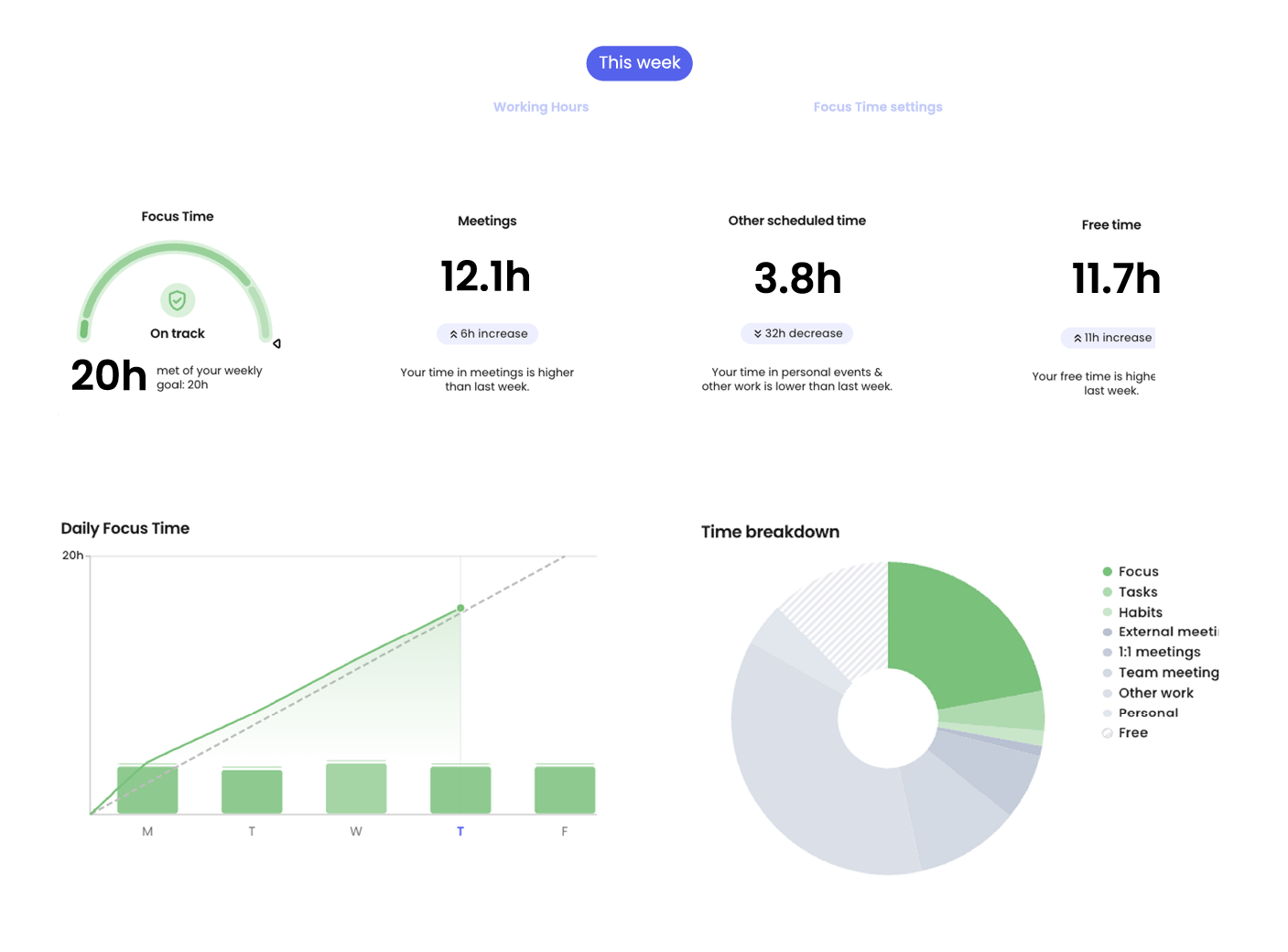
The scale and outcome figures above come from Reclaim. Treat the 7.6-hour result as a vendor-reported aggregate, not a promise that a robot will smuggle an extra workday into your week.
What it does before your first coffee
Sets a weekly goal, places sessions inside your preferred windows and finds a new home when a meeting wins the original slot.
Habits behave like recurring events with knees. Lunch can move without dropping off the calendar altogether.
Buffers reserve prep, decompression and travel so a day does not become one continuous video call with costume changes.
Calendar Sync copies busy time between work and personal accounts, with controls over what colleagues are allowed to see.
Scheduling Links and Smart Meetings look for practical times while respecting hours, priorities, durations and attendees.
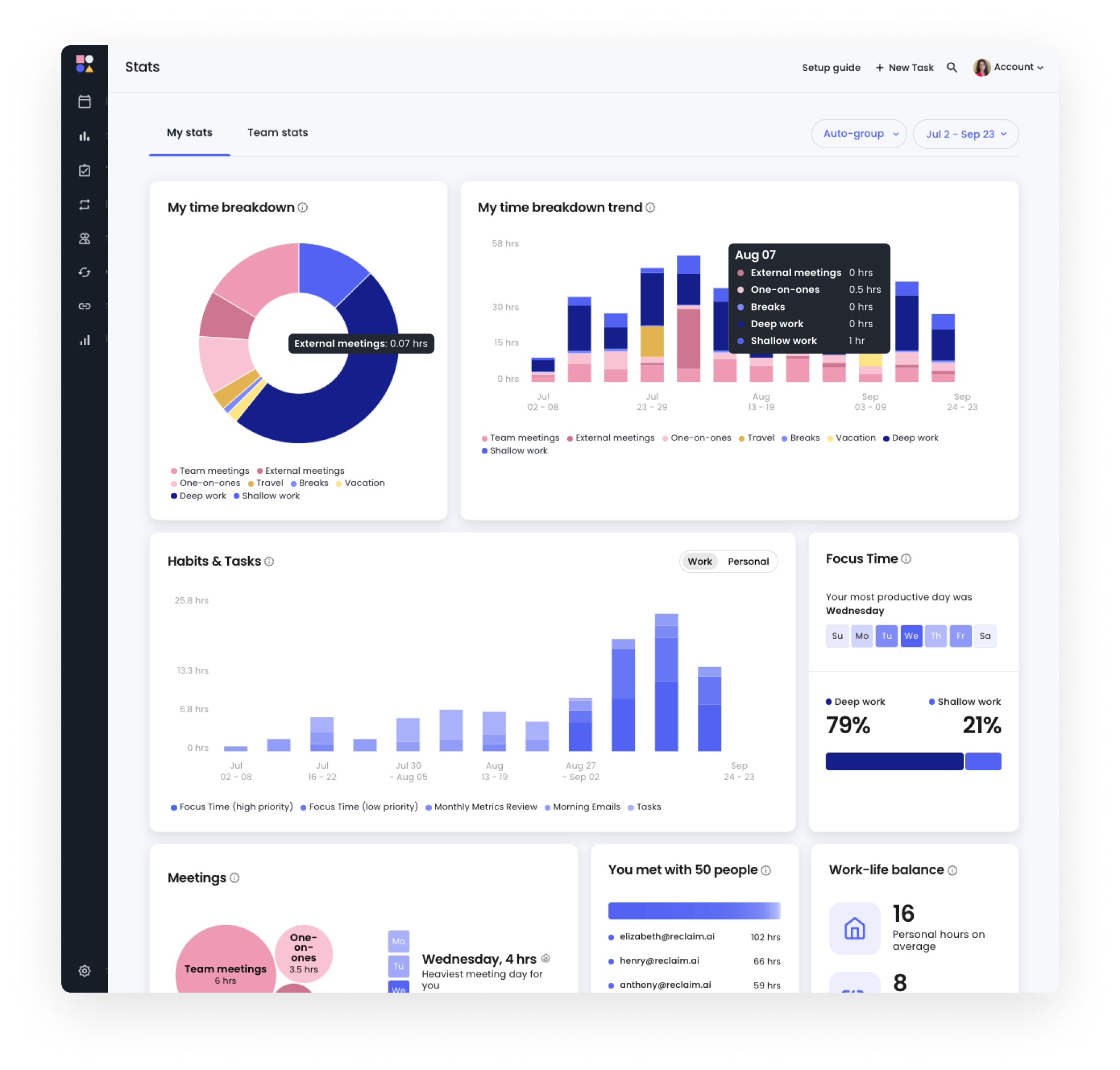
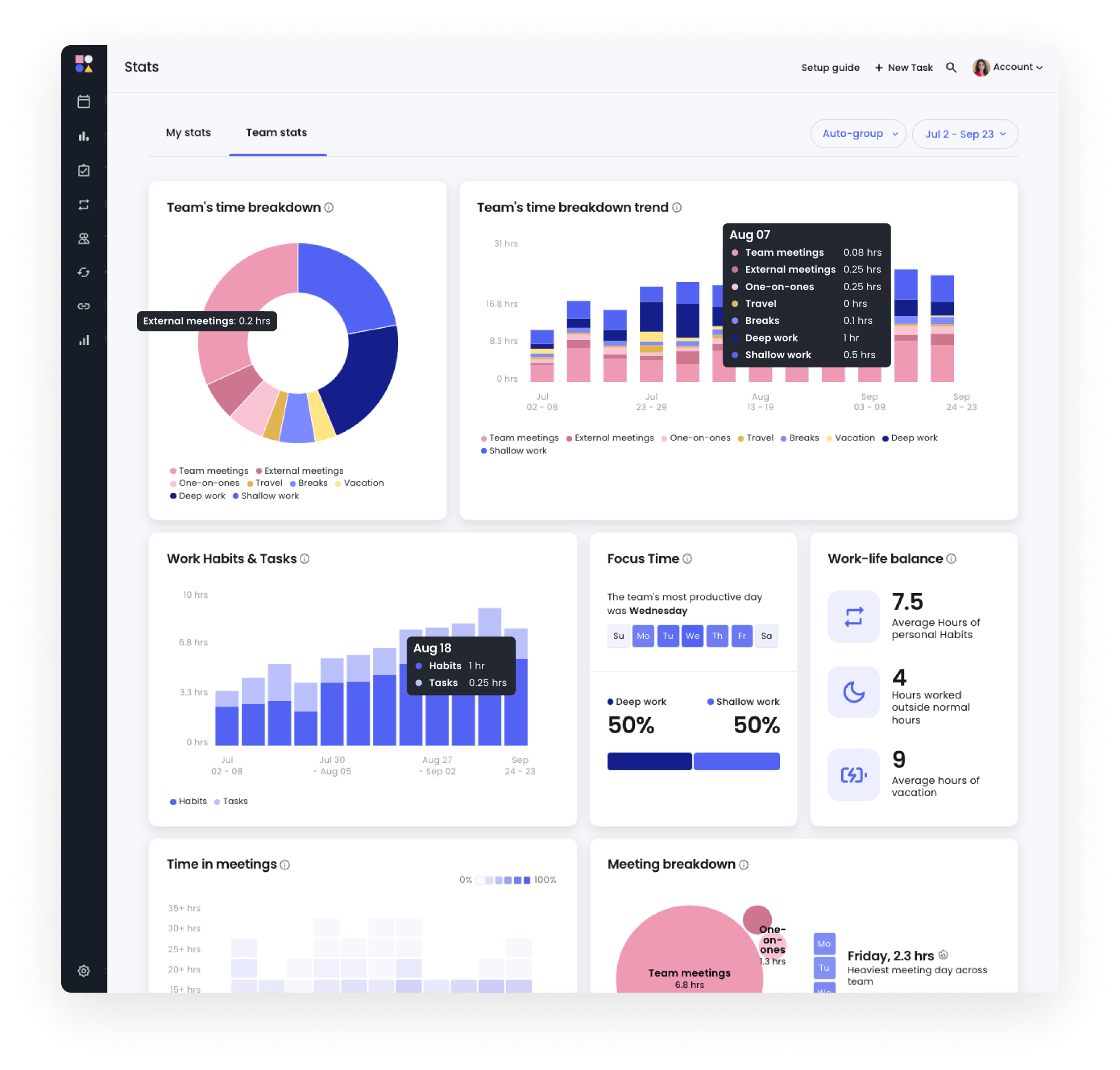
Personal and workforce analytics measure focus, meeting load, fragmented time, habits and work outside normal hours.
The distinction between a fixed event and a flexible one is the hinge. A dentist appointment should not roam. A two-hour research block often can. Reclaim becomes pleasant when those categories match your actual life. It becomes annoying when everything is marked movable or when priorities are vague. The first week is less about enjoying automation than teaching it your grammar.
A week after the squares learn to scoot
The trust fall, in calendar form
Reclaim's strong reviews tend to praise the quiet recovery from chaos. On G2, where the product showed 4.8 out of 5 from 138 reviews when checked, one reviewer titled the experience “A gentle nudge to focus when my day falls apart.” Users also call out calendar sync, scheduling links and responsive support. Reclaim's customer page contains the neatest expression of product-market fit: “If it isn't in Reclaim it doesn't exist for me.”
The clever part is not blocking two hours. It is refusing to let those two hours die when Wednesday gets ideas.YesPress assessment
The complaints describe the mirror image. Some users dislike placements in odd fragments, want more granular control or miss a native mobile app. Reddit comparisons often favor SkedPal for customization and project-like organization, while describing Reclaim as easier or cheaper to live with. Trustpilot's much smaller and harsher sample includes reports of unwanted calendar events and cancellation frustration. These are not side notes. Any product allowed to write to a calendar must make cleanup, consent and undo behavior boringly clear.
A sensible trial starts small. Connect one calendar. Create one focus goal, one lunch Habit and a post-meeting buffer. Watch how they move for several working days. Then add task integrations or recurring Smart Meetings. If you begin with every routine you have ever admired, the calendar fills with pastel good intentions and the software looks guilty.
The price of five tiny robots
The Free plan now includes five AI agents. That sounds abstract until you count: a focus goal, lunch, exercise, a weekly review and a post-call buffer can use the allowance. It is enough for a real trial and possibly enough for a light personal system. Everyone receives a 14-day Business trial before falling back to Free if they do not upgrade.
With annual billing, Starter is listed at $10 per seat per month, Business at $15 and Enterprise at $22. Month-to-month prices are $12 for Starter and $18 for Business; Enterprise is not offered monthly. Higher tiers increase agent limits, scheduling ranges and calendar syncs, then add team controls, integrations, analytics, SSO and SCIM. Recheck the pricing page before buying, because packaging is precisely the sort of thing that moves almost as often as a Reclaim Habit.
| Choose | Best when | Trade-off |
|---|---|---|
| Reclaim | Focus, habits, meetings and buffers must coexist inside Google or Outlook. | Requires trust in flexible blocks and thoughtful rules. |
| Motion | You want scheduling tied more tightly to an all-in-one task and project system. | A broader workspace can mean a bigger migration and more machinery. |
| Calendly | External booking links are the main job and calendar defense is secondary. | It does less to continuously reshape the rest of the week. |
| SkedPal | You enjoy detailed scheduling maps and fine-grained task rules. | The extra control brings a steeper setup. |
| Native calendar | Your week is stable and manual blocking already survives contact with meetings. | You remain the rescheduling engine. |
Dropbox bought the right problem
Henry Shapiro and Patrick Lightbody founded Reclaim in Portland in 2019. By August 2024 it had raised more than $9.5 million from investors including Index Ventures, Gradient Ventures, Calendly and others. Dropbox acquired the company for an undisclosed sum; all 22 employees joined, and Reclaim said the product and support would continue. At that moment it reported 320,000 users and 43,000 companies. The present 600,000 and 70,000 figures suggest the audience kept expanding after the deal.
The technical bones are unusually public for a scheduling app. Reclaim has identified Java with Micronaut on the backend, TypeScript with React on the frontend, and Amazon Web Services as its primary infrastructure. Its trust center lists SOC 2 Type II materials, while the product offers Google and Outlook connections, Slack and Zoom integrations, a Raycast extension and an MCP endpoint for compatible AI clients. The company says it does not train AI on customer data.
Recent releases show a product stretching from personal scheduling into organizational time policy. Team out-of-office calendars arrived in April 2026. Custom Slack out-of-office replies followed in June. Workforce dashboards and company-wide initiatives aim at meeting agendas, buffers, no-meeting days and calendar fragmentation. This will delight operations leaders who want evidence about meeting culture and alarm employees if the analytics feel like surveillance. Reclaim says its enterprise insights are privacy-first; buyers should still inspect permissions, aggregation and rollout language before turning the calendar into management telemetry.
Who should actually use it?
Yes: people whose important work is repeatedly displaced by meetings, people balancing work and personal calendars, and teams willing to agree on what can move.
Maybe not: meticulous manual schedulers, mobile-first users waiting for native iOS or Android apps, or teams seeking a full project-management database.
The practical verdict is to use Free as an audition. If three automations make the week calmer, add two more. If you spend the trial correcting every move, believe the evidence. You do not need an AI scheduler; you need a calendar that obeys.
Five answers before you connect the calendar
Does it replace Google Calendar or Outlook?
No. Reclaim is an assistant layered on top. Google Calendar and Microsoft Outlook remain the calendars of record.
Can it protect personal appointments from work bookings?
Yes. Calendar Sync can copy busy time between connected calendars while controlling how much event detail colleagues can see.
Is there a phone app?
Reclaim does not publicly list native iOS or Android apps. The web product is mobile-accessible, and its calendar events still appear in the native calendar you already use.
What changed in version 2.0?
The June 2026 redesign introduced the conversational assistant, specialized agents, task recommendations and more explicit preview-and-approval workflows.
What should I automate first?
Pick the promise your calendar breaks most often. For many people that is focus time. For consultants it may be cross-calendar availability; for sales teams, buffers and meeting links. One repaired promise is a better test than twenty decorative automations.