The useful thing about Poe appears five minutes after you open it. You ask one model to tighten a proposal, call another into the same thread for a second opinion, then wander off to make an image without opening three accounts or remembering three passwords. Poe has turned the unruly AI market into a single, purple-fronted counter. For people who like comparing tools, it is wonderfully practical. For anyone who wants one trusted assistant with a simple monthly allowance, it can feel like buying groceries with arcade tokens.
That distinction decides whether Poe belongs on your phone. This is primarily for the curious generalist: the writer who tests tone across models, the programmer who wants a quick alternative when one bot stalls, the student comparing explanations, the creator experimenting with images and video, or the developer who wants an audience for a specialist bot. If your work depends on one provider's deepest native features, direct access may be cleaner. Poe earns its keep through breadth.
The browser for a web made of bots
Poe is short for Platform for Open Exploration. Quora launched the first iOS version in December 2022, during the first ChatGPT rush. Chief executive Adam D'Angelo has explained the founding idea with an unusually durable metaphor: a web browser for AI. A browser gives many sites one familiar frame; Poe aims to give models from many labs, and products built by independent creators, one chat interface.
The idea also rhymes with Quora. The older service aggregated answers from people. Poe aggregates answers from machines and the people who configure them. D'Angelo said the team reached its conclusion around August 2022: instant, abundant machine answers needed a chat product rather than a retrofit of Quora's publishing system. A small team built Poe separately. It first arrived with only a handful of bots, then expanded into a model directory, bot marketplace, developer platform and miniature app workshop.
“We want Poe to be a single interface so that people can use that to talk to any model.”Adam D'Angelo, in conversation with Andreessen Horowitz
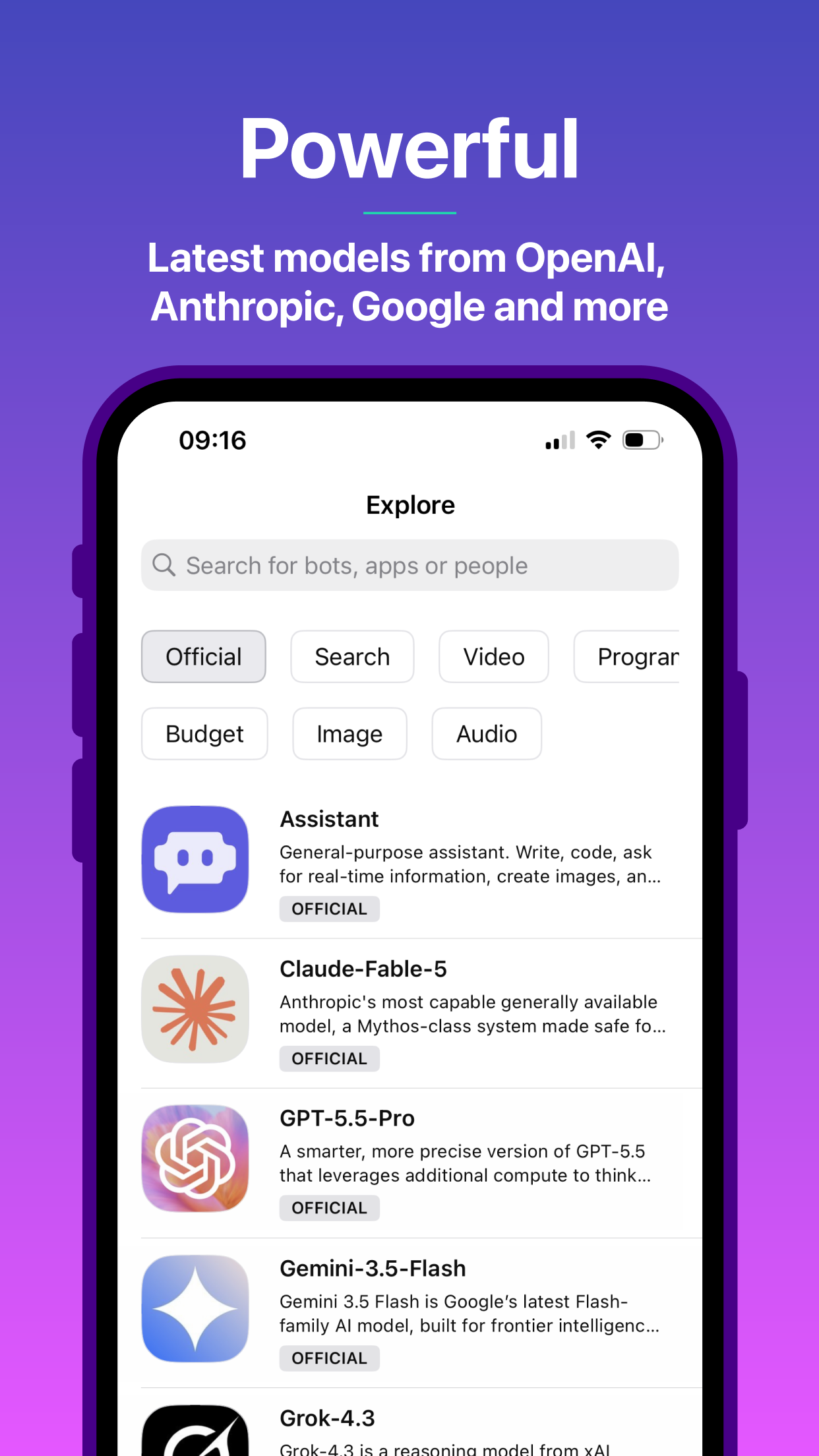
That bet looks sensible in 2026. Poe's subscription page advertises access to current text and media models including GPT-5.5, Claude Opus 4.7, Gemini 3.5 Flash and Veo 3.1. The precise roster changes quickly, which is part of the product. You are renting access to a moving shelf, rather than marrying a single model family.
What you can actually do before lunch
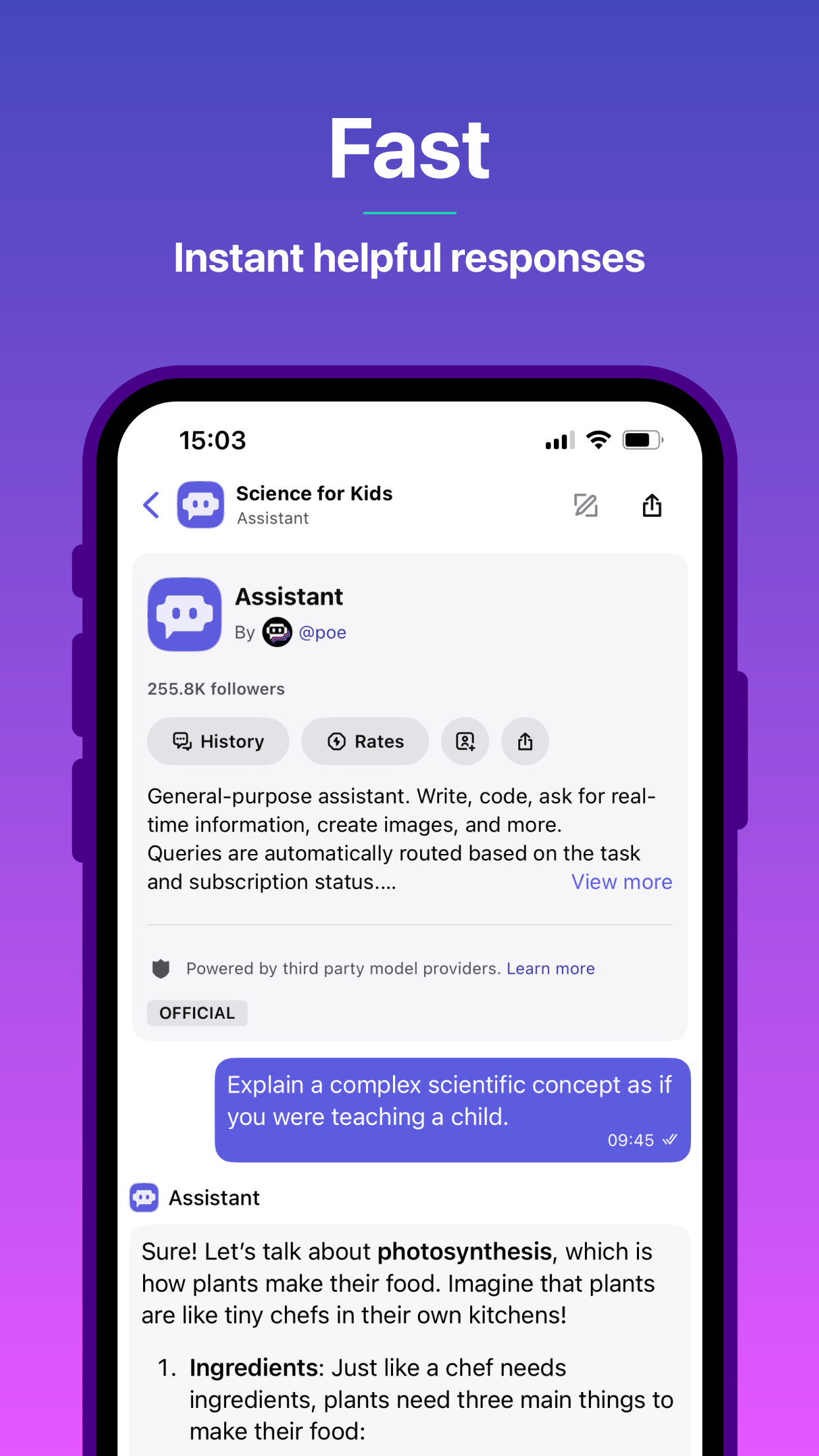
Start with ordinary chat: write, summarize, code, brainstorm, search the web or ask questions about uploaded files. The valuable wrinkle is multi-bot conversation. Mention another bot inside a thread and you can ask for a critique or alternative without rebuilding the context elsewhere. It is less scientific than a formal benchmark, but far more useful for daily work. A draft can pass from a fast model to a careful one while the brief stays visible.
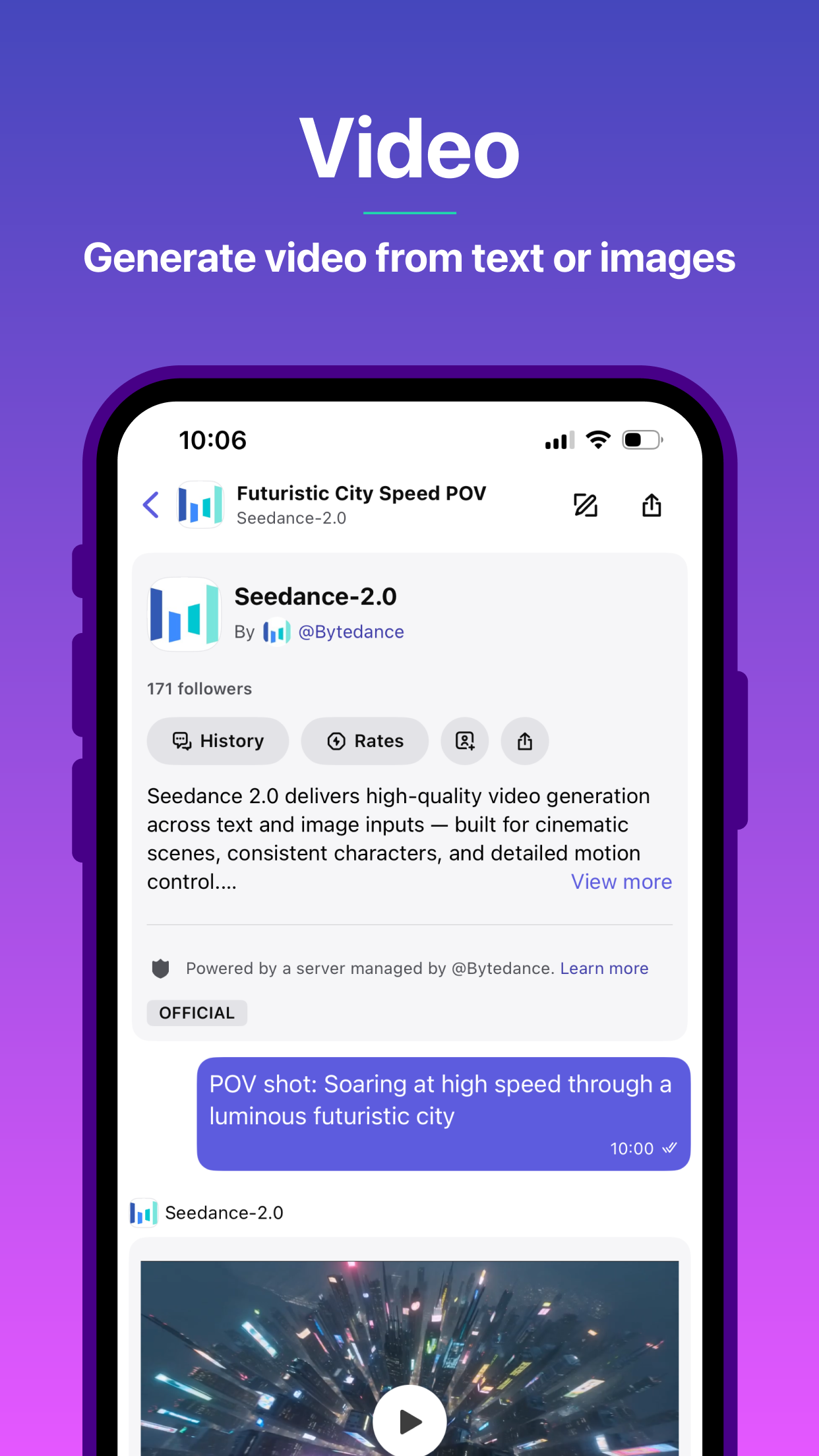
The same account reaches image makers such as FLUX and Ideogram, video systems from companies including Runway and Luma, plus audio and music bots. Poe's Explore area mixes official models with more than a million user-made bots. Some are sober utilities built around documents, code or a knowledge base. Others are tutors, role-play characters and strange little experiments. Discovery feels like an app store whose shelves are restocked faster than anyone can label them.
| Job | Poe's useful move | Watch for |
|---|---|---|
| Compare an answer | Call several models into one thread | Each response can consume points |
| Read a document | Upload a file and test specialist bots | Long context can raise the charge |
| Make media | Switch from text to image, audio or video | Generation jobs can be much dearer than chat |
| Build a helper | Create a prompt bot, knowledge bot or server bot | Quality and privacy depend on the implementation |
| Prototype an app | Describe a canvas app, inspect the code and remix it | Generated apps still need testing and judgment |
Creators get the more interesting half of Poe. A prompt bot can be assembled around instructions and private knowledge without running a server. Technical teams can connect their own endpoint, stream replies through the Poe Protocol and expose controls such as sliders or toggles. Poe also offers OpenAI-compatible and Anthropic-compatible APIs, plus Python and Node.js routes. Eligible creators in supported countries can set a per-message price and earn when people use their bot.
Then there are Poe Apps, interactive canvases generated from a description. They can sit beside chat, use models behind the scenes, and reveal HTML and JavaScript for manual editing. The creator changelog shows how quickly this corner has moved: web access, Claude Agent underpinnings, model switching, remixing, file downloads and improved tool calling arrived across 2025. In March 2026, Script Bot Creator gained intro messages and adjustable parameters.
The meter is the product too
Every Poe user gets a pool of compute points. Free points refresh daily and do not roll over. Subscribers receive larger daily or monthly allocations and access to more expensive models. The wrinkle is that a message has no universal price. One cheap text reply may barely register; a long context, extended reasoning run or video generation can bite hard. Bot pages show an estimated cost and a Rates panel, while settings let users place per-message budgets and inspect point history.
The point bill, translated
Poe says prepaid add-on points are displayed at an approximate rate of $30 per 1 million. Actual message costs vary by bot.
US App Store purchases currently list Basic at $4.99 monthly or $49.99 annually and Plus at $19.99 monthly or $199.99 annually. Poe's web page also presents higher point tiers. Taxes, currencies, availability and allocations vary. Treat those figures as a snapshot and inspect the live plan page before buying.
This system is rational from Poe's side. The company is reselling workloads with wildly different underlying costs and sharing revenue with creators. It is also cognitively expensive. A conventional subscription asks, “Have I hit the limit?” Poe asks, “How much might this particular thought cost?” Long chats become pricier because more history may be sent back to the model. Poe offers auto-managed context and budgets, but those controls are evidence of the complexity they tame.
“I can use lots of different ai tools and chatbots without buying 100 subscriptions.”Five-star Trustpilot review, March 2025
That happy review captures the bargain. Another reviewer on the same page called the pricing “horrendous.” Reddit threads repeat both positions: people love model variety and resent watching costly bots drain an allowance after a handful of ambitious prompts. Neither camp is confused. Poe offers unusually broad access, and broad access is not the same thing as carefree access.
How it compares when the novelty wears off
| Option | Best reason to choose it | Main compromise |
|---|---|---|
| Poe | Many model families, media tools and creator bots in one account | Variable point budgeting and fewer provider-native extras |
| ChatGPT | Deep OpenAI feature integration and a coherent default assistant | Less neutral if you want to compare rival model families |
| Claude | Focused Anthropic experience and its native workflows | One principal model family |
| Gemini | Google ecosystem integration and Gemini-native tools | Again, one principal model family |
| Perplexity | Research-first search with visible citations | Less of a creator-bot bazaar |
| OpenRouter | Developer-oriented model routing and granular API choice | Less friendly as a mainstream social chat app |
Poe wins when switching is part of the work. If you regularly compare outputs, roam between text and media, or publish bots to an existing audience, its common interface removes friction. Direct subscriptions win when you rely on one vendor's memory, projects, voice, integrations or generous limits. Developers should compare Poe's point conversion with direct API rates for their actual models, because convenience can be worth a premium without making every workload economical.
The privacy shield deserves one click
Poe chats are not public by default, but their contents must travel to the model provider that answers them. Poe's updated privacy center uses shield icons. A fully shaded shield means data goes to named model providers or services in Poe's sandbox and is not used by those providers for training. A half-shaded shield means an outside developer or external resource may receive the interaction and may use it for training.
Account identity is generally separated from the chat sent to a provider, but anything you type into the chat is still in the chat. Group conversations and Poe's optional memory feature add further sharing conditions. The sensible rule is boring and durable: check the shield, check the bot maker, and keep financial, health, client and identity secrets out of prompts unless your organization has explicitly approved the workflow.
Poe fits if you…
- use several AI model families each week
- like comparing answers in one thread
- make text, images and video
- want to publish a bot or tiny app
Look elsewhere if you…
- want simple, predictable unlimited use
- depend on one provider's native workspace
- dislike tracking variable usage
- handle sensitive material without policy support
The verdict: buy the switchboard, not a soulmate
Poe is easiest to recommend as an AI switchboard. Use the free allowance to price three real tasks, then choose a plan from evidence rather than model-list excitement. Test a short research question, one long document and the media job you actually expect to run. Check the point history afterward. If the arithmetic works, Poe can replace a ridiculous row of tabs with one playful, capable address. If it does not, keep the free account for comparison days and pay your main model provider directly.
The broader achievement is cultural. Poe treats models as interchangeable ingredients and creators as product designers, rather than presenting one chatbot as an oracle. More than one million bots later, the shelves range from useful to silly to dubious, which is exactly what an open platform tends to produce. The fun comes from wandering. The wisdom comes from reading the rate card before you press send.