If your support queue has become a museum of password resets, delivery checks and questions already answered on page six of the help center, My AskAI has a sensible proposition. Leave Zendesk, Intercom, Freshdesk, Gorgias or HubSpot where it is. Add an AI agent to the existing inbox. Let it answer the repetitive tickets. When the customer asks something delicate, unusual or simply too human, pass the thread to a person with the context attached.
That last move matters. Bad support bots behave like nightclub bouncers who have lost the guest list: no entry, no explanation, please try the same sentence again. My AskAI is built around escalation. Teams can set rules for what the agent should answer, what information it should collect, and when it should get out of the way. There is even a private-notes mode, so the bot can draft beside human agents before anyone lets it speak to customers.
The fit is specific. This is for a SaaS company, online shop, marketplace or service business already paying for a helpdesk and receiving enough repeated written questions to make automation worthwhile. A solo founder answering twelve intimate, chaotic emails a week should probably keep answering them. A team handling hundreds of variations on “where is my order?” should keep reading.
Good fit
- Support lives in a supported helpdesk
- Questions repeat at real volume
- Answers exist in docs or solved tickets
- The team can review quality weekly
Think twice
- Most tickets demand judgment or empathy
- Your source material contradicts itself
- You need voice support or a mobile SDK
- Nobody owns QA after launch
The bot that found a job
Founders Alex Rainey and Mike Heap started in the glorious confusion of early 2023. Their previous no-code fine-tuning tool had produced a useful clue: customers wanted to ask questions of their own content, but did not want a lecture about model training. Before building the full My AskAI, the pair sold access for $99. More than 50 buyers put down roughly $5,000. It was a compact form of market research, with receipts.
The first product promised “chat with anything.” It gained just over 300 users and about $14,000 in monthly recurring revenue by May 2023, then lost momentum. The founders later said they stayed broad for too long. Around a year in, they narrowed the product to customer support. Revenue later reached a reported $40,000 MRR. The lesson is more useful than the number: a general AI trick became a product when it inherited a queue, a workflow and a human owner.
Read the labels: the rollout, resolution and language figures above come from My AskAI’s own current materials. Treat your trial results as the number that matters.
How it actually works
Connect a help center, website, files, SOPs, Notion, Google Drive or previous tickets. My AskAI retrieves the relevant passages for each question, then gives those passages to a language model to compose the response. This is retrieval-augmented generation, or RAG. The company does not offer a model picker. Its founders have said different jobs can be routed across providers including OpenAI, Anthropic and Google, with models tested over time.
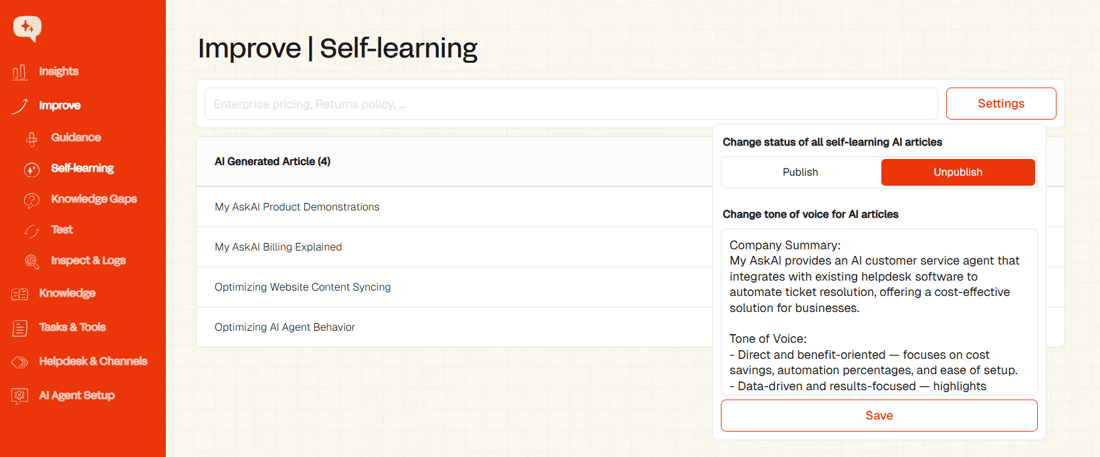
A fresh account need not begin with a pristine knowledge base. Historic-ticket training can examine thousands of solved conversations and draft grouped help articles. Self-learning continues the loop: when a case is escalated, the software compares what the human knew with what the AI knew, then creates a generalizable article for future use. Those articles remain visible and editable, which is preferable to a mysterious agent claiming it has “learned.”
Guidance handles behavior rather than facts: tone, phrasing, forbidden territory and handoff conditions. Custom Answers cover exact responses. Tasks and Tools reach into other systems for work such as order lookup, address changes, refund requests or account actions. The Shopify connection can read order details, recommend products and check live variant inventory. Image reading lets supported channels interpret screenshots and photos, useful when “it is broken” arrives with the only evidence attached.
“We offloaded informational questions from live agents so have more time for other requests.”Caelan B., G2 review, January 2026
The money: simple headline, fiddly noun
Pro starts at $199 a month with 1,000 credits. Scale is $499 with 2,000. Enterprise starts at $999. Overages run $0.12 per credit on Pro and $0.10 on Scale. The free trial lasts 30 days, unlocks the features and requires no card.
The noun to interrogate is “credit.” In helpdesk chat, every two AI replies count as one. For email, the first AI reply is one credit and each follow-up question is half. In My AskAI’s own widget, any number of messages from one visitor inside an hour is one credit, provided the session is not refreshed. Across more than a million chats and tickets, the company says the average sits just under two AI replies, producing the familiar ten-cent headline for chat and roughly fifteen cents for email.
| Plan | Monthly base | Included | Overage |
|---|---|---|---|
| Pro | $199 | 1,000 credits, 5 seats | $0.12 per credit |
| Scale | $499 | 2,000 credits, 3 agents | $0.10 per credit |
| Enterprise | From $999 | Custom support and SLA options | Quoted terms |
Optional meters remain. AI tagging costs $0.05 per attribute per ticket. Translation is $0.05 per ticket. Image processing, tool calls and task steps generally add $0.02 when used. Branding removal costs $49 monthly on Pro and is included above it. None of this is scandalous; all of it belongs in your spreadsheet. Run the trial against a representative week, export the usage, and price the messy month rather than the quiet one.
What customers like, and what still rubs
G2 showed a 4.5 out of 5 rating from 22 reviews during this review. The pattern is consistent: buyers like fast setup, competitive pricing, responsive human support and meaningful first-line deflection. A small-business customer called it “a good low-cost alternative to Zendesk’s native AI.” Another reported reaching 80 percent deflection after using the Improve tab to close documentation gaps.
The complaints are useful shopping advice. Reviewers asked for clearer documentation around advanced setup, more customization, better handling of complex email, and a conversational way to correct a poor response. An older review said the agent could not read screenshots; image reading arrived in April 2026 for Intercom and Zendesk, showing both the original gap and the pace of repair. Another reviewer thought unbranding was expensive. At $49 a month on Pro, that objection is easy to understand.
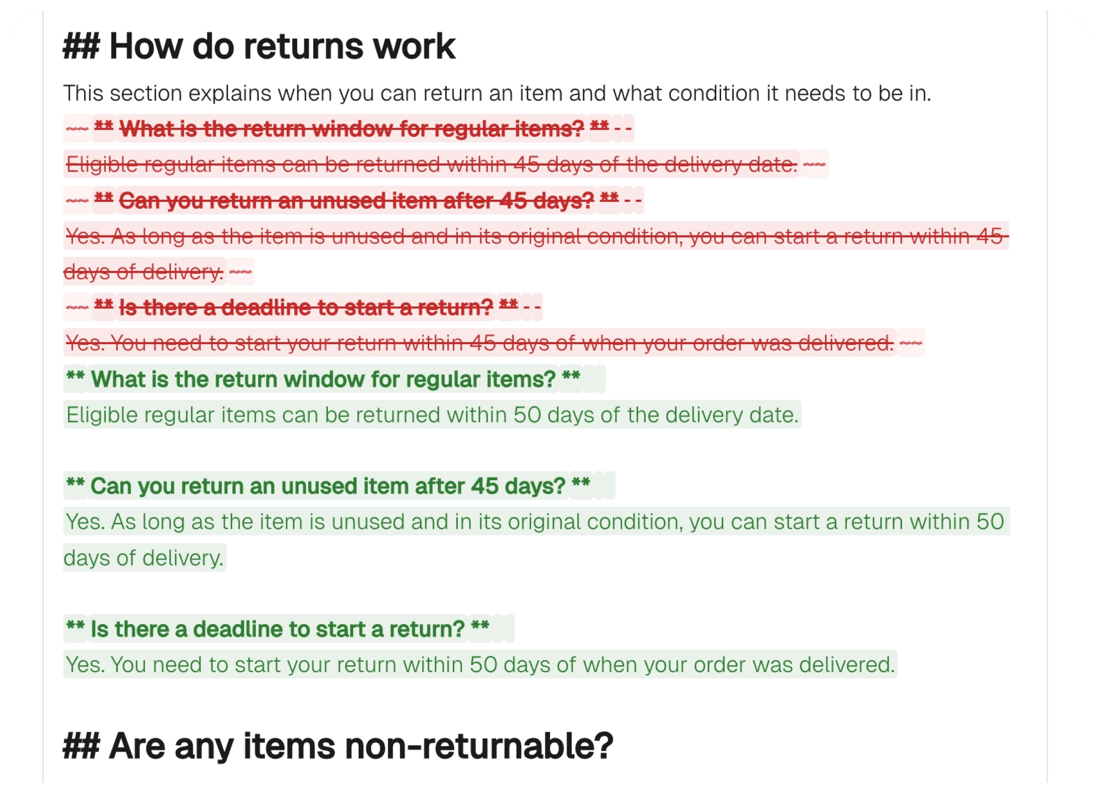
There is a broader warning hiding in the praise. Good performance depends on good material. Contradictory policies, stale webpages and improvised exceptions make poor training fuel. My AskAI can expose gaps and propose articles, but somebody must decide what the truth is. The software reduces the work of distributing an answer. It does not appoint the person who owns that answer.
The five-day buyer test
Day 1: Choose one boring queue
Start with a narrow ticket type such as order status, password resets or a well-documented billing question. Connect only the sources needed for that lane. A small clean test reveals more than a tour of every toggle.
Day 2: Turn on private notes
Have agents score drafts for accuracy, completeness and tone. Record the failure reason, not merely thumbs down. Missing knowledge needs a new article; wrong behavior needs guidance; a policy exception may need immediate escalation.
Day 3: Rehearse the exit
Ask angry, vague and sensitive questions. Request a person. Send an image. Remove an article. Check the handoff summary. A demo answer is pleasant; a clean recovery is the real procurement test.
Day 4: Price your worst week
Count actual replies, tags, translations and tool calls. Include your helpdesk subscription, because My AskAI sits on top of it. Compare total AI cost and staff time saved, not one vendor’s favorite unit.
Day 5: Give one topic permission
Enable direct replies for the safest lane and leave everything else in notes mode. Review a sample every week. The company sketches a 30-day progression from setup to controlled autonomy; there is no prize for doing it by Friday afternoon.
The product earns trust in the moment it declines a job gracefully.
Verdict
My AskAI makes the most sense for a lean support team that likes its helpdesk, dislikes its native AI bill, and has enough repeated work to measure. Its advantages are practical: approved integrations, notes-first deployment, visible knowledge improvement, task connections and a published price. The two-founder backstory adds a little scrappiness, but buyers should evaluate the operating system, not the romance.
The decision should come from your own queue. Give it the awkward tickets, calculate credits by channel, inspect every source, and watch what happens when the answer is absent. If the agent handles the routine without making humans clean up a new category of mess, the arithmetic can be attractive. If your queue is mostly exceptions, empathy and unwritten institutional knowledge, spend the month improving the system around your people first.