Most customer-support AI is sold with a heroic demo and a suspiciously tidy knowledge base. Real support work arrives wearing muddy boots: a half-updated help article, a refund exception buried in Slack, three contradictory old tickets, and a customer who calls the blue button “the round thing.” eesel AI is interesting because it starts from that untidiness. It connects to the places where a team’s answers already live, then lets the bot practice on yesterday’s mess before answering tomorrow’s customer.
That makes it a strong fit for support leaders who already run Zendesk, Freshdesk, Intercom, Gorgias, Front, Help Scout, Jira Service Management, HubSpot, or Salesforce and do not want another inbox. It also suits IT and operations teams fielding repeat questions in Slack or Microsoft Teams, plus e-commerce operators who need live order, product, inventory, or subscription context. A tiny company with twenty straightforward tickets a month may be happier with a good FAQ. A team whose hardest answers live only in one veteran agent’s head should fix that problem before asking any bot to improvise.
Who should put it on the rota?
Start with the team that can name its repetitive queue. Password resets. Order status. Return windows. “Where is that policy?” Product questions answered from the same six articles. eesel can draft replies for a person to approve, add internal notes, classify and route tickets, or answer automatically. It can also put the same knowledge in a website chat bubble, a public chat link, Slack, Teams, email, WhatsApp, Instagram DMs, Facebook Messenger, or SMS.
The useful distinction is between a source and a destination. A source might be Confluence, Notion, Google Drive, SharePoint, a PDF, GitHub discussions, a help center, a product catalog, or old tickets. A destination is where the answer appears. eesel’s pitch is that one agent can learn from several sources and show up in several destinations without forcing colleagues to visit a shiny new portal. That sounds mundane. Mundane is where adoption lives.
The rehearsal room is the product
Any vendor can put a language model behind a chat window. eesel’s more defensible feature is ticket simulation. Connect historical conversations from Zendesk, Freshdesk, Gorgias, or Intercom and the agent can attempt them in bulk. A team sees what it would have said, checks whether it found the right source, and adjusts instructions before real customers become unpaid quality testers.
Instructions are written in plain language: preferred tone, escalation rules, what the agent may do, and what requires approval. Actions can reach into connected systems, so the bot can move beyond retrieval toward jobs such as checking an order or updating a case. Sensitive steps can stop at a human checkpoint. This staged path, draft first and autonomy later, is sensible. The company’s own “trust is earned” language is better product guidance than the industry habit of measuring success by how quickly a human disappears.
“We use it to be the first responder to our Helpdesk tickets in Jira. It essentially acts just like an agent would.”Jason Loyola · Head of IT, InDebted
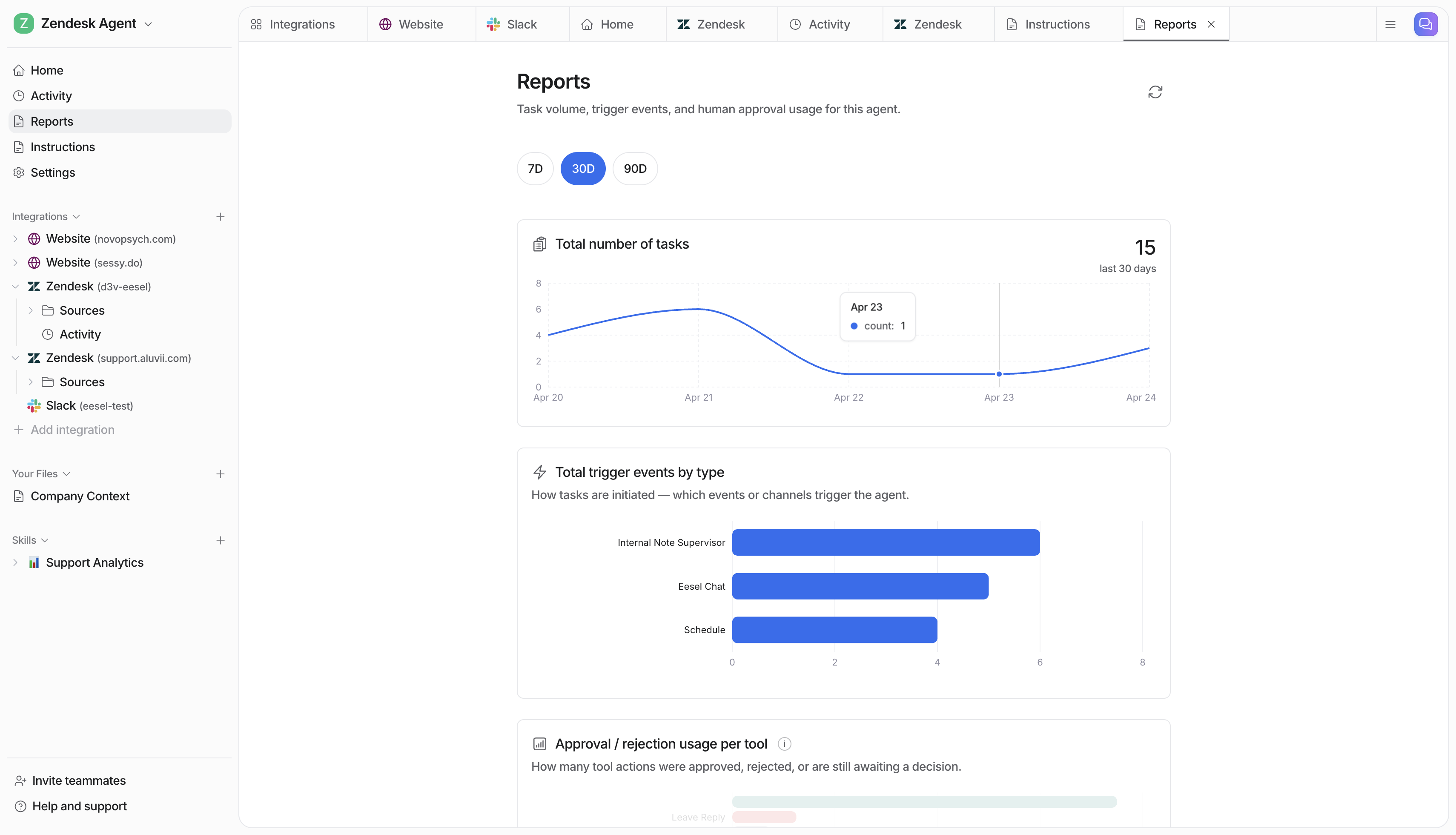
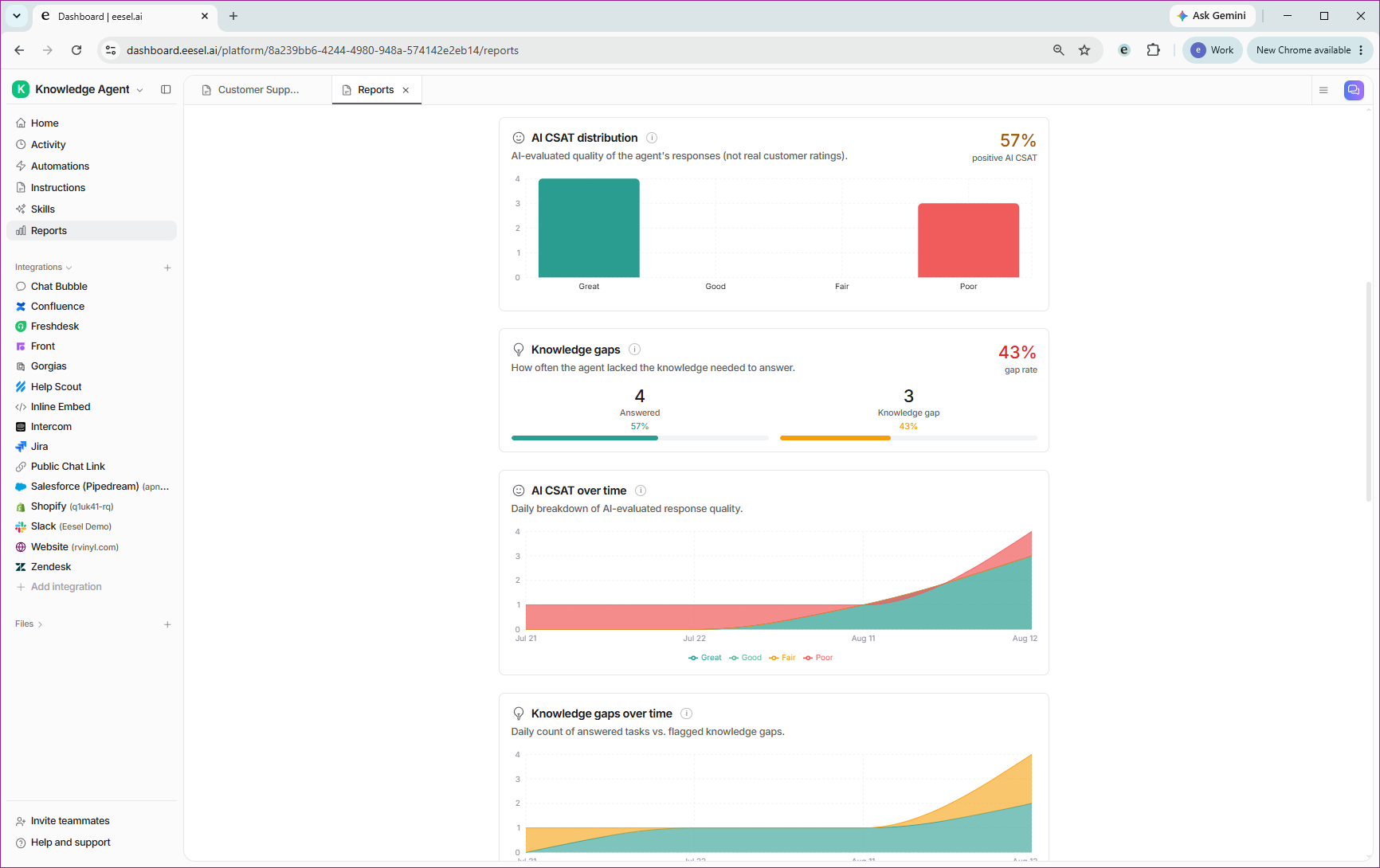
Reports track volume, approvals, review time, quality signals, and knowledge gaps. The gap report is particularly handy: a failed answer may be a bot problem, but it may also reveal that the policy was never written down. In that case, automation has performed an accidental company audit. The newer skills marketplace adds support analytics, performance review, knowledge-base updating, ticket simulation, and blog writing. Scheduled triggers can run recurring work from a natural-language schedule.
The bill has stopped pretending to be a seat
eesel replaced its older monthly tiers with usage pricing in April 2026. New accounts currently receive $50 in usage and two blog generations without a credit card. A simple dashboard lookup is a free light task. A regular task, including one entire support ticket or chat session with all its back-and-forth, costs $0.40. A heavy task such as producing a blog draft costs $4. Standard use has no platform fee or monthly minimum, and an annual prepaid commitment can reduce the rate by up to 25 percent.
| Job | Current price | Editorial translation |
|---|---|---|
| Dashboard question or simple lookup | Free | Ask where the work went without feeding the meter. |
| Support ticket or chat session | $0.40 | The whole conversation counts once, not every “thanks.” |
| Blog draft | $4.00 | A heavier task with research and optimization included. |
| Enterprise controls | $1,000/mo + usage | Dedicated people, higher limits, SSO, agreements, and regulated-work options. |
The math is refreshingly legible: 1,000 handled support conversations are $400 before any annual discount. Set a monthly usage cap and the agents pause when they hit it. The catch is equally legible: a task is billed even when the result is imperfect because model resources were still used. Budget for a supervised ramp and measure accepted work, not merely attempted work. Enterprise costs include a $1,000 monthly platform fee on top of usage, with a dedicated solutions engineer and account manager, higher knowledge limits, SSO, HIPAA and BAA options, and signed cloud agreements.
What the customers say, with the volume turned down
Public review samples remain small. Product Hunt shows a 4.6 out of 5 rating from ten reviews; G2 listed 4.7 from sixteen reviews. Product Hunt reviewers repeatedly mention quick setup, fast access to documents, useful embeds, and accurate replies. One called the setup simple and the reply accurate “in seconds.” Another said it was uncanny how often they used the product to find Google Docs, Jira tickets, and Miro boards.
There is dissent. One Product Hunt reviewer made serious privacy and GDPR allegations about an earlier Chrome extension. The company now publishes a more detailed security program and says it is GDPR and CCPA compliant, isolates workspaces, never uses customer data for model training, supports PII redaction at ingestion, and encrypts data with AES-256 at rest and TLS 1.2 or newer in transit. Its pages describe SOC 2 Type II certification as underway, not complete. Buyers should read that verb carefully, ask for the current trust-center evidence, and map every connected source to their own data rules.
How it stacks up
Intercom Fin and Zendesk AI are natural choices for teams committed to their parent helpdesks. Their native context can reduce setup friction. Ada and Forethought compete for broader support automation, Chatbase for a lighter knowledge chatbot, and Glean for enterprise search and internal knowledge. eesel’s angle is portability across helpdesks and sources, plus a single workshop for simulation, instructions, actions, and multiple agents.
| Choice | Best when | Watch for |
|---|---|---|
| eesel AI | Knowledge is scattered and the agent must work across several existing tools. | Usage can scale quickly; governance still belongs to your team. |
| Native helpdesk AI | Nearly everything already lives in one support suite. | Cross-tool flexibility and pricing may be less attractive. |
| Lightweight chatbot | You need website Q&A, not operational actions. | Fewer controls for tickets, approvals, and complex sources. |
| Human-only queue | Volume is low, cases are sensitive, or the knowledge is mostly tacit. | Repetition and response time remain stubbornly human. |
The buyer’s five-day audition
Do not begin with “automate support.” Pick one queue, one language, and one measurable outcome. On day one, connect the approved knowledge sources and remove contradictory articles. On day two, write escalation rules and forbidden actions. On day three, simulate at least a few dozen old tickets, including ugly edge cases. On day four, let agents draft while humans score factuality, tone, citations, and correct escalation. On day five, enable a narrow automatic path and set a spending cap.
Track resolution quality, reopened tickets, handle time, and customer satisfaction beside automation rate. Read the failures. If the agent cites the wrong document, fix retrieval or source scope. If it cites the right document and gives a bad answer, tighten instructions. If no document contains the answer, improve the knowledge base. That taxonomy prevents every mishap from becoming the vague diagnosis “AI being AI.”
Bring it in for an interview
- You have repeatable support volume.
- Knowledge already lives in connected tools.
- You want simulation and staged autonomy.
- Per-task pricing fits seasonal demand.
Keep a hand on the leash
- Your policies contradict one another.
- Tickets carry highly sensitive data.
- You need completed SOC 2 evidence today.
- No one owns ongoing answer quality.
The verdict
eesel AI has grown well beyond its 2023 pitch as “ChatGPT over your company knowledge.” It now spans support, internal operations, e-commerce, and content, with model options including GPT, Claude, Gemini, or a customer’s fine-tuned model for enterprise setups. Recent releases added e-commerce agents, agent email inboxes, schedules, a skills marketplace, Salesforce and Jira connections, reporting, and pay-as-you-go billing. The breadth is useful, though it also invites buyers to attempt five transformations at once.
The winning use is narrower and less cinematic: give the agent one dull, expensive job; show it the manual; let it sit the old exams; and review its work until the errors become boring too. eesel’s product is built around that progression. For teams with documented answers and enough volume to learn from, it deserves an audition. For everyone else, the bot has already delivered its first piece of advice: write the manual.