There is a particular hour in group finance when every spreadsheet begins to look guilty. Subsidiaries have sent different versions, exchange rates have moved, an elimination will not eliminate, and somebody has renamed the final file “FINAL_v7_USE_THIS.” Lucanet is for the team that has reached this hour too many times. It sits above ERP and accounting systems, pulls their numbers into a common model, and turns consolidation, planning, close, and reporting into governed processes. The promise is not glamour. It is knowing where a number came from before the auditor asks.
That makes the buying question refreshingly concrete. Lucanet is worth a look when your company has several legal entities, currencies, ledgers, or reporting standards and Excel has become the unofficial integration layer. A single-company startup with a clean cloud accounting package will find far more machine than it needs. A multinational finance team juggling local GAAP, IFRS, intercompany balances, and a board pack may feel seen.
Who should invite it into the close?
The clearest fit is a group controller or CFO whose team already has capable source systems but no reliable layer across them. Lucanet imports posting data, maps charts of accounts, translates currencies, reconciles intercompany positions, and produces consolidated statements from one model. It can run legal and management views without forcing every subsidiary onto one ERP. That last point matters. Replacing ten accounting systems is a transformation program; connecting them to a consolidation layer is a project.
Private-equity portfolios, acquisitive companies, and businesses preparing for stricter reporting are natural candidates. So are finance teams that want planning tied to accounting logic. Revenue and cost plans can flow through projected P&L, balance sheet, and liquidity statements rather than ending as an isolated budget tab. Lucanet also reaches beyond the classic close into disclosure, XBRL, ESG, lease accounting, tax, and banking. Breadth is the pitch, although buyers should resist paying for breadth they will not deploy.
“Lucanet shortened our consolidation by a week.”A telecommunications CFO reviewing the product on Capterra
What the machine actually does
Consolidate without séance
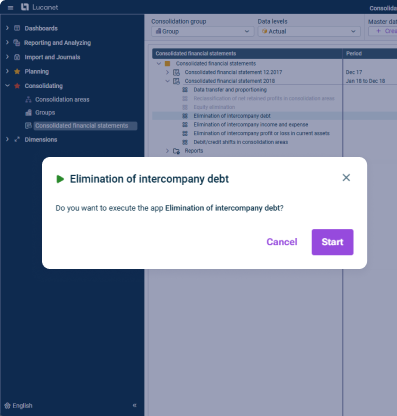
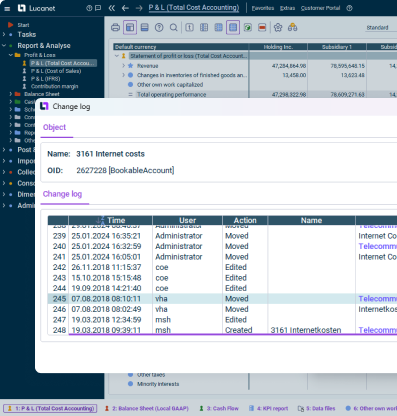
Imports, validations, eliminations, currency effects, and period integration live in a traceable workflow. Drill-down can reach the original posting and supporting document.
Make the three statements talk
Budgets and forecasts feed accounting-linked P&L, balance sheet, and cash views, with variants, comparisons, comments, and rolling scenarios.
Get the report out the door
Disclosure tools connect numbers and narrative, add collaboration and audit trails, and support XBRL or iXBRL tagging for regulated filings.
Keep the source systems
More than 300 interfaces cover ERP and financial accounting systems. Excel, APIs, and relational-database conversion handle the less tidy edges.
The core advantage is the shared financial model. Reporting tools often look good after the data is prepared; consolidation tools often stop once the group result is produced. Lucanet tries to keep collection, accounting rules, plan data, controls, and presentation close enough that a change does not trigger five manual repairs. Its traffic lights, difference columns, pivots, and sparklines are practical rather than theatrical. Reviewers repeatedly praise the depth, flexibility, drill-down, and quick learning curve for regular finance users.
There is a counterpoint in those same reviews. The interface has been called dated or clunky, graphics draw criticism, and advanced functions may need a consultant to uncover or configure. One reviewer reported inconsistent ERP-to-Power BI connections; another wanted stronger planning. Lucanet redesigned its Financial Client in version 24, and the Causal acquisition brought a more modern xP&A layer, but a demo should include the exact workflows your occasional users will perform. Watching a trained solution engineer glide through a model is not the same as watching a regional controller upload Tuesday’s package.
A month in the life
Picture the practical rhythm. Local teams submit balances from SAP, Microsoft Dynamics, NetSuite, or a smaller accounting package. Lucanet applies the mapping rules and flags incomplete or inconsistent data before group accounting begins. Intercompany partners can reconcile differences earlier, rather than leaving headquarters to play detective on closing night. The group team runs eliminations and consolidation postings, checks currency translation, and moves from a suspicious total to its source document without opening a separate evidence folder. Reports update from the same governed numbers.
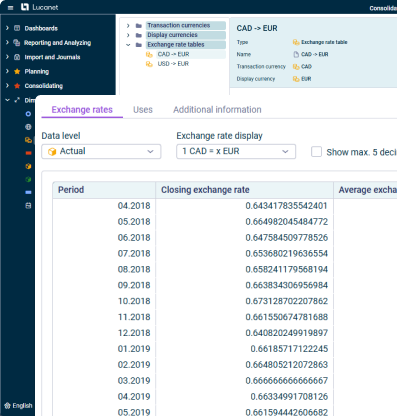
Planning follows a similar route. Contributors enter assumptions at the level they understand, while accounting rules carry the effects into integrated statements. A sales plan can meet a hiring plan and a capital-expenditure plan inside one scenario. Finance can compare budget rates with actual rates, annotate movements, and preserve versions. This is less thrilling than a cinematic dashboard reveal, but it addresses the real failure mode of planning: several locally reasonable models that do not add up to one believable company.
The catch is administration. Someone must own mappings, permissions, dimensions, interfaces, and master data. That person needs enough accounting knowledge to recognize a bad rule and enough systems judgment to keep the model orderly. Lucanet markets fast implementation, and users often describe it as easy to maintain once configured. Neither point removes the need for design discipline. If every business unit receives a custom hierarchy and every report becomes sacred, the new platform can inherit the clutter of the old spreadsheets. Agree on the group model first, then automate it.
The new colleague is an agent
In June 2026, Lucanet announced Lume, a conversational entry point for a family of specialist agents. The roster includes an Analyst for variance work, a Close Agent for imports and validation, a Modeler that builds models from natural language, a Report Agent, an ESG Emission Agent, and an XBRL Tagger. Lucanet says the Tagger can reduce XBRL effort by up to 95 percent, while the emissions agent can generate footprints up to five times faster than manual work. Treat those as vendor performance claims to test on your own data.
The architecture is more interesting than the names. Lucanet says deterministic calculations remain in the finance engine while probabilistic AI handles interpretation, explanation, and reasoning. Human review stays in the loop. That division is sensible in a product that may need to defend its output to an auditor. A language model can explain a variance; it should not quietly invent the closing balance.
YesPress field notes / 100
The price of fewer surprises
Lucanet publishes three packages - Basic, Advanced, and Professional - but no currency figures. Quotes vary by solution, entity count, users, deployment, interfaces, implementation, and support. Basic includes core functions and business-hours web or email support. Advanced adds more integration and functional support. Professional brings enterprise interfaces, direct-phone support, extended hours, and a dedicated customer-success contact in many modules. There is no public free plan or trial.
This is not a casual swipe-card purchase. G2’s review summary shows an average implementation time of three months and an average return-on-investment period of 23 months, based on its reviewer data. Those figures are directional, not a schedule. The real project lives in account mapping, ownership, historical data, interfaces, policies, and change management. Lucanet can automate a clean process. It cannot decide which subsidiary’s chart of accounts is secretly correct.
| Shortlist when… | Also inspect… | Why |
|---|---|---|
| Consolidation is the anchor | CCH Tagetik, OneStream, Oracle Cloud EPM | Compare accounting depth, implementation model, and scale. |
| Disclosure is the pain | Workiva, CCH Tagetik | Test narrative collaboration, data linking, XBRL, and controls. |
| Planning leads the purchase | Planful, Anaplan, Adaptive Planning, Prophix | Compare modeling freedom, contributor experience, and operational planning. |
| Excel must remain the front door | Vena, Datarails | Decide whether the spreadsheet is an interface or still the operating system. |
How to run the buying process
Bring one ugly month to the proof of concept. Include a late entity, a mismatched intercompany balance, two currencies, one local chart that maps badly, a prior-period adjustment, and the board’s favorite custom KPI. Ask the vendor to import, validate, consolidate, explain the variance, change a hierarchy, and regenerate the report. Then have your own controller repeat the process. A successful scripted demo proves that the software exists; a successful rehearsal proves that your team can operate it.
Request a five-year cost view covering licenses, implementation, extra interfaces, partner work, training, sandboxes, support level, AI consumption if applicable, and internal administration. Confirm data residency, tenant isolation, export rights, recovery targets, and exit assistance. Lucanet reports ISO 27001, 27017, and 27018 certifications plus SOC 1 and SOC 2 attestations. Its cloud architecture uses AWS authorization, isolated customer tenants, and encryption in transit and at rest; regulated buyers should verify the current reports in the trust center rather than rely on badges.
Finally, separate “platform available” from “module live.” Lucanet has expanded through AMANA, Causal, and firesys, adding tax, xP&A, disclosure, and reporting capability at speed. That breadth is valuable, but integration maturity can differ by workflow and release. Ask which experience is unified today, which requires a handoff, and which is still on the roadmap. The honest answer may still be good enough. It simply belongs in the project plan.
The verdict
Lucanet deserves a shortlist when consolidation is genuinely difficult and finance wants one governed model to extend into planning and reporting. Its accounting fluency, connectivity, and traceability are the reasons to buy. Quote-only pricing, consulting dependence, and uneven visual polish are the reasons to test carefully. For the right group, fewer reconciliations and a shorter close beat a prettier dashboard. For a simpler business, the platform may solve complexity you do not have.