Frase is for the content team whose real enemy is not the blank page. It is the relay race. A strategist opens six search results. A writer gets a brief in another tab. An editor moves the draft into a CMS. Someone remembers to check the ranking three months later, perhaps. By then the spreadsheet has gone stale and the person who knew why the page existed has joined a ceramics class in Lisbon.
The current Frase tries to keep that entire journey in one place. Give it a subject and it can inspect the live search results, collect questions, sketch an outline, draft in a saved brand voice, and score the work for both conventional SEO and generative engine optimization, or GEO. It can then send the page to WordPress, Webflow, Sanity, Wix, or FraseCMS. After publication, separate monitoring tools watch Google decay and citations in AI answers.
That makes it most interesting to small in-house teams, agencies, and solo operators who already publish regularly but lose hours to handoffs. A writer who needs occasional phrasing help can get that almost anywhere. Frase earns its fee when several steps in the production line are leaking time.
The old brief machine learned a new job
Longtime users may remember Frase as the friendly contraption that read top results and assembled a content brief. That history still matters. Founders Tomas Ratia and Cody Jacques built the original Boston company around answering questions with content, and its May 2019 Product Hunt launch talked about “answers, not links.” The phrase aged rather well.
Frase found its audience through a notably loud 2020 AppSumo campaign. Its own post says the customer count went from 169 to 8,266 in 28 days. Copysmith acquired Frase and fellow writing product Rytr in October 2022. The business now sits inside Copysmith AI, led by founder and CEO Shegun Otulana, while the product serves a mix of individual operators, marketing departments, agencies, and enterprise teams.
Then search itself split. People still scan Google, but they also ask ChatGPT, Perplexity, Claude, Gemini, and other answer engines for a short list. Frase added GEO scoring in 2025, then announced a ground-up rebuild in early 2026. The new pitch is less “make this article thorough” and more “run the content loop.”
What a Tuesday looks like
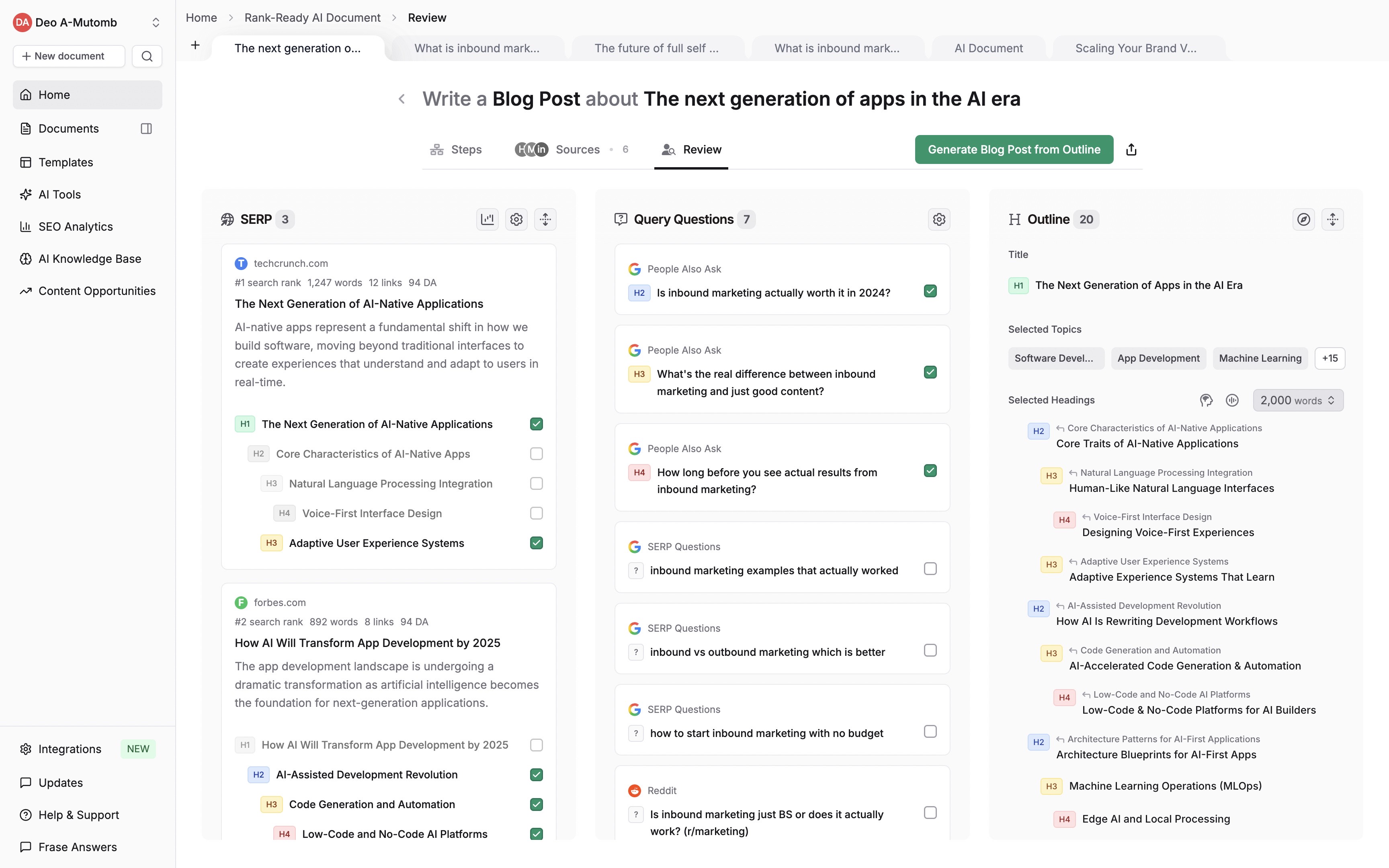
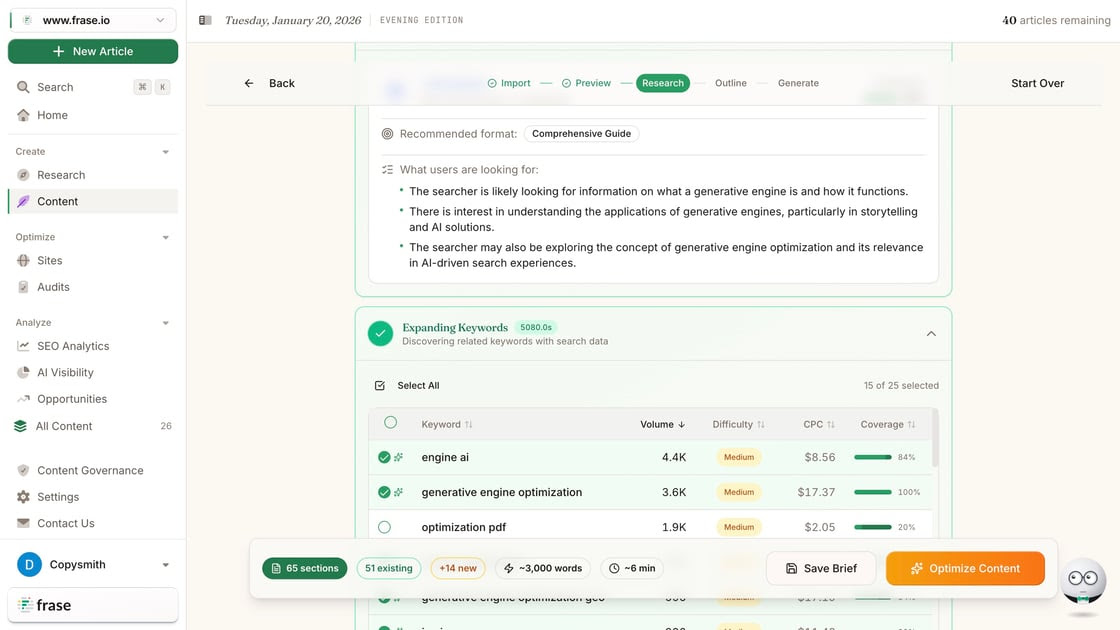
The cleanest way to understand Frase is as five connected beats. Research reads the field. Creation turns the findings into a brief and draft. Optimization keeps SEO and AI citation readiness visible while someone edits. Publishing moves the approved page into a destination. Monitoring returns later with news, good or bad.
The research screen is still Frase at its most immediately useful. It compresses the headings, questions, topics, and source patterns across ranking pages into something an editor can scan. That is not a substitute for reporting or firsthand experience. It is a fast map of the neighborhood. Used badly, it encourages every publisher to write the same article with the furniture rearranged. Used well, it shows what readers expect so your own evidence and point of view can do something different.
The Agent can take on individual jobs or the whole sequence through ordinary instructions. Brand Hub learns from existing pages or follows rules you enter. Inside the editor, the SEO and GEO scores sit side by side. One asks whether the page covers the territory that performs in Google. The other looks at structure, authority, clarity, and the qualities that make a passage easier for an answer engine to extract and cite.
The feature that matters happens later
AI writing is now common enough to feel like spell-check with better manners. The more defensible part of Frase is what happens after a page goes live. Content Guard watches a selected number of pages for ranking or traffic decay in Google. When a page slips, it diagnoses the problem and drafts a revision. A person approves the change by default. Teams can opt into limited autonomy for lower-risk work.
AI Visibility does a different job. It checks whether chosen AI engines cite the brand for tracked prompts and reports shifts against competitors. Frase is unusually explicit about keeping these systems separate: Content Guard can prepare a repair; AI Visibility monitors and informs. That distinction is healthy. A lost citation is not an invitation for a machine to rewrite a live page every morning before coffee.
The dual scoreboard is the product’s clearest expression of the new search reality. A page can rank in Google yet never appear in an AI answer, or win a citation without owning a classic blue-link position. Frase gives both outcomes a seat at the desk.
Frase Answers completes a curious side loop. The widget responds to visitors using a company’s own content and records the questions in their language. Those questions become first-party research. A repeated support question can therefore turn into the next guide, which can be published, monitored, and improved inside the same system. It is a neat idea because it begins with actual demand rather than a keyword volume estimate.
What you get, and where rivals lean
Surfer SEO and Clearscope remain the obvious comparisons for writers who want a focused optimization editor. Semrush and Ahrefs provide wider search intelligence suites. MarketMuse emphasizes content planning and inventory. Jasper and Writesonic approach the problem from AI creation and marketing automation. Frase’s case is breadth across the editorial lifecycle, especially the bridge from diagnosis to publishing and later repair.
| Need | Frase | A focused optimizer | A broad SEO suite |
|---|---|---|---|
| Live SERP brief | Core workflow | Usually strong | Varies by module |
| Draft in brand voice | Included | Often available | Varies |
| SEO + GEO scores | Side by side | Product-dependent | Usually separate |
| Publish to several CMSs | Native path | Often export-led | Not the main job |
| Draft decay repairs | Content Guard | Limited or separate | Reports first |
| Technical SEO depth | Content-oriented audit | Narrow | Usually deeper |
This is not an automatic win for breadth. A dedicated optimizer may feel calmer. A broad SEO suite may go deeper on backlinks, crawling, and market research. Frase is strongest when the buyer values continuity more than maximum depth in any single analytical category. If your team already loves its CMS, rank tracker, brief template, and editorial calendar, replacing the entire arrangement could create work rather than remove it.
The bill has more than one number
Starter costs $49 month to month or $39 per month billed yearly. It covers one person, one site, 10 articles, 50 audited pages, basic AI Visibility coverage, and three pages watched by Content Guard each month. Professional rises to $129 monthly or $103 on annual billing, with three seats, five sites, 40 articles, 250 audit pages, and broader monitoring. Scale is $299 monthly or $239 yearly for five seats, up to 10 domains, 100 articles, and 1,000 audit pages. Enterprise is quoted.
The limits matter more than the logo on the plan. Count the articles you genuinely finish, the pages you want watched, the domains you manage, and the people who need a seat. Agencies should price extra seats and overages before falling for the tidy headline rate. Starter stops at its limits. Optional pay-as-you-go on Professional and Scale is off by default, a small but welcome defense against surprise invoices.
Every plan includes a free FraseCMS tier on a Frase subdomain with 100,000 monthly page views. A custom domain or subdirectory starts at another $19 per month, while the $99 Pro CMS tier raises capacity to one million views. Existing WordPress, Webflow, Sanity, and Wix users do not have to move. The seven-day product trial asks for no credit card.
Good reasons to buy
- Your bottleneck lives between research and publish.
- You manage enough pages to care about decay.
- You need Google and AI-search visibility together.
- You want approvals before automation touches live content.
Reasons to pause
- You publish only a few pieces each quarter.
- Your existing stack already connects cleanly.
- You need deep technical SEO or backlink analysis first.
- You expect generated drafts to supply original expertise.
What reviewers actually notice
The broad review pattern favors speed, approachable editing, quick outlines, and research gathered in one view. G2 displayed a 4.8 out of 5 rating from 299 reviews in the snapshot we checked. Its pros-and-cons summary highlighted content creation and SEO improvement, while the small cluster of stated complaints centered on onboarding and the learning curve. One reviewer called the software “fiendishly clever” behind a welcoming interface. Another said outline building made it easy to see what ranking articles were doing at a glance.
Frase’s own customer page cites a 4.8 rating across more than 500 combined G2 and Capterra reviews and says thousands of teams use the product. Treat vendor-selected testimonials as the shop window, not the whole street. Trustpilot was much more divided at 3.7 from 63 reviews, with 36 percent at one star in the September 2026 snapshot. That spread is a useful reminder to test support, billing, and the present interface yourself.
Reddit discussion tends to place Frase alongside Surfer, Clearscope, MarketMuse, and NeuronWriter. The praise usually concerns fast briefs and practical on-page guidance. The recurring warning is larger than Frase: optimizing against the same top results can flatten every article into a competent cousin of the next. A score is a guardrail, not an editorial idea.
Buy the loop, not the robot writer
Frase makes sense when it removes handoffs and brings neglected post-publication work back into the schedule. Run one real article through the trial, connect the CMS you actually use, and return a week later to see whether the workflow feels lighter. Judge the research and monitoring before the prose. Your writers can improve a draft. They cannot edit a dashboard nobody remembers to open.
How to trial it without fooling yourself
Pick one page that matters and one fresh subject. Import the existing page, note its starting SEO and GEO scores, and read the cited competitors rather than blindly accepting topic suggestions. Then build the new brief. Add an interview, proprietary data, a strong opinion, or firsthand testing before asking for a draft. These ingredients are what the ranking pages cannot hand back to you.
Next, connect a noncritical CMS destination and test the formatting. Check headings, links, images, metadata, schema, and revision behavior. Set Content Guard on a few pages whose traffic pattern you already understand. Track a short list of commercially relevant AI prompts, not vanity questions engineered to mention the brand. Finally, invite the editor who will use it every week. A strategist’s impressive demo can still become a writer’s extra chore.
Frase has become an ambitious piece of editorial infrastructure. Its appeal is mundane in the right way: fewer transfers, fewer forgotten pages, and a visible record of what needs a human decision. The machine can keep the belt moving. The publication still needs someone who knows what is worth putting on it.