Nick Brown’s closing announcement about Accelerate Agency contained an unusual combination of subjects: closing a business, thanking its people and looking forward to what came next. For someone who had spent years helping companies grow, it was an interesting place to arrive. In October 2025, he said the agency was entering a planned closure. He described its obligations as met and his own future as open.
A founder’s biography tends to accumulate things. Clients, markets, employees, titles. Brown’s acquired plenty of those. But the decision to finish a chapter gives his story a different shape. It invites a question that a handsome growth chart rarely answers: what, exactly, is all this activity meant to make possible?
Follow his career backwards and the scenery changes considerably. Before software marketing there was online retail. Before online retail there was zoology. There was also, somewhere along the way, a mountain gorilla with an objection.
Before the browser, a different habitat
Brown began his working life as a zoologist. A mountain gorilla once charged at him. It is a splendidly economical anecdote: an entire encounter, with a very clear indication of who controlled the meeting. The details end there, which leaves the gorilla mercifully free of any responsibility for Brown’s subsequent career choices.
By 2007, Brown had started an ecommerce business. The venture was reported to have reached £500,000 in turnover within a year. Selling online brought him into a world where being available and being discovered were separate problems. A shop could have a website and still require considerable work before the right customer reached it.
In 2017, Brown and Phil Pearce founded Accelerate Agency. Both became directors on April 25. Brown brought search marketing to a partnership in which Pearce specialised in analytics. The combination gave the business two related questions to work on: how people arrive at a website, and what happens after they get there.
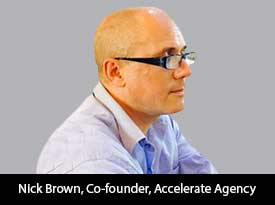
A change of habitat.
A continuing interest in behaviour.
Half a million pages, and nowhere obvious to go
A technical article Brown published in 2019 makes the work tangible. He described an anonymised client website with more than 500,000 pages. Some content sat as many as 15 clicks from the homepage. Only a tenth of the pages were being indexed. The site had accumulated material without maintaining an intelligible route through it.
These are the problems that can disappear behind the word “digital”. A person still needs directions. A search engine still needs to understand how the pieces fit together. Half a million pages offer an impressive quantity of answers; they are less helpful when finding the relevant one becomes an expedition.
The same analysis found more than 400 links in the menu and 42 in the footer. The website had plenty of signposts. Choosing among them was the difficulty. More navigation had not necessarily made the place easier to navigate.
Brown’s account worked through the architecture: crawling the site, examining its links, considering its categories and bringing order to its structure. It showed a practitioner interested in the machinery beneath a marketing promise. The useful work happened before anyone got to admire a chart.
The crowded calendar problem
His own company also needed a better structure. Accelerate could win project work, but a varied client base required time for explanation and support. The founders were busy delivering what they had sold. Finding space to design the business was another matter.
They sought outside advice. Strategy workshops made time for decisions about the offer, its price and its intended customers. The agency moved towards longer retainers. Its adviser reported six new profitable clients, a tripling of the team and 400% turnover growth in the first year after the pricing and packaging review.
The numbers describe the adviser’s account of that intervention. The underlying choice is useful even without them. Different pieces of work impose different demands on a company. A series of disconnected projects requires repeated starts. A continuing engagement can support a more regular pattern of planning and delivery. The review changed the shape of the work the agency sold.
A bigger team needs a wider idea of leadership
Then the scale changed. Brown wrote that Accelerate had 10 people sharing an office in March 2020. Eighteen months later, it had more than 70 across four continents. Many had never met face to face.
His account put practical questions beside those numbers. Hiring relied on demonstrations of ability. He argued against concentrating senior positions around the British office. An administrative colleague in the Philippines had developed into a manager supporting nearly 20 people there. Leadership could emerge where the team actually lived.
“We want the best people in each role”
Nick Brown, on international recruitment, 2021
There was a public teaching side to the business, too. In April 2020, Brown was announced as a speaker at a free virtual summit, presenting on content marketing for SEO and lead generation. Phil Pearce, Brightpearl’s Xiaoyun Tu and RingCentral’s Sam O’Brien were also on the programme. It put agency specialists and software marketers in the same conversation, discussing the practical business of finding customers.
Writing for a reader who has somewhere else to be
Brown’s published work offers another view of his working temperament. In 2023, he complained about online writing that sounded unnatural, repeated itself and discussed a question without supplying a useful answer. Anyone who has searched for a simple instruction and found a thousand-word overture will recognise the offence.
His argument allowed for both readers and algorithms. Content needed to be informative and authentic, while remaining understandable to the systems that helped people discover it. The tension was familiar to his profession. A page has to get found; once found, it has to be worth reading. Optimising the first part cannot excuse neglecting the second.
His SaaS marketing guidance took a similarly practical route through the customer relationship. Subscription software needs customers who stay. Free trials, useful information and a clear account of the product’s value belong to a longer process than a single visit. Winning attention begins the work; helping someone understand the service gives that attention somewhere useful to go.
His guide also discussed acquisition costs, customer lifetime value and churn. These measures forced the conversation beyond the moment someone signed up. A subscription could bring revenue this month and disappear the next; a free trial could attract interest without turning into a lasting relationship. That was the business model his clients were asking a marketing agency to understand. It required a different sense of progress from simply sending more people to a homepage.
This matters when looking at Brown as a founder. The work he described required repeated explanation: of a product, a website, a commercial offer. His writing made that explanation part of the job. There was always another person at the far end of the page.
When the answer arrives before the visit
By 2025, Brown was writing about discovery inside AI systems. His articles considered generative engine optimisation, AI Overviews and brand mentions. The familiar ambition of appearing in search results was acquiring another question: would a system include the brand in the answer it gave?
Discussing colleague Paul Wilkinson’s newsletter, Brown argued that some searches with large volumes delivered little commercial benefit. He called them “red herrings”. His point was that attracting visitors could consume work and budget without producing worthwhile customer interest. A falling traffic number deserved examination before anyone decided what it meant.
His July article on mentions extended that argument. He wanted marketers to consider the language and context surrounding a brand, including references that carried no hyperlink. These were his prescriptions for a changing discovery market. They show him reconsidering the measures used in a field where he had already spent years working.
The vocabulary was changing quickly. The commercial question remained familiar: does this activity help a prospective customer understand and consider the business? A crowded search-results page, like a crowded calendar, can reward a closer look.
The next chapter has no company name yet
On October 28, 2025, Brown announced the planned closure. The company passed its winding-up resolution the following day. A declaration of solvency and the appointment of a voluntary liquidator were filed on November 6. The formal ending sat alongside his message of thanks.
Brown said the agency had never recorded a loss-making month. That was his account of its operating history. His plans were to spend time travelling, writing, consulting and considering what to do next. The announcement gave no need to turn those intentions into a new company before they had become one.
Former senior colleagues went on to create Evolv, which describes itself as an entirely new agency. Experience could travel with them. Brown remained part of Accelerate’s legal record as a director, while his description of the next phase left room for several kinds of work.
There is an appealing lack of tidiness in that ending. A career that began in zoology had already made room for retail, search, management and writing. It could accommodate another change. Brown had learned how to build an agency around growth. He had also reached the point of deciding what deserved his time after it.
Follow the work
Profiles, writing and the company’s closing chapter.
- Nick Brown on LinkedIn
- His closure announcement
- Accelerate’s former website
- Early career and press photograph
- The agency’s commercial reset
- International team management
- The 500,000-page website
- Writing for humans and algorithms
- Forbes Agency Council articles
- Brown’s SaaS marketing guide
- The 2020 summit programme
- His comments on AI search
- Evolv’s account of the transition
- Company filings
- Zapier author profile