Clearscope is for the moment when an editor asks, “Did we miss anything?” and everyone in the meeting suddenly studies the carpet. Give it a query and a draft, and the software reads the competitive search landscape, produces a list of relevant concepts, checks readability and length, then hands the page a school-style grade. The result is not glamorous. It is useful. A writer gets a brief that changes as the copy changes; an SEO lead gets fewer vague recommendations; an editor gets a common language for revision.
That was the original pitch. The current product, called Clearscope 2.0, follows a piece of content from topic research through AI-assisted drafting, optimization, publication and refresh. It also watches whether a brand appears in answers from ChatGPT, Gemini and Claude. The modest content report has become a broader discoverability platform, yet the reason people keep recommending it is still the old one: it turns an awkward specialist task into a workflow a writer can understand in minutes.
Who should invite this hall monitor?
The strongest fit is a team publishing or refreshing search-led work every week: a SaaS company with a serious library, a publisher with several writers, or an agency that needs briefs to survive the trip from strategist to freelancer. Clearscope is especially handy when the person who understands search intent is not the person writing the sentences. A shared Draft link carries the research, target grade and relevant terms without requiring another seminar on semantic SEO.
A solo consultant can benefit too, but the economics get stern. Essentials costs $129 a month. It includes unlimited users and projects, 20 Topic Explorations, 20 monthly Drafts, 50 tracked prompts and 50 monitored pages. If you publish four articles a month, you are paying about $32 per article before counting the monitoring tools. At 20 drafts, the same subscription is $6.45 per draft. Clearscope rewards a calendar, not an aspiration.
It is a poor fit for someone seeking backlink research, full technical audits or a universal SEO dashboard. Clearscope can expose certain content issues and internal-link opportunities, but it is not trying to replace a crawler or the sprawling databases inside Ahrefs and Semrush. Buyers who want one subscription to do absolutely everything will find the edges quickly.
The working loop is the product
Start with Topic Exploration or a target query. Clearscope examines the result landscape and makes search intent legible: instructional pages, community discussions, service pages or another dominant format. A strategist can inspect related queries and clusters before commissioning anything. Then a Draft becomes the home for an outline, a blank page, an imported URL or an AI-generated first pass.
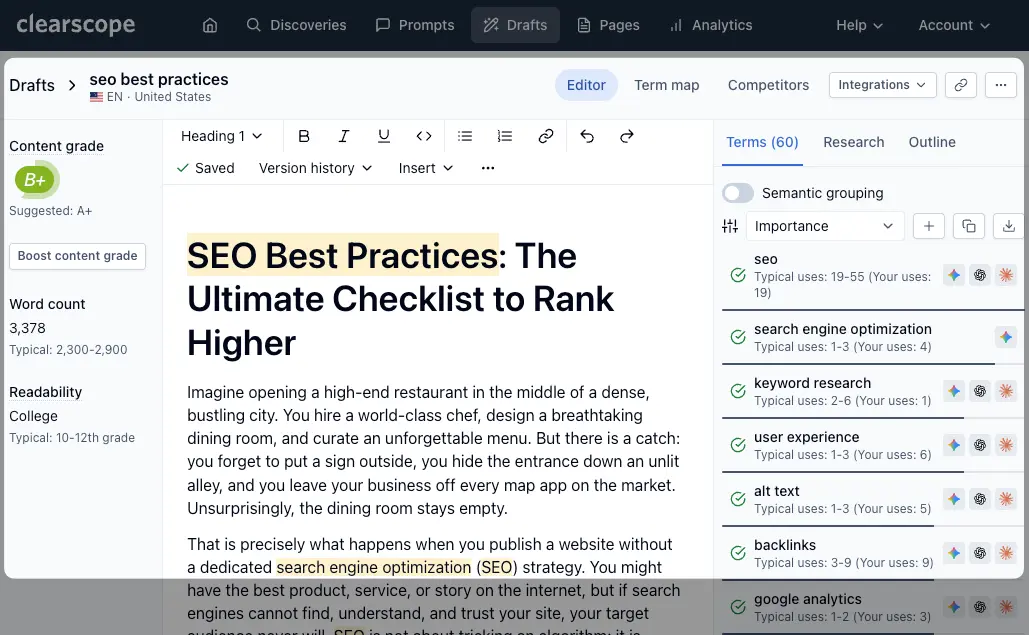
Inside the editor, the left rail shows the content grade, typical word count and readability benchmark. The right rail lists terms and their recommended usage. Coverage changes the grade in real time. The system recognizes concepts rather than demanding one exact phrase every time, a small mercy noted by users comparing it with fussier rivals. Google Docs and WordPress integrations let writers stay in familiar territory, which matters more than a long feature list when ten contributors already have ten habits.
Discover
Map related questions and topic clusters before a brief hardens into a headline nobody wanted.
Write
Build an outline, begin from a blank Draft or ask the AI assistant for a voice-aware starting point.
Optimize
Use term coverage, competitors, length and readability as editorial signals while the grade updates.
Protect
Watch pages for decay, striking-distance queries, content health and internal-link openings.
“It makes content optimization feel so straightforward.”Vishal K., Tech SEO Lead · G2 review, January 2026
A grade can end a meeting, not write the truth
The grade is Clearscope’s tiny organizational masterstroke. “Make this more comprehensive” is a foggy instruction. “Move the draft from C+ to A-minus without wrecking the lede” is a concrete assignment. G2 reviewers repeatedly mention the clean interface, relevant suggestions and confidence that comes from a visible target. On Reddit, a long-time user said the tool helped writers apply SEO tactics when an expert could not shadow every assignment.
The danger arrives when the grade becomes the editor. A recommended competitor may be irrelevant to a product review. A niche topic can inherit terms from pages that rank for a different reason. The easiest way to ruin a decent article is to wedge every green-light phrase into it and celebrate A++. Clearscope supplies evidence about the existing result set. It does not know your interview subject, your private customer data, your original reporting or the one useful opinion the top ten pages lack.
Use the terms as an audit. Ask why an important concept is missing. Reject the ones that do not serve the reader. The best operators stop at the grade that indicates credible coverage, then spend their remaining time on examples, structure and the sentence people will remember. Even Clearscope’s own founder has argued that the future belongs to unique perspectives, not classical keyword research by itself.
Where Clearscope earns its desk space
The bars are our editorial assessment, not vendor measurements. Originality remains the human assignment.
The AI-search turn
Clearscope 2.0 arrived in October 2025 after more than a year of rebuilding. Reports became Drafts. Topic Exploration, AI-assisted writing and visibility tracking joined the familiar optimization engine. AI Term Presence now marks language used in ChatGPT and Gemini answers. In February 2026, Boost Content Grade began suggesting contextual placements for unused terms. July brought Prompt Tracking, which runs selected prompts across ChatGPT, Gemini and Claude and reports how often a watched brand appears.
Prompt Tracking is the more consequential addition. A team can compare its domain with as many as five competitors, inspect prompt-level mentions and follow a 21-response rolling average designed to smooth the wobble of generative answers. That gives marketing teams a directional instrument for a problem that standard rank trackers cannot see. The interface also reveals whether a prompt has commercial intent, a useful guardrail against spending the quarter optimizing for questions no buyer asks.
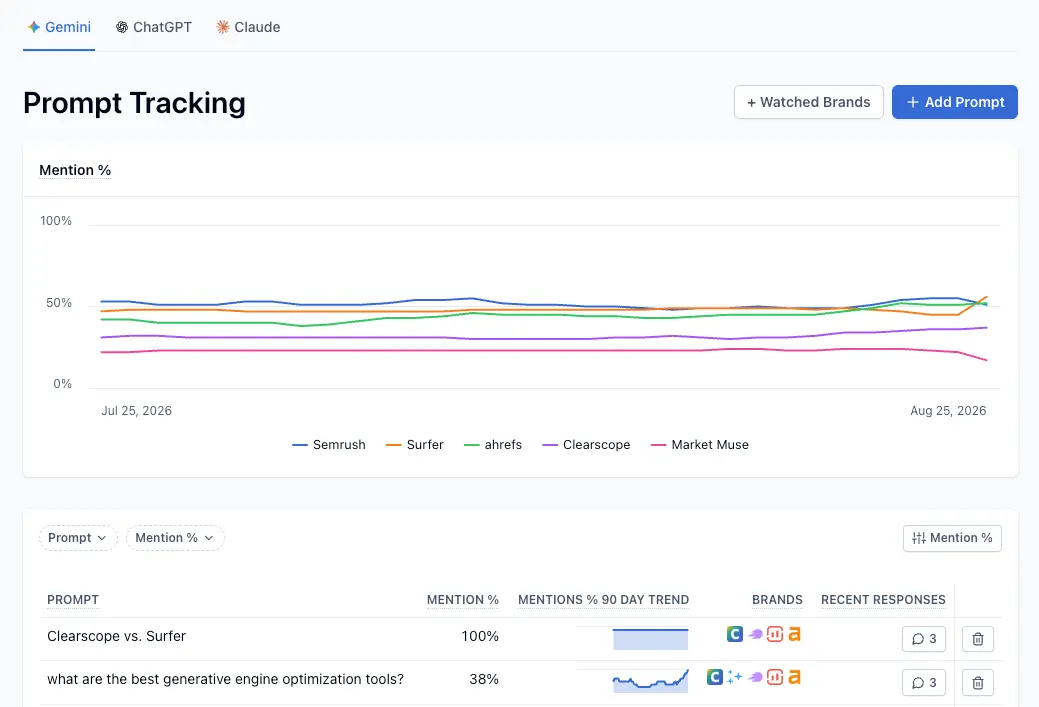
Treat those numbers as a trend, not an audited census. Model answers vary, prompt demand is hazy and a mention can happen without a click. Clearscope itself has publicly wrestled with the difference between tracking isolated prompts and understanding topics. The practical move is to pair the dashboard with referral traffic, branded search, self-reported attribution and the quality of actual leads. A graph becomes valuable when it changes a content decision.
The bill, with the confetti swept aside
Current monthly pricing is refreshingly visible. Essentials is $129; Business is $399; Enterprise is custom. Every plan includes unlimited users and projects, sharing, exports, onboarding and direct support. Business raises the limits to 300 tracked prompts, 300 pages and 50 Topic Explorations, though it still includes 20 Drafts, and adds a dedicated account manager. The advertised free trial lasts 14 days.
Credits deserve attention. Monthly Draft and Topic Exploration credits do not roll over. Annual customers receive their year’s allocation upfront. Extra usage costs vary by plan. This is friendlier than per-seat pricing for a large editorial bench, but less friendly to a small team whose demand arrives in bursts. Put three numbers in the buying sheet: drafts per month, pages worth monitoring and people who will actually use the brief.
| Choose | When it fits | Where it beats Clearscope | What you give up |
|---|---|---|---|
| Clearscope | Writers and SEO leads need one calm workflow | Clean guidance, support, unlimited seats | Broad technical and backlink tooling |
| Surfer | You want a busier optimization and AI production suite | Volume-oriented feature breadth | Clearscope’s restrained interface |
| MarketMuse | Site-level authority planning drives the program | Deep inventory and strategy modeling | A lighter writer experience |
| Frase | Budget and rapid briefs matter most | Lower-cost entry and research workflow | Clearscope’s recommendation reputation |
| Semrush / Ahrefs | You need one wider SEO intelligence subscription | Links, keywords, competitors and audits | A focused editorial cockpit |
The archive finally gets a pulse
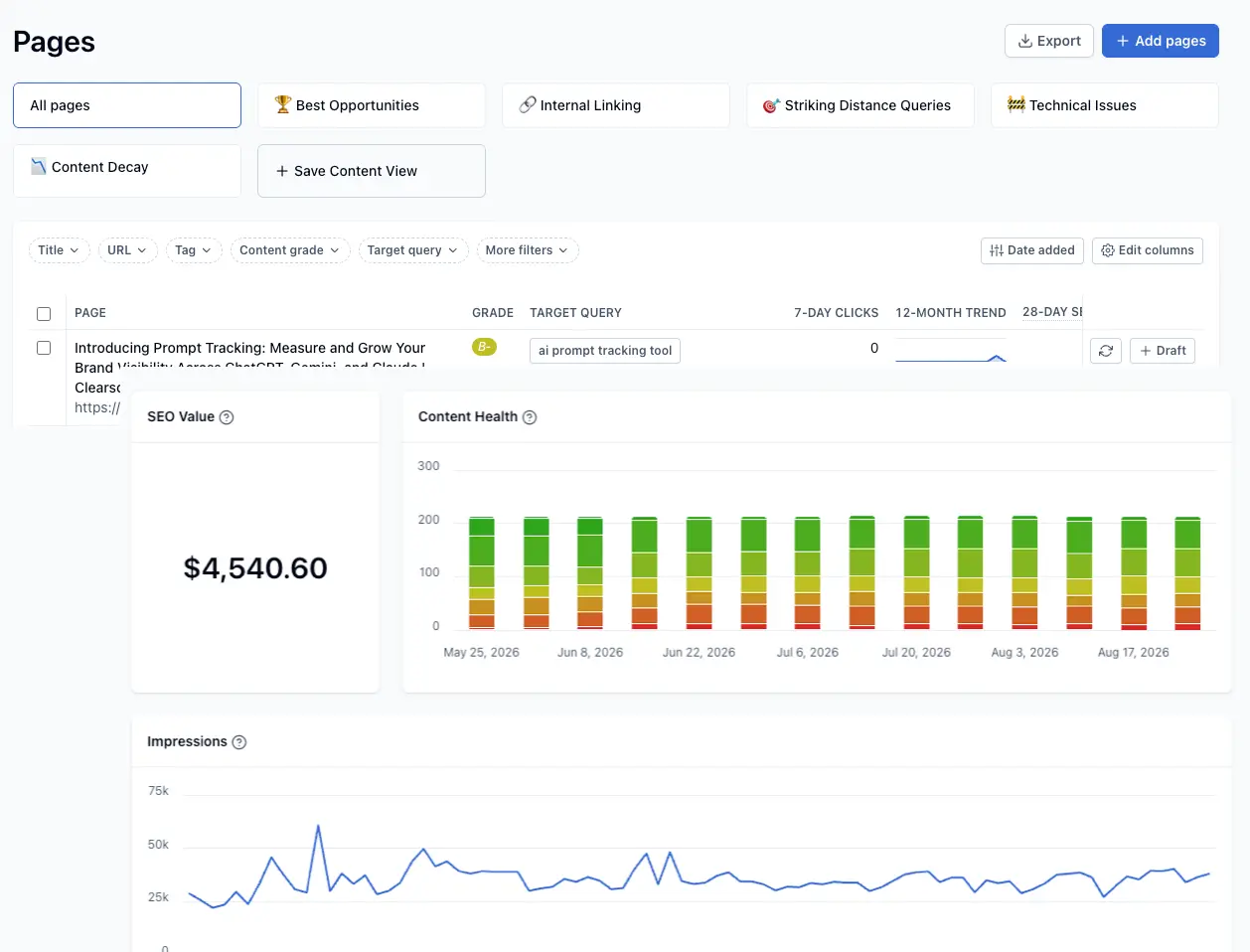
Content Inventory makes the subscription more defensible for teams with years of published work. Connect Search Console, add pages and use prebuilt views such as Content Decay, Best Opportunities, Internal Linking and Striking Distance Queries. The system combines performance signals with content grades so an editor can distinguish a page that needs a refresh from one that needs patience. Custom views help larger programs turn the archive into a queue rather than a graveyard.
From two consultants to the control room
Bernard Huang and Kevin Su built Clearscope through Mushi Labs, an SEO consultancy that began in San Francisco. The recurring work was obvious: consultants manually inspected the pages ranking for a query, extracted important concepts and translated the pile into recommendations. Clearscope automated that loop with IBM Watson Natural Language Understanding. An IBM case study described the early engine stripping away page furniture, finding concepts and scoring their salience.
The bootstrapped company launched the software in 2016 and stopped consulting when recurring revenue could carry the team. It now operates through Texas-based Mushi Labs LLC and says thousands of teams use the platform. The customer list includes Intuit, Adobe, Shopify, IBM, Condé Nast, Deloitte and YouTube. Huang’s pre-software résumé also contains a breakdance crew and a homemade middle-school board game, which is more personality than most optimization dashboards can claim.
“We’re easily seeing a time-saving of 1.5-3 hours per article.”Ryan Law, then VP of Content at Animalz · Clearscope customer story
Verdict: buy the agreement, not the grade
Clearscope’s real value is social. It creates an agreement among strategist, writer and editor about what the page must cover, then keeps that agreement visible inside the act of writing. The product saves research time, catches topical holes and makes refresh work easier to prioritize. Prompt Tracking adds a credible reason for existing customers to stay as discovery spreads beyond Google.
The limits are equally plain. A high grade cannot make an unoriginal article worth reading. AI visibility remains directional. Technical audits and backlink intelligence live elsewhere. And $129 a month is still a serious line item for a writer with a light calendar, even after the 2025 price cut.
Our take
Choose Clearscope when avoiding one muddled brief or one full rewrite each month is worth more than the subscription. Run the trial with live assignments, invite every role in the workflow, and judge the product by time saved and decisions improved. If the team only chases the green grade, keep the money and hire a sharper editor.
A five-question trial
- Can a writer understand the recommendations without an SEO specialist beside them?
- Does the brief remove revision rounds, or merely add another checklist?
- Are the suggested terms relevant enough to earn trust on your niche topics?
- Will Content Inventory replace a real spreadsheet or become a prettier abandoned one?
- Do prompt trends lead to useful pages, updates or positioning changes?