A few years ago, at a bowling alley in Boston's Seaport, Greg Hakim let a dangerous sentence escape. He told his colleagues at Corporate Ink that he would love a shorter workweek with three-day weekends. It would not happen overnight, he added. The qualifying phrase was useless. The staff remembered the first part.
This is a good place to begin with Corporate Ink because public relations firms sell the management of expectations. They turn complicated products into graspable stories, ambitions into announcements, and attention into something a sales team can use. Here was the agency making a promise to itself. The audience was inside the building. The skeptics included other agency leaders. And there would be nowhere to hide if Friday arrived before the work was done.
The little agency with the long memory
Corporate Ink began in 1989, when Amy Bermar built the agency from scratch. In December 2009, Hakim joined as an assistant account executive. Ten years later, as the firm marked its 30th anniversary, he acquired it. That is a tidy succession story, but the useful detail is the ten years in the middle. The new owner had learned the business from the lowest titled rung, and his declared plan was to make it both people-first and accountable for client results.
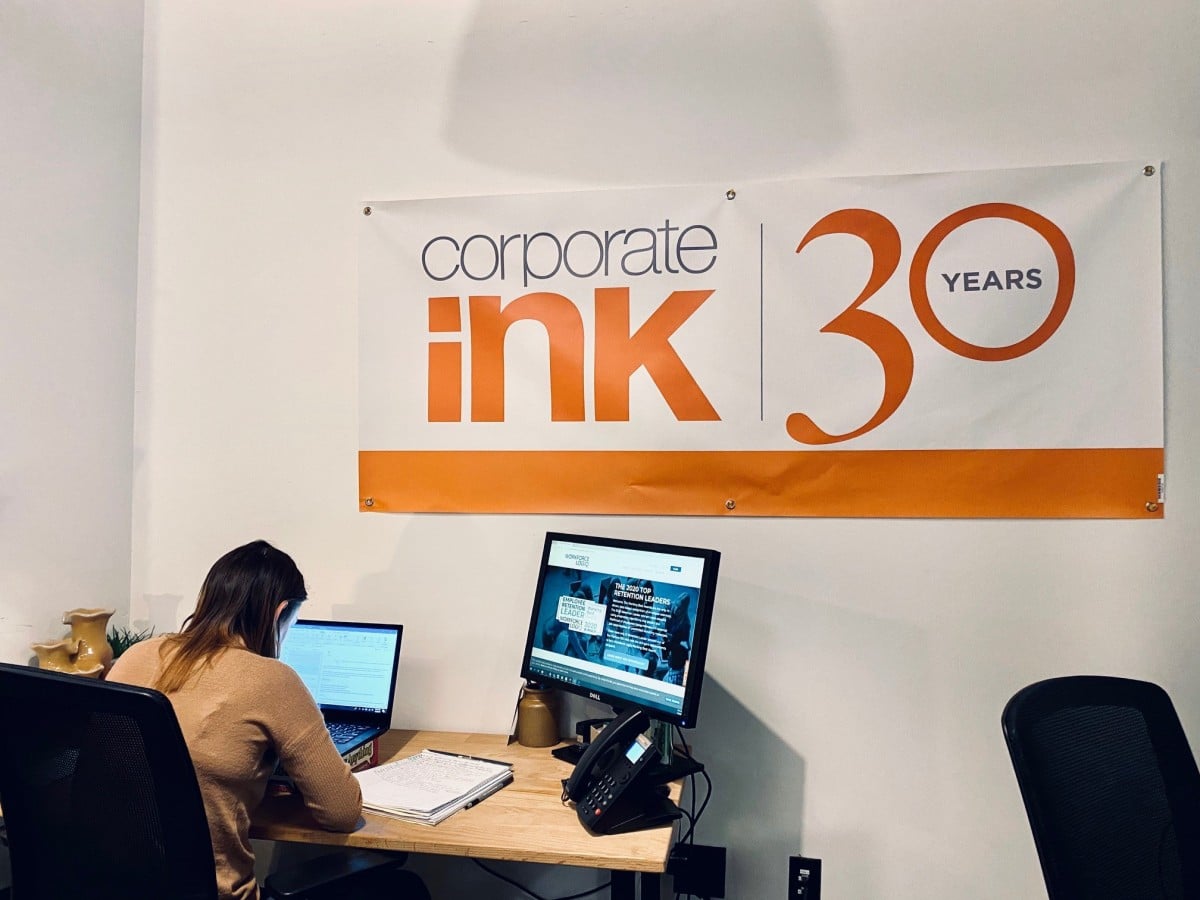
Today the company is a virtual Boston-based agency for B2B technology and SaaS brands. Its public client history runs from 3M and VeriSign to Universal Robots, Riskonnect, Doble Engineering, LeanDNA, VikingCloud and EcoVadis. The common thread is not company size. It is an explanation problem. Procurement software, cyber risk, industrial automation and supply-chain analytics can all become thickets of features. Corporate Ink is hired to find the consequence a buyer will care about.
The menu resembles a full B2B communications department: messaging and positioning, media relations, PR strategy, thought leadership, content, social media, market-survey campaigns, funding announcements and crisis work. Fees are customized rather than posted. Engagements sell expert time, category knowledge and execution, with global support available through Worldcom, the international partnership of independent agencies that Corporate Ink joined in 2005.
“Doing work is easy. The real value lies with understanding why you are doing something.”Greg Hakim, reflecting on a decade at Corporate Ink
Coverage is not the product
The firm's sharpest market position is a refusal to treat publicity as the finish line. It talks about RFP invitations, sales urgency, market validation, buyer trust and pipeline. A story in the right publication is useful because a prospect sees it, a salesperson sends it, an analyst cites it or an investor takes the meeting. Raw impressions are a shadow on the cave wall.
The buyer-centric chain
This orientation explains the firm's sweet spot. It works with venture- and private-equity-backed challengers, market creators and established companies in cyber, procurement, risk, AI, manufacturing and sustainability. A generalist can learn a product. A specialist should already understand the buyer's committee, the trade press and the argument that has gone stale. Corporate Ink competes with larger Boston agencies such as PAN, Matter, Racepoint and Highwire, and with focused shops like V2 and Tier One. Its counteroffer is senior attention plus deep category pattern recognition.
Worldcom supplies the missing geography. Its network gives an independent Boston agency partners in major markets without turning the client into one more account inside a holding company. In 2024, Corporate Ink passed the group's peer review of strategic approach, client satisfaction and partner performance. The structure suits a boutique with global clients: local ownership at the center, borrowed reach at the edges.
What broke when Friday disappeared
In February 2022, the agency converted Hakim's bowling-alley wish into a 90-day trial. Employees would get every other Friday off. Two teams alternated flex weeks so accounts remained covered. A guidebook set expectations. Weekly pulse surveys tracked happiness, stress and productivity; account leads and clients supplied another check. It was less a perk launch than a controlled release.
The first cracks were mundane and therefore valuable. Twenty-three percent of the team said squeezing weekly responsibilities into four days was a challenge. The same share struggled to preserve time for strategic agency projects. Those are the parts of work that calendars usually conceal: the task that expands because Friday exists, and the important internal project that survives only in leftover minutes. The team adjusted planning, prioritization and handoffs as the trial ran.
By Memorial Day, every employee valued the benefit and rated happiness and engagement a four or five out of five. Ninety-two percent gave productivity the same high marks. Corporate Ink later said it grew more than 50 percent that year and maintained 100 percent retention through the period. Clients did not notice the trial because coverage continued. In June, the experiment became Inker Fridays.
What changed minds was not the romance of a long weekend. It was instrumentation. The company made the idea reversible, named the failure conditions, kept a control on client service and changed the process while the test was running. The copyable piece is not “take Friday off.” It is “turn a cultural promise into an operating experiment.” A firm needs enough staffing overlap to cover live accounts, work that can be planned, managers willing to measure outcomes instead of presence, and employees who can hand work across a seam. A solo consultancy or an incident-response team would face a different equation.
Choose one reversible policy. Run it for 90 days. Define client and employee measures before launch. Build alternating coverage. Ask weekly where work is bunching up. Keep the benefit only after the system proves it can carry the load.
The next search box has no blue links
Corporate Ink's newest service applies the same logic to generative engine optimization, or GEO. Enterprise buyers increasingly ask ChatGPT, Gemini and Perplexity for shortlists. The agency argues that this is not merely an SEO puzzle. If an answer engine trusts industry publications, customer evidence and third-party authorities, then earned reputation becomes part of the retrieval system.
Its May 2026 survey of 150 U.S. B2B tech marketers gives the pitch teeth. Eighty-eight percent of senior marketers said leadership or the board was asking what they were doing about AI visibility. Yet only 34 percent of all respondents had a defined strategy, and 29 percent were actively measuring it. Seventy-two percent had seen AI describe their company, category or value proposition inaccurately, incompletely or with stale information.
Corporate Ink now sells the diagnostic work behind those answers: identify the buyer prompts that matter, learn which media and authority sources engines use in a category, study where competitors appear, then connect PR and content to the gaps. The claim still needs careful attribution. Chatbot answers shift, vendors reveal little about ranking, and a press mention cannot be assigned a clean fraction of revenue. But the underlying advice is durable: be specific about the audience, earn trust where that audience looks, and measure behavior closer to the sale.
That is also the connective tissue in the company's story. Amy Bermar created a durable independent agency. Hakim inherited it from the inside. The firm made its calendar conditional on results and made its PR conditional on buyer relevance. Even the AI service is an old communications craft wearing a new acronym: understand who shapes belief, and give them something worth repeating.