Consider the missing page title. It is a tiny defect, the sort of thing an SEO audit catches without breaking a sweat. Finding it may take seconds. Getting it changed can involve a marketer, a developer, a ticket, a sprint and a meeting about why the sprint is full. By the time the title is repaired, the report that identified it has acquired the quiet dignity of an archaeological document.
Search Atlas has built its pitch around that interval. The company sells software for helping businesses appear in search results, local maps and AI-generated answers. Its more interesting proposition is about labor: connect the analysis to the machinery that can act on it. The appeal is especially clear to an agency doing similar work across many clients. A small delay, multiplied often enough, becomes a business model’s least charming feature.
- The job: research, audit, optimize and track a business’s visibility across search channels.
- The bet: OTTO applies supported website changes, with controls for review and reversal.
- The buyer: agencies and marketing teams managing recurring work across websites and locations.
- The price: monthly subscriptions start at $99; capacity and usage still matter.
The report was ready. The work wasn’t.
Manick Bhan, Search Atlas’s founder, CEO and CTO, came to this problem through the team behind LinkGraph. The connection matters. An agency encounters software at its least glamorous: with a client waiting, a website misbehaving and someone responsible for explaining the bill.
In her account of the group’s growth, co-founder and COO Sophia Deluz-Bhan describes LinkGraph’s 2019 start as a deliberate way to earn revenue and learn from enterprise clients before building software. The lesson readers can borrow is fairly practical. Sell a service, notice which jobs keep returning, then decide whether enough customers share the problem to justify a product. The service supplies both cash and evidence.
It also imposes a condition. An agency’s recurring chore must be common enough to become software. A bespoke solution for one elaborate client is still bespoke, however impressive its dashboard. Search Atlas’s product catalogue suggests its team found plenty of repetition: keyword research, technical audits, content briefs, backlink analysis and reports. These jobs recur because websites keep changing and so do the systems that send them visitors.

What gave way first in this account was the handoff between knowing and doing. Bhan’s company biography describes repeated SEO tasks as work software should handle. That diagnosis explains the direction of the product better than another inventory of features would. An audit is useful; a queue of unimplemented audits is an oddly expensive filing system.
June 13, 2024: the tool gets permission to act
Search Atlas’s year-end review dates OTTO’s debut to June 13, 2024. OTTO is the execution layer: it identifies supported technical and on-page issues and applies optimizations through a connection to the website. The company describes a script called the OTTO Pixel, with a Cloudflare installation option also advertised. Search Console and other connected data give the system information about site performance.
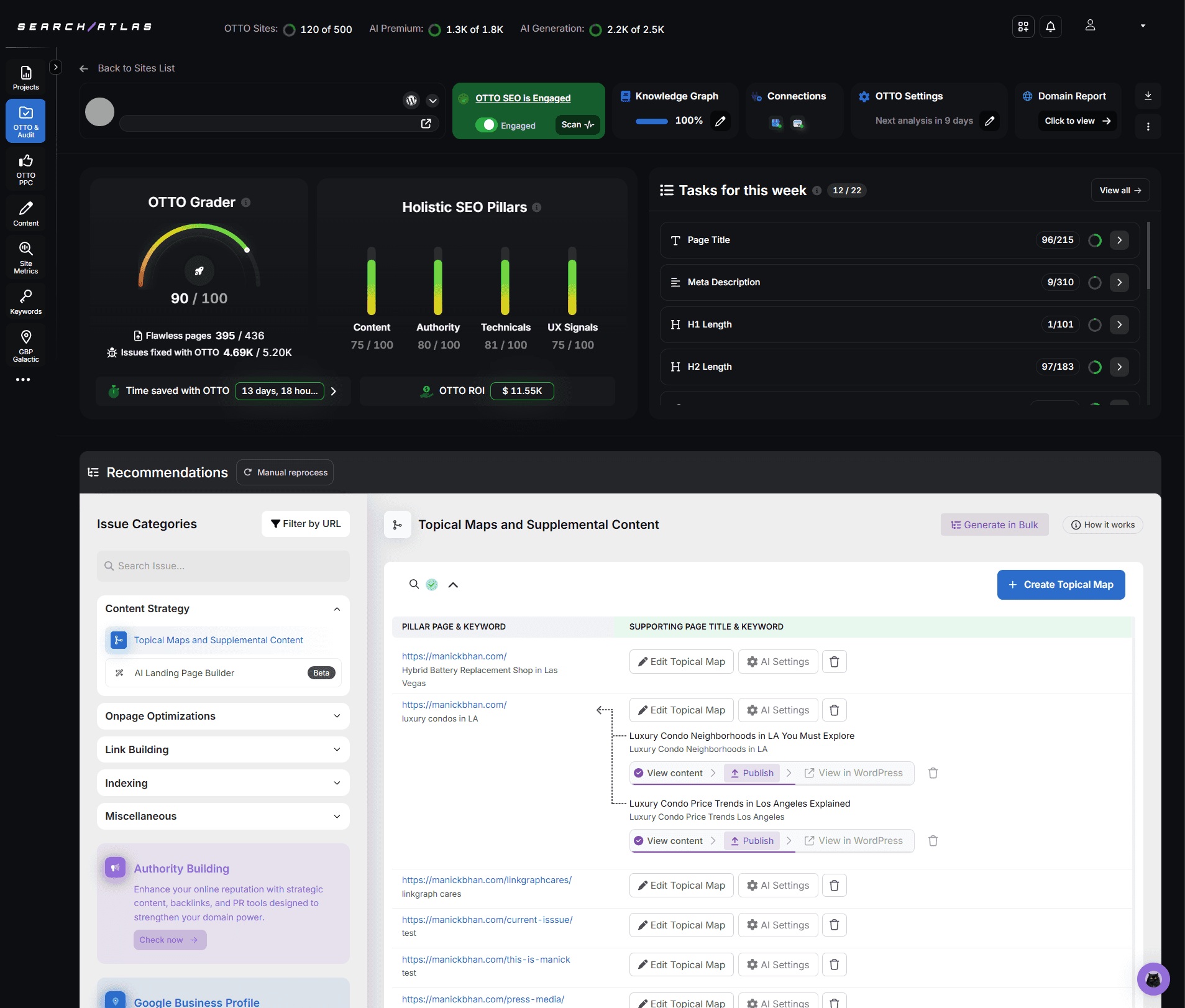
The tasks are concrete. Titles and descriptions can be rewritten. Headings, image alt text, internal links and structured data can be adjusted. The dashboard lets a team review recommendations and deployments. Approval mode allows a person to sign off before changes go live; rollback controls provide a route back. The product’s attraction lies in shortening the journey from a detected problem to a deployed change.
- 01Connect
Site + search data - 02Diagnose
Find supported issues - 03Decide
Review or automate - 04Deploy
Apply changes - 05Measure
Watch performance
Victor Macias of MVM Management offers a suitably unromantic testimonial on the company’s website: “It has cut our time in more than half.” It is a vendor-published customer account, rather than a controlled experiment. Even so, it names the benefit an agency can actually budget around. Time recovered from repetitive changes can go into client strategy, checking results or simply finishing the day.
The missing title is a small defect. The queue behind it is an operating expense.
An editorial observation
The subscription has a second arithmetic
As checked on October 1, 2026, Search Atlas’s homepage lists monthly prices of $99 for Starter, $199 for Growth, $399 for Pro and an Agency tier from $999. Annual billing is discounted. These are software prices; a buyer should budget advertising spend separately when planning paid campaigns.
The meaningful comparison includes capacity. Plans limit projects, seats and execution credits, and the current offering uses a shared Universal Credits budget across tools. White-label dashboards and reporting appear at Pro, while larger agency arrangements add client portals and more capacity. A low entry price is useful only if the plan accommodates the sites and tasks that prompted the purchase.
Monthly billing. Plan limits, usage and enterprise terms affect the total.
This is where a prospective customer can copy the method rather than the marketing: choose one site, record the baseline, review a narrow batch of changes and count the hours saved. Then examine traffic and useful outcomes over time. Completing more tasks proves throughput. It does not, by itself, prove that more people bought something.
An SEO company buys a distribution network
On August 12, 2024, Search Atlas announced its acquisition of Signal Genesys, a press release distribution platform. The move brought digital PR and syndication capabilities into the portfolio. It reveals a wider theory of search marketing: editing a website covers only part of the job. A brand also needs to be encountered elsewhere.
Press distribution, backlink analysis and outreach tools therefore sit alongside the audit and content products. Distribution can put material into additional outlets; the quality of the story and the value of the resulting attention remain separate questions. A syndicated release should not be mistaken for a reporter deciding a company deserves a feature.
Content Genius handles another set of recurring chores. Give it a keyword or URL and it researches search results, develops a brief and prepares a draft for publication. Topical maps help organize coverage. For a team producing pages regularly, that reduces the preparation work. Someone still needs to decide whether the page says anything worthwhile and whether the claims are correct.
The map is changing under the marketer’s feet
Search Atlas also serves businesses whose competition is geographic. Local heatmaps show ranking positions across a grid, making visible how results vary around a location. Google Business Profile tools address posts, listings and other local tasks. A business can look conspicuous near its front door and rather less impressive several streets away. One ranking number can conceal that distinction.
AI answers create a different visibility problem. Search Atlas’s LLM Visibility product tracks brand mentions, sentiment and share of voice in supported answer platforms. Bhan’s writing on the shift toward answer engines connects the company’s broader direction to this change in how customers discover businesses. If the encounter happens inside an answer, a conventional Google position describes only part of it.
Measuring appearances in selected prompts gives a marketer evidence to work with. It does not confer control over an AI system’s answers. The useful question is how often the business appears for relevant requests, what is said about it and which pages or competitors receive attention. That is a measurement programme, with all the sampling choices such a programme requires.
The agency is both customer and laboratory
Agencies are a particularly natural audience for the assembled suite. They repeat similar processes across clients, need reports under their own branding and benefit when one workflow serves several accounts. In-house teams, consultants, e-commerce brands and multi-location businesses can use the same capabilities without reselling them. Search Atlas’s current about page reports more than 5,000 agencies; that is the company’s own count.
The competitive set changes with the task: Semrush and Ahrefs for broad SEO research, Surfer for content optimization, Screaming Frog for crawling and BrightLocal for local search work. Search Atlas’s distinctive sales argument combines that work with deployment and coordinated automation. The sensible comparison is the actual workflow a buyer needs, including integrations and controls, rather than a contest between feature-list lengths.

Deluz-Bhan describes the group’s operations as remote-first, with written documentation, asynchronous communication and performance judged by outcomes. In November 2025 she reported $30 million in annual recurring revenue for Search Atlas Group. The distinction matters: it is a co-founder’s group-level figure, encompassing a broader business than the software subscription alone.
There is outside recognition too. The Global Search Awards named Search Atlas OTTO Best AI Search Software Solution in 2025. An award establishes that judges liked a submitted product. A customer’s useful test remains more intimate: did approved changes reach the site, did the team spend less time administering them, and did the business benefit?
The next queue is inside the suite
Current products such as Atlas Agent and Search Atlas Coworker extend the approach to coordinating work and reporting in Slack and Microsoft Teams. As more tools join the platform, someone has to connect research, content, site changes, advertising and measurement. Search Atlas wants that coordination to become another software job.
The approach fits teams with recurring work, compatible website access and the ability to supervise deployments. It is less useful when the bottleneck is an unclear offer, content nobody wants or an organization that cannot permit an outside system to make changes. Automating the wrong task makes it happen sooner. The missing title is worth fixing. The more interesting decision is whether it was what stood between the business and its next customer.