Certainly is for the customer-experience leader who has stopped being impressed by fluent answers. A polite paragraph about a late parcel is pleasant; finding the order, checking the carrier, offering the permitted remedy and recording the result is useful. That gap between talking and finishing is where this Danish software company now lives.
The product sits on top of the systems a support team already uses. Give an agent approved knowledge, connect the helpdesk, CRM, store or internal API, and define what it may do. It can then answer a question, recommend an item, look up an account, trigger a return, hand a difficult case to a person and preserve the history. Certainly calls this agentic AI. In ordinary office language, it is a support worker with a tightly supervised set of keys.
Who should careFor busy counters, not lonely websites
The best fit is a mid-market or enterprise team with enough repetitive contact to justify plumbing. Ecommerce is the obvious home: shoppers ask about sizes, deliveries, returns and products, while the answers live across a catalogue, order system and policy library. Financial services, SaaS, gaming and internal operations also appear in Certainly's public work. Multilingual teams and European companies with strict data-residency reviews have an extra reason to look.
A tiny shop seeking a cheerful FAQ bubble should keep shopping. Certainly's annual Starter price begins at €500 a month, or $449 on its dollar-priced page, before any extra onboarding or model usage specified in the contract. The value arrives when an agent can reduce a real queue, influence a sale or cover channels that otherwise require people on rotating shifts. If the business case is “our website ought to have AI,” the business case is not ready.
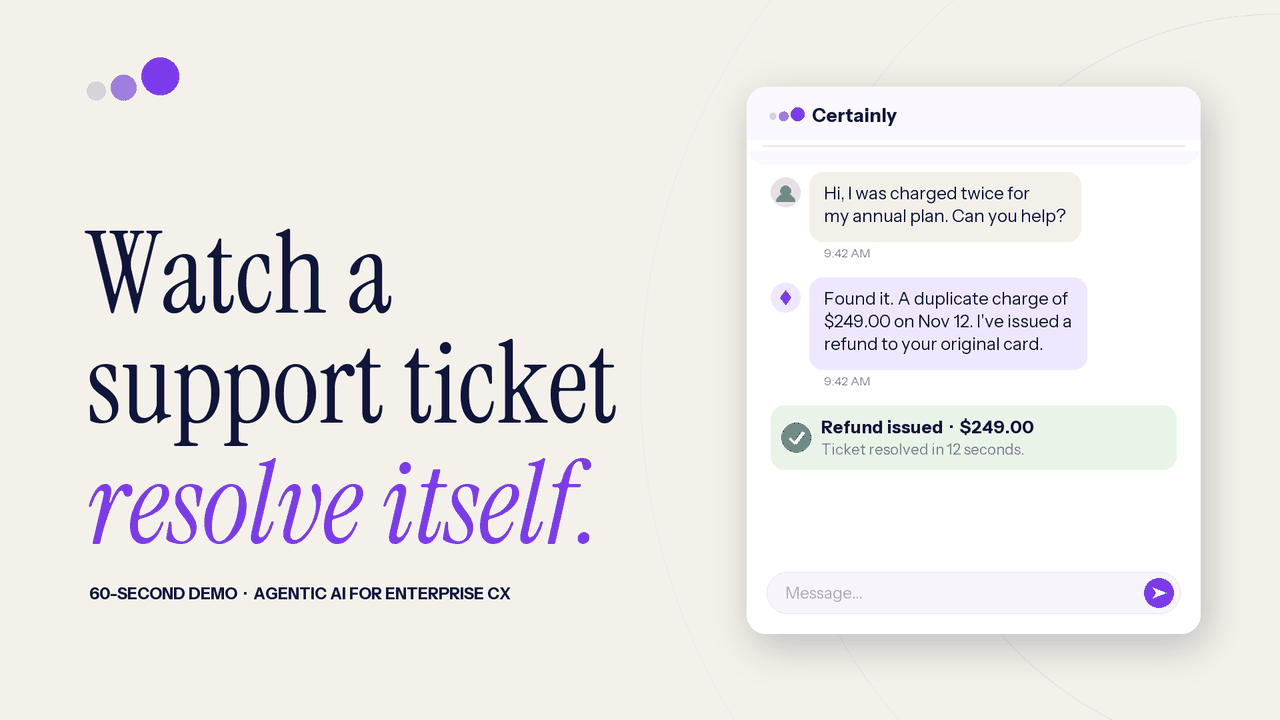
A customer request, with fewer scenic detours
The model is replaceable. The work is the product.
Certainly is not married to one model provider. Customers can use models from OpenAI, Anthropic, Google and providers available through OpenRouter, choose by task and route simpler work to cheaper models. Automatic failover is designed to move traffic if a provider has trouble. For a buyer, that matters more than a logo wall of fashionable model names. Model quality, price and availability move quickly; rebuilding a customer operation every time the leaderboard changes would be a grim hobby.
The second distinction is integration depth. Certainly advertises native connections with Shopify, Magento, Salesforce, Zendesk, Gorgias, Freshdesk, Kustomer, Intercom and others, then fills gaps with REST APIs, webhooks and MCP tools. Its older visual flow builder remains in the family, but the current interface puts agents, prompts, tools, knowledge and model providers together. A CX manager can see the design; an engineer can still inspect the machinery.
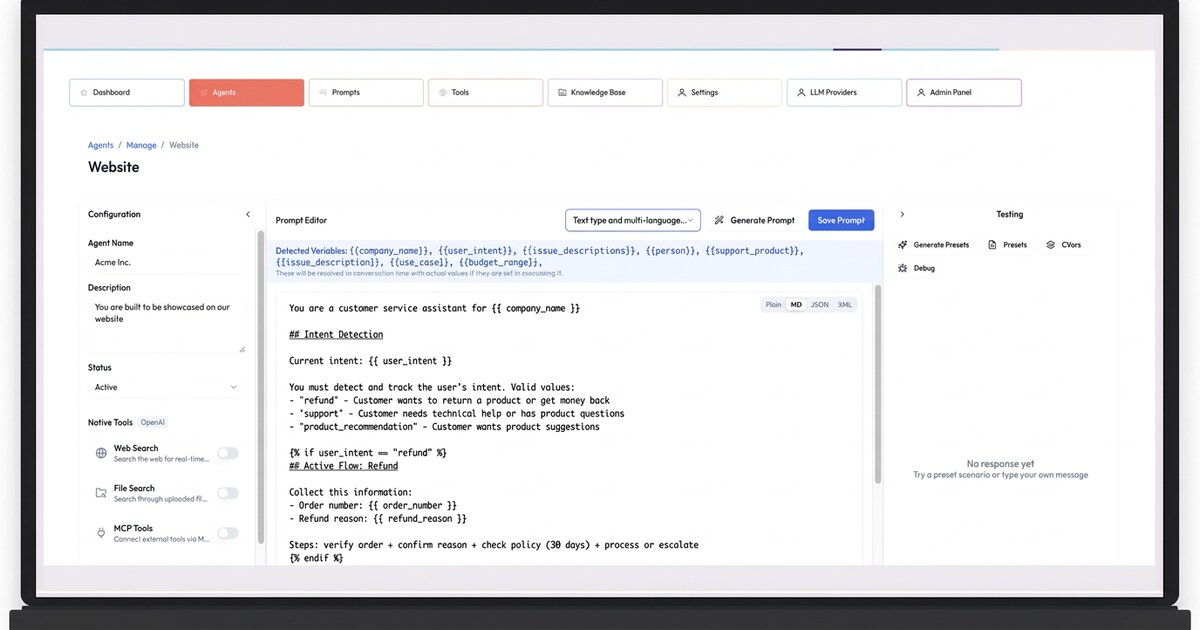
Reporting is sensibly split into traffic, business impact and AI insight. The first says what happened. The second follows resolution, savings, drop-off or influenced revenue. The third mines topics, sentiment and missing knowledge. This is a welcome correction to dashboards that celebrate message volume while customers circle the drain.
“The chatbot is fast and easy to use.”A verified education-management reviewer on G2Receipts, with footnotes
Chocolate, paperwork and numbers worth testing
Certainly's most memorable case study belongs to Feastables, the snack company associated with MrBeast. The vendor attributes $6.24 million, or 6.5 percent of total revenue, to one agent, alongside a 20 percent lift in average order value after chat and an NPS of 52. The agent was tuned to the brand's voice, connected to the catalogue and checkout, and used recommendations and games rather than behaving like a laminated help card.
The other useful example is Fintiba, whose customers are international students navigating German financial requirements. Certainly reports that its agents moved the company from less than 50 percent containment to 97 percent autonomous resolution, across more than 30 languages. One case is fizzy commerce, the other visa-critical administration. Together they explain the proposition better than an abstract AI demo.
Independent review volume is modest. As of this review, G2 shows 4.8 out of 5 from 11 reviews and Capterra shows 4.4 from 13. Reviewers repeatedly praise responsive support, ease of setup and integrations. The less polished notes matter too: one reviewer wanted faster training on large datasets and better uptime; another wanted an easier way to upload response libraries. These comments come from the platform's earlier chatbot era, so ask to see the modern workflow rather than assuming every old complaint survived or vanished.
The public evidence stack
Price the conversation, then inspect the outcome
| Plan | Published annual price | Allowance | Best reading |
|---|---|---|---|
| Starter | €500 / $449 monthly | 1 agent, web widget, 2,000 conversations | A contained web pilot |
| Pro | €1,250 / $1,099 monthly | More agents, channels, integrations, 10,000 conversations | A working CX team |
| Enterprise | Bespoke | Unlimited agents, all channels, white label, custom SLA | Complex volume and governance |
Certainly bills by conversation rather than seat, and annual rates carry the advertised discount. A three-month pilot is available. Read the order form carefully: onboarding may be separate, bring-your-own-model keys push token charges to the model provider, and the terms describe other account arrangements. Ask for a worked invoice at your expected volume, including reopened conversations, overages, AI tokens, implementation and the human work required to maintain knowledge.
The competitive fork is straightforward. Intercom Fin is attractive when Intercom already owns the support surface. Gorgias is a natural shortlist item for Shopify-centered merchants. Zendesk AI and Salesforce Agentforce sit close to their parent service systems. Ada and Forethought compete for enterprise automation, while PolyAI is prominent in voice. Certainly earns its meeting when a buyer wants to keep the existing helpdesk, switch among model providers, operate across channels and retain an EU-centered data story.
How to test itBring the ugly tickets
A glossy demo will resolve a clean order-status question. Your pilot should include the customer who changed address after dispatch, the return outside policy, the ambiguous product name, the mixed-language message and the angry person who should reach a human immediately. Certainly says an agent can be built in a day and most production launches take two to six weeks. Use that period to test the seams, because the seams are the product.
Choose autonomous resolution, post-contact CSAT, cost per resolved conversation and revenue influence before launch.
Remove contradictory policies and stale help articles. A grounded agent repeats the mess it is given.
Specify which tools, refund limits and account actions are allowed, logged or reserved for humans.
Make sure the person receiving an escalation sees context, attempted actions and the reason the agent stopped.
Use native speakers and actual phrasing, especially for regulated or high-value customer journeys.
Compare the promised rate with total platform, model, setup and maintenance costs at realistic volume.
The curious corporate footnote
Certainly began as BotXO, then adopted a name designed as the affirmative second half of a customer question. Its history also contains a harder turn. Danish records show the original Certainly ApS entered bankruptcy, while today's service is contracted through a different company, Certainly Group ApS. Certainly's own timeline describes private-equity acquisition in 2023; the current company says it is independent and privately held. This does not grade the software, but enterprise buyers should understand the chain of ownership, intellectual property and contractual entity during diligence.
The company has kept building. It partnered with European IT provider Cegeka in 2024, says it passed 50 million handled conversations in 2025, and now presents a multi-model architecture, EU data residency, role controls, audit logs and a 99.9 percent uptime SLA. Its public terms identify Copenhagen-based Certainly Group ApS as the supplier. The backstory is less tidy than the homepage, which makes it more human and more worth asking about.
Verdict: a capable agent needs a capable manager
Certainly is compelling for a CX team that can name the work, open the right systems and measure a finished outcome. Its model flexibility protects buyers from one-provider dependence, its channel range is broad, and the case studies show ambition beyond ticket deflection. The trade-offs are enterprise-level cost, a small pool of independent reviews and the operational homework every serious agent deployment demands.
Put it on the shortlist when multilingual service, commerce actions, EU residency or a mixed helpdesk stack are central. Skip it when the requirement is a cheap FAQ widget, the knowledge base is neglected or nobody owns escalation rules. The sharpest feature here is not conversation. It is closure.