Augment Code is for the developer who has stopped believing that one more chat box will fix the codebase. The repository is too old, too wide, too full of tribal knowledge. A small change in billing wakes a service three folders away; the person who understood the dependency left after the last reorg. Augment’s answer is a live semantic map of the whole mess. Models come and go. Context, it argues, is the durable part.
That makes the product most interesting for experienced teams with mature software, not beginners making a weekend weather app. If your recurring pain is locating the right code, preserving local conventions, reviewing changes across repositories or turning repeated engineering chores into supervised automation, Augment has a coherent case. If you mainly want inexpensive autocomplete and occasional boilerplate, its new enterprise-shaped package can feel like renting a workshop to hang one picture.
The useful idea hiding under the agent parade
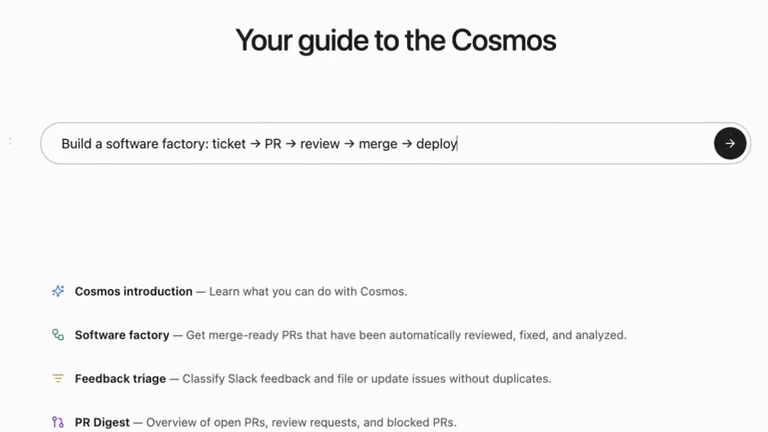
Augment was founded in 2022 by Igor Ostrovsky, a former Pure Storage chief architect, and Guy Gur-Ari, previously an AI researcher at Google. It emerged from stealth in April 2024 with an eye-popping $227 million Series B, bringing disclosed funding to $252 million. The original pitch was an AI coding assistant that understood large codebases. Two years later, the homepage leads with Cosmos, a system for arranging agents into “software factory” loops from ticket to code, review, deployment and monitoring.
The language has grown grander, but the useful idea remains pleasantly specific. Augment’s Context Engine indexes code, docs, dependencies, history and patterns, then retrieves the relevant pieces for whichever model is doing the work. It is semantic search rather than a heroic stuffing of millions of lines into a prompt. For truly huge estates, the company says quantized vector search made retrieval 40 percent faster on codebases above 100 million lines. That is a company-reported engineering result, but it explains the machinery better than another “AI teammate” slogan ever could.
Three products in one trench coat
The easiest way to understand Augment today is as three connected layers. The Context Engine is the memory. Auggie is the hands in your terminal. Cosmos is the control room. IDE extensions and GitHub review plug the same system into familiar work.
Context Engine
Maintains a live semantic index across repositories and related knowledge. Since February 2026 it can also serve context to other MCP-compatible agents in local or hosted mode.
Auggie CLI
Runs interactively or headlessly, edits files, calls tools, delegates sub-tasks, resumes sessions and fits into CI. It installs through npm and supports ACP clients.
Cosmos
Builds reusable “experts,” environments, integrations and automations, with human checkpoints. The ambition is repeatable delivery systems rather than isolated prompts.
Code Review
Reviews GitHub pull requests with repository context. Enterprise controls add analytics, allowlists, cross-tool context, multi-org support and broader governance.
What you can hand it on Monday morning
The obvious job is feature work: give Auggie a ticket, let it inspect the repository, propose a plan, edit coordinated files, run tests and prepare a pull request. The more revealing jobs are less glamorous. It can investigate a failed build, draft a pull-request description, review a dependency update, trace a production incident, map an unfamiliar subsystem or generate tests around a risky migration. In Cosmos, those jobs can become reusable experts triggered by tickets, CI failures, security alerts or schedules.
This matters because most engineering drag lives between the celebrated moments of writing code. Somebody has to collect context, find the owner, compare the ticket with the implementation, chase a red check and explain the change to the next reviewer. Augment is trying to carry that middle while leaving approval gates with humans. The approach works best when a team can state its rules, connect its systems and identify a repeatable bottleneck. A vague instruction to “make engineering faster” will produce an expensive fog. A nightly dependency triage with explicit risk rules can produce a result you can count.
“The CLI changed everything. Being able to call agents directly from my existing workflows - CI/CD, validation, architecture reviews - that’s what made Augment's value real.”Wojciech Trocki, MongoDB software engineer, in an Augment customer story
What the reviews actually say
Public customer stories contain striking numbers: Quorum says one feature moved from three weeks to three days; a Keeta executive reported more than 40 percent developer-productivity improvement; Pure Storage is aiming for three-times velocity with a 2,000-engineer group. These are useful signals, not laboratory results. Different teams count productivity differently, and vendor case studies select happy endings.
Independent commentary is messier and therefore more helpful. A verified G2 reviewer praised Augment’s daily workflow fit, proactive agent and easy model switching, while noting slower behavior on larger tasks. Another liked the Context Engine and fiercely objected to pricing changes. Product Hunt’s ten-review sample averages 4.6, yet its most detailed critical review centers on billing and an unanswered support request. Reddit users repeatedly admire long-context work and JetBrains integration, then argue about credit economics, support and whether agents lose the plot during sprawling tasks.
The sane reading is neither “miracle” nor “scam.” The Context Engine has earned a recognizable reputation. The commercial experience has changed quickly enough to bruise trust among some individual users. Augment’s live offer now looks designed to simplify the team sale: one Business subscription, up to 50 seats, pooled usage.

The $100 question
As of September 2026, the Business plan costs $100 per month flat for up to 50 seats. That includes $100 of pooled monthly usage across models, the Context Engine and Cosmos compute. Model inference follows providers’ public API rates, then Augment adds a 40 percent service fee; compute carries no such fee. Top-ups are pay-as-you-go. Enterprise pricing is custom and adds unlimited users, custom or multi-region compute, expanded controls and dedicated support.
That arrangement is unusually friendly to a small team with light, uneven usage and potentially awkward for one relentlessly prompting developer. It also means the sticker price is a starting balance, not an unlimited buffet. Ask for a real workload trial and watch dollars per merged change, not messages sent. The current page promises no training on customer data for paid plans and lists SOC 2 Type II. Security-sensitive buyers should still inspect retention, model-provider routing, residency and access-control details in the applicable contract.
| Option | Best fit | Distinctive angle | Watch closely |
|---|---|---|---|
| Augment Code | Teams with big, mature codebases | Repository-scale context plus orchestration | Usage economics and workflow change |
| GitHub Copilot | GitHub-centered organizations | Broad IDE and platform distribution | Depth of context for your estate |
| Cursor | Developers happy to adopt an AI-first editor | Tight editor-agent experience | Editor migration and enterprise controls |
| Claude Code / Codex | Terminal-first agent users | Direct access to model-maker agents | Team orchestration and repo retrieval needs |
| CodeRabbit | Teams starting with pull-request review | Focused review workflow | Whether a narrower tool is enough |
A buying test that beats a demo
Give every candidate the same ugly job: a change that crosses services, follows undocumented conventions, needs tests and has one tempting wrong path. Use a repository your team knows painfully well. Then score the boring things.
- How much setup and explaining happened before useful work began?
- Did the agent find the non-obvious dependency and reuse existing code?
- Could a reviewer understand, interrupt and recover the work?
- What did the complete task cost, including failed exploration?
- Did the generated tests catch behavior, or merely flatter the patch?
Augment should win on the first two if its thesis holds. Cosmos should improve the third for teams prepared to design workflows and checkpoints. If it does not, the rest of the platform is decoration. Also test a tiny rename and a one-file fix. Several users note that an agent loop can take longer than doing small edits by hand. A good tool should know when the hammer can stay in the drawer, even if the hammer raised a quarter-billion dollars.
The model menu is not the meal
Augment currently supports a long list of Claude, GPT, Gemini, GLM and Kimi models. Prism offers routing within curated Claude/Gemini or GPT families based on task and conditions. Choice is valuable, but model availability changes quickly and staged rollouts mean two workspaces may not see the same menu at the same moment. The product’s defensible character is the harness around those models: retrieval, tools, rules, permissions, environments and feedback.
That is why opening the Context Engine through MCP was a clever move. A developer can keep another preferred agent while asking Augment for repository context. It makes the product less of a walled garden and turns its best-known capability into infrastructure. It also creates a clean trial: plug the engine into an existing workflow and measure whether search improves before reorganizing the team around Cosmos.
One more practical advantage: model choice is not welded to a new editor. Teams can introduce Augment through VS Code, JetBrains, the terminal, GitHub Actions or an ACP-compatible client, then expand only where the results survive review.
Verdict: buy the memory first
Augment Code is easiest to recommend when codebase comprehension is already expensive: monorepos, migrations, cross-service changes, slow onboarding and review queues. Start with one painful repository and one measurable loop. The Context Engine is the reason to show up; Auggie makes it practical; Cosmos earns its keep only when repeated, governed workflows matter.
Solo developers with modest projects should calculate usage before falling for the 50-seat generosity. Large teams should resist buying the “software factory” as a metaphor. Buy it when one loop produces cleaner merges, shorter investigation and fewer senior-engineer interruptions. Factories are wonderful when they make the right thing.